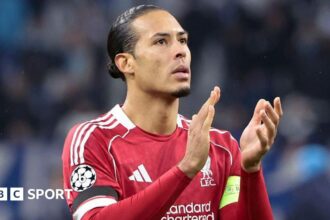
Virgil van Dijk: A Colossus Under Scrutiny as Liverpool’s Rock Shows Cracks
The narrative at Anfield this season has often orbited a single, shimmering star. Mohamed Salah’s form, his contract, his place on the bench. Yet, as a stubborn Sunderland departed Merseyside with a precious point on Wednesday night, the fierce spotlight that seeks out legends in moments of vulnerability didn’t linger on the Egyptian King. It shifted, decisively and perhaps more ominously, to the man who was supposed to be immutable: captain Virgil van Dijk.
The Unthinkable Becomes Routine: A Leader’s Uncharacteristic Struggles
For years, Virgil van Dijk didn’t just defend; he imposed a reality. His mere presence on the team sheet was a psychological advantage, his performances a masterclass in authoritative, almost serene, dominance. He was the Premier League’s defensive final boss, a player whose aura seemed to physically shrink the pitch for opponents. This season, and crystallized in the 1-1 draw with Sunderland, that aura has flickered. The own goal that gifted the Black Cats their equalizer—a desperate, off-balance lunge at a low cross—was less a singular error and more a symbol of a player operating a step behind his imperious best.
This is not the Van Dijk who marshaled Liverpool to Champions League and Premier League glory. The statistics and the eye test converge on an uncomfortable truth:
- Aerial Duels: Once unbeatable, his success rate has dipped, with forwards now sensing a contest where none existed.
- Recovery Pace: That galloping stride to snuff out danger now sometimes ends with a stretched leg or a tactical foul, a last resort he rarely needed.
- Organizational Command: Liverpool’s defensive line, once a synchronized trap, has looked disjointed, prone to gaps that savvy attackers exploit.
The Mukiele own goal was a tragicomic highlight of these struggles. It was the type of chaotic, desperate moment Van Dijk of old would have prevented long before it required a decisive intervention.
Anatomy of a Decline: Fatigue, System, or Father Time?
Diagnosing the dip in a player of Van Dijk’s caliber requires looking beyond a single game. This is a multi-layered issue, rooted in physical, tactical, and psychological factors.
The Achilles Catalyst: The catastrophic knee injury suffered against Everton in 2020 remains the pivotal event. While he returned to play every minute of a seismic 2021-22 campaign, the cumulative toll of that recovery, both physically and mentally, cannot be discounted. The explosive power and effortless mobility that defined him may have been permanently recalibrated.
A System in Flux: Jurgen Klopp’s high-line, aggressive system is a demanding ballet for its center-backs. It requires perfect timing, supreme confidence, and relentless concentration. As Liverpool’s midfield dynamics have changed and the press has been less consistently ferocious, the defensive line has been exposed more frequently. Van Dijk is being asked to solve more problems in more space, a challenge that exacerbates any fractional loss of athleticism.
The Captain’s Burden: With the armband came a new dimension of responsibility. He is now the vocal leader, the standard-setter, and the de facto face of a transitioning squad. That mental load, coupled with the pressure to personally rectify the team’s collective defensive frailties, may be weighing on performances that once seemed effortless.
Crossroads at Anfield: What Comes Next for Van Dijk?
The critical question for Liverpool and their captain is not about this week or this month, but about the next chapter. Is this a permanent descent or a manageable dip? The path forward hinges on several key decisions.
Adaptation is Key: The greats don’t just maintain; they evolve. Van Dijk must refine his game, relying more on positional intelligence, earlier decision-making, and leadership communication than pure physical supremacy. He can study the late-career blueprints of defenders like Thiago Silva, who mastered the art of anticipation.
System Support: The incoming manager, whether it be Arne Slot or another, must construct a defensive structure that provides more consistent protection. A dedicated defensive midfielder of the highest caliber, a long-standing need, would be the most significant gift to Van Dijk’s longevity, shielding the backline and reducing the frequency of high-stakes duels.
Managing the Minutes: The era of Van Dijk as an automatic, ever-present starter in every competition may need to end. A more strategic rotation policy, preserving him for the biggest battles, could help maintain his peak performance levels and extend his career at the summit.
Verdict: A Test of Legacy, Not Just Form
The scrutiny on Virgil van Dijk is intense because his previous standard was celestial. He is not playing “badly” in the conventional sense; he is playing like a very good defender, when we became accustomed to a transformative one. The fierce spotlight now upon him is the price of his own past perfection.
This period is more than a poor run of form; it is a profound test of his legacy. True greatness is not defined by an unchallenged peak, but by the response to adversity. Can Van Dijk, the architect of a defensive revolution at Liverpool, now engineer a personal reinvention?
The draw with Sunderland, punctuated by that desperate own goal, was a stark emblem of a legend fighting against decline. The coming months will reveal if this is the beginning of a twilight or merely a difficult, but navigable, valley before one final climb. For Liverpool’s new era, the stability of their captain—the rock upon which their greatest modern triumphs were built—remains the most critical foundation of all. The spotlight won’t be moving on anytime soon.
Source: Based on news from BBC Sport.
Image: CC licensed via www.wallpaperflare.com