The Szoboszlai Conundrum: A Moment of ‘Weird’ Genius or Pure Disrespect?
The magic of the FA Cup is woven from threads of the sublime and the ridiculous, often within the same ninety minutes. At Anfield, as Liverpool eventually dispatched a valiant Barnsley side with late goals adding a gloss to the scoreline, the narrative was hijacked by a single, baffling moment from Dominik Szoboszlai. It was an act so audacious it left managers, pundits, and fans alike grappling for the right word. Was it a moment of careless arrogance, or simply a bizarre blunder from a world-class talent? The debate rages on.
A Tale of Two Halves: From Worldie to “What Was That?”
To understand the controversy, you must first appreciate the duality of Szoboszlai’s performance. In the first half, the Hungarian midfielder showcased exactly why Liverpool invested so heavily in his talent. Picking up the ball outside the box, he unleashed a thunderous, swerving strike that ripped into the net—a “belter” that truly no goalkeeper on earth could have saved. It was a moment of pure, unadulterated quality, a reminder of his game-changing ability.
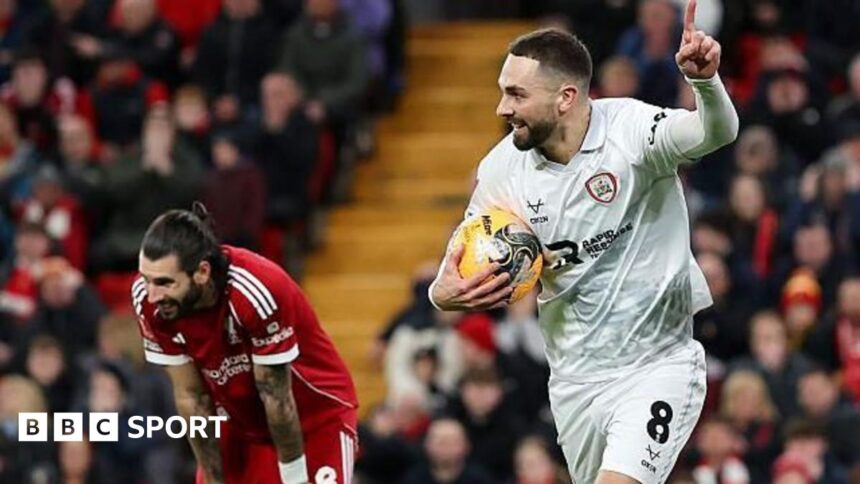
Yet, football has a cruel sense of humor. Later in the same half, with Liverpool leading and seemingly in control, Szoboszlai chased down a loose ball near his own penalty area. He won the race ahead of Barnsley’s Adam Phillips, hustling with admirable determination. Then, the inexplicable happened. Instead of clearing his lines, taking a touch, or even booting it into Row Z, Szoboszlai attempted a nonchalant, no-look backheel pass to his goalkeeper, Giorgi Mamardashvili. The execution was a disaster. The ball scuffed feebly, Phillips couldn’t believe his luck, and Barnsley had a shock equalizer from a yard out.
The reaction was instant and polarized. Anfield fell into a stunned silence, broken only by the joyous celebrations of the traveling fans. The cameras panned to a bewildered Arne Slot on the Liverpool bench. The moment was, in a word, weird.
The Managerial Verdict: “Disrespectful” vs. “Weird”
The post-match analysis was dominated by this one incident, and the two managers offered starkly different interpretations that frame the entire debate.
Barnsley manager Conor Hourihane did not mince his words. A seasoned midfielder himself, he viewed the act through the lens of football’s unwritten codes. “For me, it’s disrespectful,” he stated. “In that area of the pitch, you don’t do that. You clear your lines. It’s a basic rule. I’m sure he’ll learn from it, but we’ll take it.” For Hourihane and many traditionalists, it was a failure of professionalism—a flashy attempt that showed a lack of respect for the opponent and the seriousness of the occasion, regardless of the gulf in divisions.
In the other dugout, Liverpool boss Arne Slot took a more analytical, yet equally critical, view. He described the error as “weird,” a term that suggests confusion over intent rather than a condemnation of character. Slot’s analysis likely points to a disconnect between decision-making and execution. He knows Szoboszlai is a player capable of the extraordinary, but even the extraordinary has its time and place. Slot’s challenge is to channel that audacity without the accompanying recklessness.
This clash of perspectives—disrespect versus a weird error—is at the heart of the modern game. Is flair in your own box a sign of confidence or complacency?
Expert Analysis: Dissecting the Decision, Not Just the Outcome
Labelling the moment simply as “stupid” is lazy analysis. To truly understand it, we must deconstruct the thought process, however fleeting it was.
- The Context: Liverpool were the dominant Premier League side against lower-league opposition. This subconsciously breeds a certain casualness, a dangerous sense of security.
- The Player Profile: Szoboszlai is a highlight-reel player. His instinct is to be inventive, to solve problems with elegance. In midfield, that backheel might spark a counter-attack and earn applause.
- The Critical Failure: The error wasn’t necessarily the decision to pass back to the keeper—that happens constantly. The catastrophic flaws were the technique (a risky backheel) and the execution (a scuff). A simple side-foot pass, even under pressure, likely sees the danger cleared.
This was a classic case of a player’s greatest strength—his inventive confidence—becoming his most glaring weakness in a high-risk zone. It was a catastrophic lapse in game management, a momentary switch-off where the spectacle overrode the situation. For a player of his caliber, it’s a teaching moment of the highest order: risk assessment is as crucial as technical ability.
Looking Ahead: What This Means for Szoboszlai and Slot’s Liverpool
This single moment will not define Dominik Szoboszlai’s Liverpool career, but it may become a pivotal footnote. How he and his manager respond will be telling.
For Szoboszlai, this is a public lesson in concentration and maturity. The best players learn from these nightmares. He must reconcile his flamboyant style with the iron discipline required at the elite level, especially in defensive transitions. We can expect a period of simplified, effective play from him as he rebuilds that on-pitch trust. The true sign of his growth will be if his next moment of magic comes at the right end of the pitch in a tight game, not his own box.
For Arne Slot, this incident is a fascinating early data point in his tenure. It tests his man-management and tactical messaging. Will he stamp out such flair entirely, or can he refine it? Slot’s philosophy encourages proactive, intelligent football, but intelligence means knowing when the spectacular is also the sensible. This error will be a go-to video clip in team meetings for years to come, a perfect example of what not to do under pressure.
Prediction: This moment will be referenced often, but Szoboszlai’s quality will see him bounce back. He will become more selective with his flair, and this “weird” error will be remembered not as a sign of disrespect, but as the painful catalyst that sharpened his footballing IQ.
Conclusion: A Stain on the Highlight Reel
Football is a game of moments, and Dominik Szoboszlai authored two of the most diametrically opposed ones imaginable at Anfield. The powerful, glorious goal will feature in his career montage. The backheel blunder will be the blooper reel staple. Was it disrespectful? From Barnsley’s gritty, fight-for-every-inch perspective, absolutely. From a neutral, technical standpoint, it was a “weird,” horribly executed decision that betrayed a lapse in judgment more than malice.
Ultimately, the incident serves as a timeless reminder: the FA Cup respects no reputation, and football’s fundamentals exist for a reason. No matter your talent, clearing your lines is never outdated. For Szoboszlai, the path forward is clear—keep the wonder goals, lose the wonder passes in your own box. His incredible talent deserves to be remembered for the right reasons, and this singular, strange error will likely ensure he never makes the same mistake twice.
Source: Based on news from BBC Sport.