Aaron Rodgers’ Final Act? Playoff Loss Ignites Immediate Retirement Intrigue
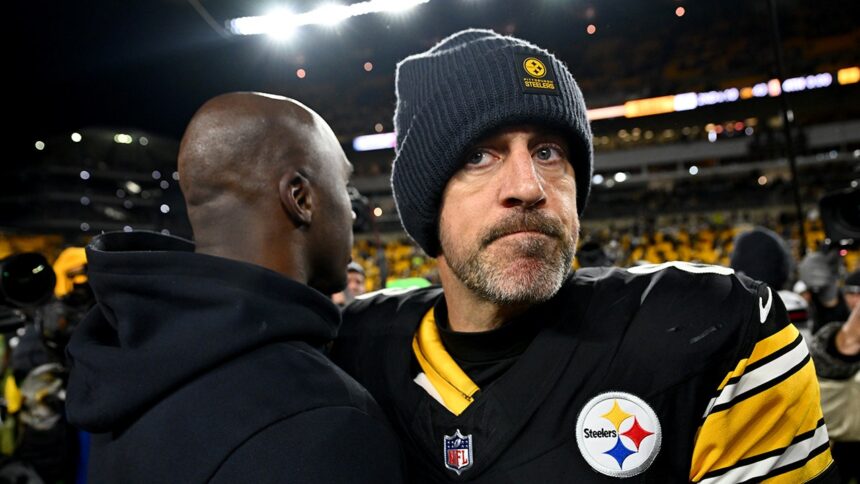
The final image was one of stark juxtaposition. Aaron Rodgers, helmet in hand, trudging through the confetti of an opponent’s celebration. A brief, solemn handshake with Houston Texans coach DeMeco Ryans served as the punctuation mark on a season—and perhaps a career—that ended not with a bang, but with a crushing, definitive thud. Following the Green Bay Packers’ lopsided Wild Card loss to the Texans, the football world isn’t just analyzing a game film; it’s scrutinizing every gesture, every word, for a hint about the future of one of the game’s most iconic quarterbacks. The intrigue surrounding a potential Aaron Rodgers retirement, a topic once whispered, has erupted into a central, deafening narrative.
A Nightmare in Pittsburgh: The Game That Changes Everything
Statistically, the Wild Card loss was among the worst playoff performances of Rodgers’ storied career. The Packers were outmatched in every phase, but the uncharacteristic errors from their future Hall-of-Fame quarterback were the most jarring. A strip-sack fumble returned for a touchdown in the first half swung momentum irrevocably. Later, a desperate, telegraphed throw became a pick-six, piling misery onto an already insurmountable deficit.
Yet, even in the rubble, there were fleeting glimpses of the old magic—a perfectly threaded back-shoulder throw, a laser into a tight window on third down. This duality defined his entire season: breathtaking physical talent occasionally dimmed by moments of critical misfortune. It was this very paradox that the “NFL on FOX” crew, including Hall of Fame quarterback Troy Aikman, seized upon in the game’s aftermath. Aikman offered a sobering, veteran perspective that resonated louder than any highlight reel.
“You look at the physical tools, and you think he could play another three years if he wanted to,” Aikman noted. “But it’s the mental grind, the constant demand to carry a franchise, that wears on you. After a loss like this, you have to wonder if he’ll decide he’s had enough.” This wasn’t speculation about ability; it was an insight into the psyche of an elite competitor, recognizing the moment when the cost of the climb may outweigh the view from the top.
The Weight of the Legacy: Rodgers at a Crossroads
At 41, Rodgers’ resume is impeccable: a four-time MVP, a Super Bowl XLV champion and MVP, and a maestro of the game whose highlight reel will be studied for generations. The question he now faces is not about securing his legacy—that is cemented in Canton—but about defining its final chapter.
- Chasing Elway or Mirroring Favre? Does he follow the path of John Elway, going out on top after a Super Bowl win, or does his story have a more protracted, perhaps turbulent, conclusion reminiscent of his predecessor, Brett Favre?
- The Physical and Mental Toll: The recovery from his Achilles tear was superhuman, but the weekly punishment of an NFL season, coupled with the immense pressure to elevate a young Packers team, is an exhaustive demand.
- A New Era in Green Bay: The Packers have a promising, youthful core. Rodgers’ potential exit would unequivocally pass the torch to the Jordan Love era, a transition the organization has been preparing for years.
Rodgers has always been a complex figure, fiercely intelligent and deeply aware of his own narrative. His decision will not be a simple calculation of physical health. It will involve his competitive fire, his personal goals outside of football, and his assessment of whether this Packers roster, as constructed, can realistically deliver him a second Lombardi Trophy before time runs out.
What the Experts Are Saying: Reading Between the Lines
The post-game analysis was less about X’s and O’s and more about semiotics. Broadcasters and insiders parsed Rodgers’ brief post-game comments, his body language on the sideline as the game slipped away, and his history of contemplative offseasons.
Key factors analysts are weighing include:
The “Clean Out the Locker” Precedent: NFL veterans often speak of a moment of clarity. For some, it’s a specific hit. For others, it’s the hollow feeling after a playoff defeat, realizing the immense effort required just to get back to that same difficult point next year.
The Aikman Principle: Aikman’s own retirement, which came after a series of injuries and while he was still playing at a proficient level, is a relevant template. He walked away because the daily commitment no longer matched his desire.
Contractual Mechanics: While Rodgers’ contract is complex, an offseason retirement is a feasible scenario for the Packers’ salary cap, allowing them to move forward with significant financial flexibility. The business side often aligns with, or accelerates, these personal decisions.
Predictions: The Three Most Likely Paths Forward
As the offseason begins, three distinct scenarios for Aaron Rodgers have emerged, each with compelling arguments.
Scenario 1: The Farewell Tour (40% Likelihood)
Rodgers announces his retirement in the coming months. He exits on his own terms, albeit after a bitter loss, avoiding a protracted decline. He transitions fully to his off-field interests in media and wellness, and Green Bay begins the 2026 season with a memorialized legend and a clear quarterback plan.
Scenario 2: The Last Dance (55% Likelihood)
After a period of reflection, Rodgers returns for one final season. The narrative becomes an explicit “Last Dance,” galvanizing the team and fanbase. He and General Manager Brian Gutekunst aggressively pursue veteran help in free agency, pushing all chips in for a 2026 championship run. Every home game becomes a celebration of his career.
Scenario 3: The Unexpected Pivot (5% Likelihood)
In a stunning move, Rodgers, should he desire to play elsewhere, or if Green Bay seeks a dramatic reset, is traded to a perceived Super Bowl contender. This is the least likely path given his age, contract, and iconic status in Green Bay, but the NFL offseason is never without shock.
Conclusion: The End of an Era, Whenever It Comes
Whether Monday night was truly the end or merely another painful chapter, one thing is undeniable: the context around Aaron Rodgers has permanently shifted. The conversation is no longer about how long he can play, but how long he wants to. The playoff loss to the Texans wasn’t just a defeat; it was a catalyst, forcing the quarterback, the franchise, and the football world to confront an inevitable transition they’ve collectively delayed for years.
His legacy as a Packer is untouchable—a magician in cleats who authored moments of sheer brilliance. But the final line of his story remains unwritten. Will he add a comeback epilogue, or did we just witness the final, sobering paragraph? The intrigue has begun. The entire NFL now awaits his decision, knowing that when Aaron Rodgers speaks, an era will officially turn its page.
Source: Based on news from Fox Sports.