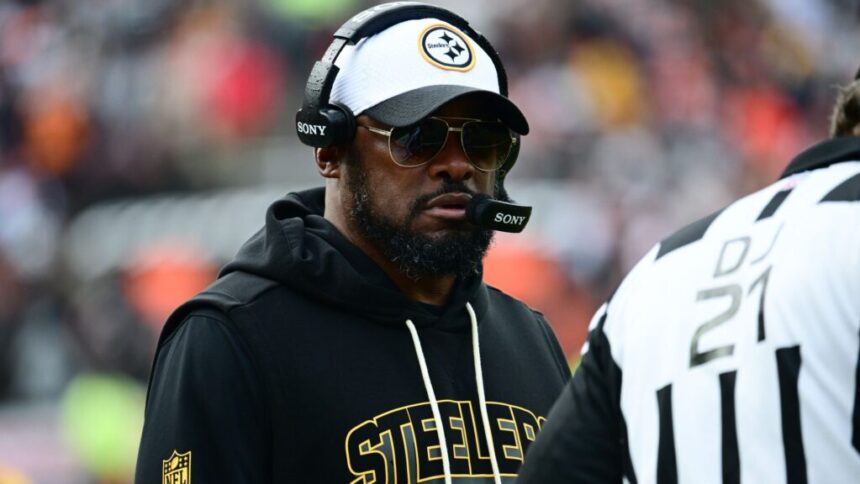
Mike Tomlin’s Murky Future Casts Shadow Over Steelers’ Offseason After Playoff Debacle
The final image of the Pittsburgh Steelers’ 2023 season was a stark and unfamiliar one: a proud franchise, clad in black and gold, being systematically dismantled on its home turf. The 30-6 wild-card loss to the Houston Texans wasn’t just a defeat; it was a statement of obsolescence. In the immediate, shell-shocked aftermath, as the questions inevitably turned from the game to the future, head coach Mike Tomlin offered no rallying cry, no promise of a fix, but rather a deliberate, almost defiant, evasion. His non-committal, lackluster update on his own future has ignited the most intense speculation of his storied 17-year tenure, leaving a legendary franchise at a crossroads it hasn’t faced in a generation.
The Sound of Silence: Tomlin’s Deflective Postgame Stance
In the wake of a performance where the Steelers looked unprepared, out-schemed, and physically overmatched, Mike Tomlin’s podium demeanor was characteristically stoic. Yet, his words carried a new and unsettling weight. When pressed on his future as the Steelers’ head coach—a topic dominating the fanbase and media—Tomlin shut down the line of inquiry with clinical detachment. “I’m not even in that mindset as I sit here tonight,” he stated. “I’m more in the mindset of what transpired in this stadium and certainly what we did and didn’t do. Not a big-picture mentality as I sit here tonight.”
This was more than a coach refusing to look ahead 24 hours after a season-ending loss. This was the architect of the modern Steelers’ identity, a man synonymous with stability, refusing to affirm his commitment to the only job he’s ever known. For a leader whose mantra has always been “The Standard is The Standard,” the refusal to address the most fundamental standard of all—his own leadership—resonated like a thunderclap. It felt less like a delay of discussion and more like an opening of a door previously thought sealed shut.
The Weight of the Legacy: Tomlin’s Unparalleled Run in Context
To understand the magnitude of this moment, one must first appreciate the unprecedented consistency of the Mike Tomlin era. Since taking over in 2007, Tomlin’s resume is the envy of the league:
- Never a losing season: An active NFL record of 17 consecutive seasons without finishing below .500.
- Super Bowl Champion: Won Super Bowl XLIII in his second season, and returned to the big game in 2010.
- 193-114-2 regular season record: A .628 winning percentage that places him among the all-time elites.
- Cultural pillar: He maintained the Steelers’ tough, defensive identity through the transition from the Bill Cowher era and oversaw the careers of legends from Troy Polamalu to Ben Roethlisberger.
However, the recent chapters of that legacy have been defined by stagnation. The playoff victory drought, now stretching back to the 2016 season, is a glaring blemish. The team has often looked offensively anemic and, in critical games like the Texans loss, fundamentally flawed. The “Tomlinism” of winning games they shouldn’t and losing games they shouldn’t has morphed from a quirky trait into a frustrating ceiling. The legacy is now a double-edged sword: it grants him immense credibility, but also raises the question of whether a change is needed to break a cycle of early-January exits.
Reading Between the Lines: What Tomlin’s Non-Answer Really Means
Expert analysis of Tomlin’s postgame comments suggests several plausible interpretations, each with dramatic implications for the Steelers’ offseason.
Scenario 1: The Negotiation Leverage Play. Tomlin has one year remaining on his contract. In the NFL, a coach in the “lame duck” final year holds diminished authority. His vague stance could be a strategic move, forcing the Steelers’ front office—the Rooney family and General Manager Omar Khan—to proactively approach him with a contract extension. It’s a power move to reaffirm his position and control on his terms.
Scenario 2: Genuine Soul-Searching. After 17 years of immense pressure, the grind may be taking its toll. The non-answer could reflect a man truly unsure if he wants to preside over the arduous, potentially multi-year rebuild the Steelers’ roster likely requires, especially at the quarterback position. The fire, for the first time, may be flickering.
Scenario 3: A Subtle Ultimatum. Tomlin’s comments could be a message to ownership about the state of the roster and his staff. It might translate to: “I’ll return, but only with assurances of significant changes, investment, and perhaps autonomy in reshaping the coaching staff (particularly on the offensive side of the ball).” The silence, in this case, speaks volumes about his assessment of the team’s construction.
Scenario 4: The Beginning of the End. The simplest, and for Steelers fans most jarring, reading is that Tomlin and the organization have mutually, and quietly, recognized that the partnership has run its course. The postgame deflection was a way to table the announcement until a more appropriate, less emotional time, allowing for a dignified separation.
Predictions and Ripple Effects for the Steelers’ 2024 Offseason
The resolution of the Tomlin question will send seismic waves through the entire organization, dictating every other decision this spring.
If Tomlin Stays (The Likeliest Outcome): Expect a massive offensive overhaul. This likely means a new offensive coordinator, a serious evaluation of Kenny Pickett’s future, and aggressive moves in free agency or the draft for quarterback competition. The defense, while solid, may see veteran cap casualties. Tomlin’s return would come with an implicit mandate: evolve the offense or the never-losing-season streak will become a hollow monument.
If Tomlin Departs (The League-Altering Scenario): The Steelers would instantly become the most attractive head coaching vacancy in football. The search would be exhaustive, likely targeting a bright offensive mind to unlock the potential of George Pickens, Pat Freiermuth, and Najee Harris. Names like Detroit Lions OC Ben Johnson or Houston Texans OC Bobby Slowik would immediately surface. Such a change would represent the end of an era and the riskiest, most dramatic shift for the franchise since the 1970s.
Regardless of the path, the quarterback position will be under a microscope. Mason Rudolph’s late-season surge complicates the picture, but the Steelers cannot enter 2024 without a clear, high-upside plan at the game’s most important position.
Conclusion: A Standard in Question
Mike Tomlin’s postgame silence spoke louder than any fiery locker room speech ever could. For nearly two decades, his leadership was the Steelers’ bedrock. Now, that bedrock has a crack. The blowout playoff loss to the Texans exposed profound roster and schematic issues, but Tomlin’s refusal to address his future exposed a profound philosophical rift. Is the “Steeler Way” now defined solely by avoiding losing seasons, or is it about contending for championships? The organization’s handling of the next few weeks will answer that question.
The Mike Tomlin era, defined by its remarkable consistency, now faces its most inconsistent moment. Whether he returns to rebuild his legacy or departs to preserve it, one thing is certain: the Pittsburgh Steelers that take the field in September 2024 will be shaped by the unsettling, ambiguous words their future Hall of Fame coach chose *not* to say on a cold January night after the standard had been shattered.
Source: Based on news from Yahoo Sports.