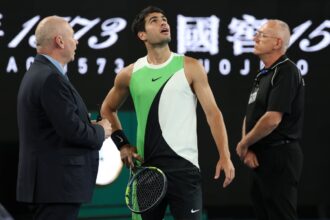
Carlos Alcaraz Shatters History, Denies Djokovic to Claim Career Grand Slam Crown
The air in Rod Laver Arena, thick with the weight of history and expectation, finally erupted. Carlos Alcaraz, sprawled on the blue hard court, let out a roar that echoed through 87 years of tennis lore. With a breathtaking display of power, finesse, and indomitable spirit, the 22-year-old Spaniard did not just win the Australian Open. He seized a legacy, toppling the king on his most dominant court to become the youngest man to complete a career Grand Slam, breaking a record held since the dawn of the Open Era.
A Clash of Eras Culminates in a Historic Shift
The final was framed as the ultimate test: the irrepressible force of Alcaraz’s youthful genius against the immovable object of Novak Djokovic’s Melbourne fortress. Djokovic, unbeaten here in a decade, started like a man determined to underline his GOAT status, racing to a 6-2 first set. The script felt familiar. But Alcaraz, in a stunning act of recalibration, rewrote it entirely. He shifted gears with a violent, beautiful intensity, leveraging his explosive power and dizzying drop shots to take the next two sets 6-2, 6-3. The fourth set was a masterpiece of tension, with Djokovic fighting to extend the match. Yet, at 5-5, Alcaraz summoned a final, furious burst, breaking serve and then serving out a monumental 2-6, 6-2, 6-3, 7-5 victory. The collapse to the court was pure, unadulterated catharsis.
In a poignant moment that captured the passing of a torch, a gracious Djokovic clambered over the net to embrace the victor. “He deserved this title today. He was the better player,” Djokovic conceded. The sportsmanship could not mask a pivotal truth: this was more than a match lost. For Djokovic, this was a missed opportunity to land a 25th major title and, perhaps, the clearest signal yet that an era of unchallenged supremacy is facing its most vibrant threat.
Decoding the Mastery: How Alcaraz Rewrote the Script
Alcaraz’s victory was not a fluke; it was a tactical and physical dismantling of the game’s greatest hard-court player. His performance provided a masterclass in modern, all-court tennis.
- Fearless Aggression: While others shrink under Djokovic’s relentless returning, Alcaraz attacked the Serb’s second serve with ferocity, refusing to be pushed into defensive rallies.
- Strategic Variety: He blended 100mph forehands with feather-soft drop shots, a disorienting mix that exploited Djokovic’s deep court positioning and disrupted his legendary rhythm.
- Elite Physical and Mental Resilience: After a one-sided first set, lesser players would have folded. Alcaraz elevated his game, showcasing a mental fortitude that belies his 22 years, proving his Grand Slam final pedigree is already elite.
This win completes a unique and rapid-fire collection: the US Open 2022 (hard), Wimbledon 2023 (grass), French Open 2024 (clay), and now Australian Open 2025 (hard). Each on a different surface, each against the highest caliber of opposition, showcasing a versatility that is arguably unprecedented for a player his age.
The GOAT Debate and Djokovic’s Crossroads
For Novak Djokovic, this loss carries a unique sting. At 37, his quest for the standalone record of 25 major titles continues. More pressingly, opportunities to underline his place as the greatest player of all-time against his prime rivals in major finals are becoming rarer. Defeat to Alcaraz, his direct heir apparent, on his most dominant stage, introduces a new narrative. The mantle of the “hunted” now rests more heavily on his shoulders than ever before.
While his greatness is immutable, the Alcaraz victory proves that the physical and tactical gap has closed. The Serb’s path to further majors now likely requires navigating a draw that includes a peaking Alcaraz, a scenario that has shifted from possibility to probability. The baton is not yet fully passed, but the handover process has undeniably begun.
The Future is Now: Predictions for a New World Order
With this victory, the tennis landscape is irrevocably altered. Carlos Alcaraz is no longer the sport’s thrilling future; he is its dominant present. So, what comes next?
- The Calendar Grand Slam Whisper: Holding all four majors, the talk will inevitably turn to the calendar Grand Slam—a feat last achieved by Rod Laver in 1969. With his confidence and all-surface prowess, it is no longer a fairy tale.
- Intensified Rivalry: The Djokovic-Alcaraz rivalry is now the central axis of men’s tennis. Each future meeting, particularly at Roland Garros and Wimbledon, will carry historic weight and define both legacies.
- Generation Next Response: How will peers like Jannik Sinner, Holger Rune, and others respond? Alcaraz has set a staggering new benchmark, challenging them to elevate their games or risk being left in a dust cloud of his making.
The era of the “Big Three” sustained dominance is over. We have entered the era of Alcaraz, with a chasing pack of legends and young stars trying to solve a puzzle that, at this moment, has no clear answer.
Conclusion: A Legacy Forged in Melbourne
On a warm Melbourne night, Carlos Alcaraz did more than win a trophy. He shattered an 87-year-old record, authored a definitive chapter in his rivalry with a legend, and announced the dawn of his own era with a performance of breathtaking audacity. The image of him lying flat on the court, overwhelmed by the magnitude of his achievement, will be etched in tennis history. The path forward for Novak Djokovic is now steeper, his margin for error slimmer. For Alcaraz, the horizon is limitless. He has completed the career Grand Slam, but this feels less like an endpoint and more like a spectacular launchpad. The youngest man to ever achieve this feat now plays with the freedom of history made and the hunger for more. The king of Melbourne has been dethroned. The new emperor of tennis has arrived.
Source: Based on news from BBC Sport.