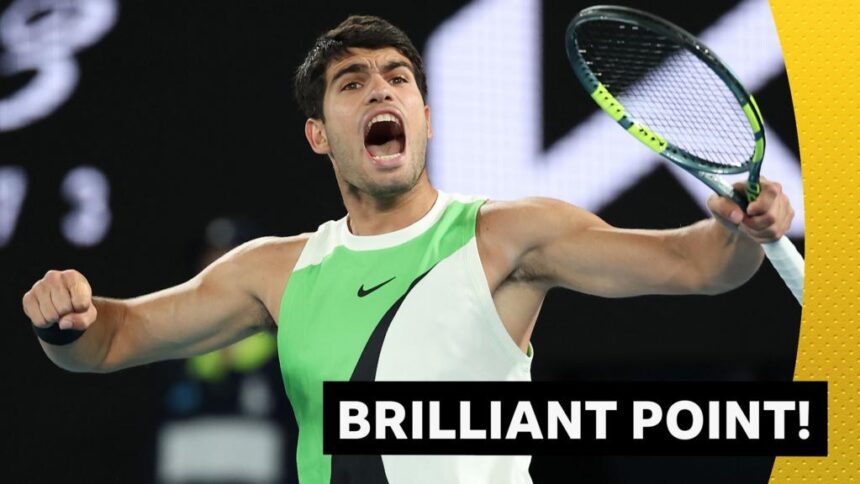
Carlos Alcaraz’s Defiance: The Point That Sealed a Dynasty’s Shift in Melbourne
The air in Rod Laver Arena was thick with a familiar tension. Novak Djokovic, the undisputed king of Melbourne Park, was applying his signature brand of pressure, a slow, relentless grind designed to break wills and rackets. Across the net, Carlos Alcaraz, the young prince whose throne had been prophesied, was facing a critical juncture. It was in this crucible of a second-set tiebreak, with the first set already gone, that a single, breathtaking 22-shot exchange didn’t just win a point—it announced the irreversible arrival of a new era. For viewers in regions where the clip is geo-blocked, the description alone must suffice: it was the moment Alcaraz didn’t just challenge the Djokovic doctrine, he rewrote it with audacious flair.
Deconstructing the Masterpiece: A Stroke-by-Stroke Revolution
To call it a “rally” is to undersell its narrative weight. This was a condensed epic. Djokovic, probing with surgical backhands down the line, forced Alcaraz into a defensive scramble. The Serb seized the net, a position from which he has closed out thousands of points. The old script was written. But Alcaraz, propelled by a combination of preternatural speed and fearless intention, launched a desperate but perfect lob. Djokovic, forced back, replied with a dipping passing shot attempt. What happened next defied conventional tennis logic.
Instead of a standard retrieval, Alcaraz produced a full-sprint, sliding forehand passing shot, a stroke of such violent beauty and precision that it whistled past Djokovic’s outstretched volley. The point was a microcosm of their clash:
- Djokovic’s Iron Will: He executed three separate shots that would have won the point against 99% of the tour.
- Alcaraz’s Physical Sorcery: His court coverage transformed defense into offense in a single, fluid motion.
- Tactical Audacity: In the highest-stakes moment, Alcaraz chose the highest-risk, highest-reward option—and it was technically flawless.
This was not a lucky winner. It was a declaration of intent, a statement that Alcaraz would not win by out-Djokovic-ing Djokovic, but by unleashing a brand of tennis only he possesses.
The Ripple Effect: How a Single Point Won a Championship
In tennis, momentum is a tangible force, and this point was a seismic event. Djokovic, the master of mental fortitude, was visibly shaken. He had thrown his entire arsenal at the young Spaniard and had been answered with something beyond the playbook. Winning the tiebreak and, subsequently, the set, did more than level the match; it fundamentally altered the psychological landscape.
Alcaraz’s game is built on fearless aggression and spontaneous creativity. This point validated his entire approach on the sport’s biggest stage. It gave him the concrete belief that his brand of magic could work against the greatest defensive wall in history. For Djokovic, it introduced a seed of doubt. His strategies are built on patterns, percentages, and predictable responses. Alcaraz, in that moment, proved himself gloriously unpredictable and unstoppable even when the pattern was going Djokovic’s way. The mental shift was immediate and decisive, fueling Alcaraz’s surge to claim the next three sets and the championship.
Beyond the Trophy: What This Means for the Tennis Landscape
Alcaraz’s victory in Melbourne, punctuated by that iconic point, completes his Career Grand Slam, a feat achieved at a younger age than any of the “Big Three.” This is not merely another title; it is a symbolic passing of the torch. The point demonstrated that the future of the sport will be played at a pace, with a physicality, and a creative bravado that pushes beyond previous limits.
We are entering the Alcaraz Era defined by hybrid style. He possesses the power of a modern baseliner, the touch and net craft of a bygone era, and the defensive resilience born of the Djokovic-Nadal dynasty. This blend makes him uniquely equipped to dominate across all surfaces. For Djokovic and the chasing pack, the challenge is now stark: adapt to a game that is faster, more physically demanding, and tactically fluid, or be left behind.
The Road Ahead: Predictions for a Rivalry Reforged
The Djokovic-Alcaraz rivalry is now the central axis of men’s tennis. This Melbourne final, and its defining point, sets a thrilling precedent. We can expect:
- An Escalating Tactical Arms Race: Djokovic will return with adjusted strategies, likely aiming to blunt Alcaraz’s first-strike power earlier in rallies. Alcaraz will continue to refine his already devastating all-court game.
- The French Open as the Next Battleground: With Alcaraz now a proven force on hard courts and grass, clay becomes the next frontier. Can he dethrone Nadal and Djokovic on the Parisian dirt? His physicality suggests yes.
- Grand Slam Count as the Ultimate Narrative: The chase for history is now a true race. Alcaraz’s rapid accumulation of majors puts him on a trajectory that threatens all records, adding immense stakes to every future major clash.
The brilliance of Alcaraz is that he forces evolution. Just as Federer, Nadal, and Djokovic pushed each other to impossible heights, Alcaraz is now the engine pulling the sport forward.
Conclusion: A Point Etched in History
Years from now, when the highlights of Carlos Alcaraz’s career are compiled, that 22-shot masterpiece in the 2024 Australian Open final will be replayed not just for its technical brilliance, but for its profound symbolism. It was the point where hope became certainty, where potential crystallized into destiny. It was the moment the tennis world, and Novak Djokovic, saw the future—and it was arriving at a full sprint, sliding into a forehand that broke patterns and sealed a legacy. For those who couldn’t see it, remember this: you missed the exact instant a new king, playing a new kind of tennis, completed his dominion and began his reign.
Source: Based on news from BBC Sport.