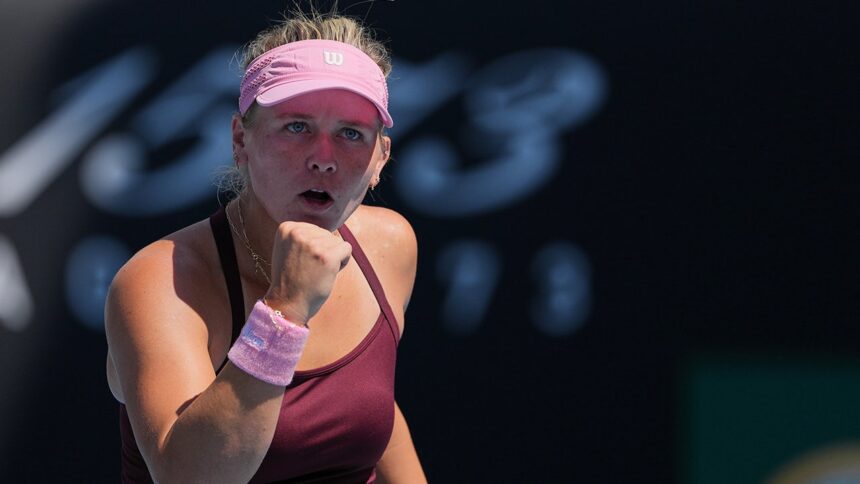
Peyton Stearns Embraces the Bark: How an Unusual Fan Interaction Fueled an Australian Open Upset
The cacophony of a Grand Slam crowd is a familiar soundtrack for any professional tennis player: the rhythmic clapping, the collective gasp after a net cord, the scattered shouts of encouragement between points. But during her first-round match at the 2026 Australian Open, American Peyton Stearns heard something different. It wasn’t a cheer or a jeer. It was a bark. And instead of letting it throw her off, the 24-year-old turned it into a rallying cry, channeling the unusual energy to power a stunning straight-sets victory over former champion Sofia Kenin. In a post-match twist that has captivated the tennis world, Stearns didn’t file a complaint; she issued an invitation, publicly requesting the anonymous fan to bring the bark back for her next match.
From Distraction to Motivation: The Anatomy of an Upset
Entering her match against the No. 27 seed and 2020 Australian Open winner Sofia Kenin, Peyton Stearns was firmly cast in the role of underdog. Kenin, with her deep experience and major pedigree, was expected to navigate the early rounds. Yet, from the outset, Stearns played with a disruptive, aggressive clarity, winning 6-3, 6-2. The stats tell a story of dominance: she fired 28 winners to Kenin’s 14 and broke the American veteran’s serve five times. But the match’s most intriguing subplot emerged not from a statistic, but from an interaction.
Mid-match, a fan’s audible bark cut through the Melbourne air, directed at Stearns. Such atypical fan behavior can often break a player’s concentration, introducing an element of absurdity or gamesmanship. However, Stearns’s reaction was telling. She didn’t glare into the stands or plead with the chair umpire. She absorbed it, internalized it, and seemingly used it to sharpen her focus. This mental fortitude is a hallmark of players who make leaps at the sport’s biggest events. Mental resilience in tennis is often discussed in the context of handling pressure or overcoming errors; handling a barking fan is a new, bizarre chapter.
“You have to find your triggers for focus, and sometimes they come from the strangest places,” says Dr. Eleanor Vance, a sports psychologist who has worked with professional athletes. “What Stearns did was a brilliant, instinctive act of cognitive reframing. She took a potential negative stimulus—a distraction meant to unsettle—and repurposed it as a personal touchstone for intensity. It became her sound, a reminder to stay in the moment and fight.”
The Social Media Rally Cry: “Find That Guy”
The true genius of the moment unfolded off the court. In an era where athletes often criticize disruptive fan behavior, Stearns flipped the script. Taking to social media, she didn’t lament the incident; she celebrated it. Her message was clear: she wanted the barking fan to identify themselves and repeat the performance for her second-round encounter with Croatia’s Petra Marcinko.
This move accomplished several things instantly:
- Claimed Narrative Control: Stearns seized control of the story, transforming it from a weird anecdote into a defining part of her tournament persona.
- Built Fan Connection: By engaging with the fan—even an eccentric one—she demonstrated approachability and a sense of humor, endearing herself to the broader audience.
- Created a Tactical Advantage: She effectively signaled to her next opponent that external noise would not be a factor; in fact, she was inviting it. This places a subtle, psychological burden on Marcinko.
“It’s savvy gamesmanship wrapped in a viral moment,” notes veteran tennis analyst Clive Reed. “She’s made the atmosphere around her matches a topic of conversation. Now, everyone will be listening for a bark. That’s a unique kind of home-court energy to generate at a neutral venue. It shows a level of competitive maturity that belies her ranking.”
Stearns vs. Marcinko: Predictions for a Bark-Accompanied Battle
The second-round matchup pits Stearns’s newfound, bark-fueled momentum against the promising 20-year-old qualifier Petra Marcinko. Marcinko, a former junior world No. 1, is a powerful hitter but will be experiencing the pressure of a main-draw Grand Slam second round for the first time. Stearns, fresh off a dominant win over a seeded player, now carries the weight of expectation.
Key factors to watch include:
- Stearns’s Aggressive Baseline Game: Her ability to take the ball early and dictate rallies from the backhand side was key against Kenin. She will look to impose this same pattern on Marcinko.
- Handling the Moment: Can Stearns handle her new status as a slight favorite and the added attention her viral request has brought? Conversely, can Marcinko block out the circus and focus on her tennis?
- The “Bark” Factor: Will the fan appear? If they do, and the bark echoes again, it will either galvanize Stearns further or prove to be a one-time mental trick that loses its potency.
The prediction here leans toward Stearns. Her powerful groundstrokes and renewed mental edge give her a solid foundation. The Kenin win was no fluke; it was a statement. Marcinko is dangerous, but Stearns’s combination of form, confidence, and a uniquely harnessed crowd dynamic should see her through in three sets.
Conclusion: More Than a Gimmick – A Sign of a Champion’s Mindset
Peyton Stearns’s request for a repeat bark is far more than a quirky social media post. It is a window into the modern athlete’s psyche and a masterclass in environmental control. In the high-stakes, mentally exhausting world of professional tennis, the ability to transform the unpredictable—even the absurd—into fuel is a rare and valuable skill. This episode underscores a critical evolution in sports: athlete-fan interaction is no longer a passive experience. It can be an active, strategic dialogue.
As Stearns advances in Melbourne, her journey will be followed not just by tennis purists but by those captivated by this novel narrative. Whether the barker returns or not, the message has been sent: Peyton Stearns is not easily distracted; she is empowered. She is not waiting for perfect silence to play her best; she is creating her own soundtrack, one that now, unmistakably, includes the possibility of a friendly bark. In doing so, she has announced herself not just as a player capable of an upset, but as a competitor with the mental agility and charismatic confidence to thrive in the sport’s brightest spotlights. The Australian Open is always full of surprises, but the sight and sound of a player barking back, metaphorically, at adversity might just be the most compelling story of the early rounds.
Source: Based on news from Fox Sports.