Amorim’s Academy Stance: Pragmatism or a Breach of Manchester United’s Sacred Trust?
The hallowed halls of Old Trafford have whispered the same names for generations: Busby Babes, Fergie’s Fledglings, the Class of ’92. The bloodline of Manchester United is not just written in trophies, but in the ascent of homegrown talent from the Cliff training ground to the Stretford End’s adoration. So, when a precocious talent like Kobbie Mainoo arrives on the first-team scene, expectation crackles in the Manchester air. Yet, as United’s turbulent season grinds on under new head coach Ruben Amorim, a stark statistic has become a lightning rod for debate: not a single academy graduate has started a Premier League match this campaign. For a club where the anthem “We’ll keep the red flag flying high” is a covenant with its youth, Amorim’s defense of this record is not just tactical—it’s a philosophical clash with tradition.
The Unbroken Thread: A Record Under Scrutiny
Since October 1937, a span covering a World War, managerial dynasties, and football’s global transformation, Manchester United have named at least one homegrown player in every single matchday squad. It is a record of astonishing cultural fortitude, a club policy hardened into an article of faith. It symbolizes a promise: the pathway exists. Amorim has been quick to publicly defend his use of midfielder Mainoo and others, while simultaneously vowing he will not break the proud record that dates back to 1937. This creates a fascinating duality. The Portuguese coach is, in effect, pledging to uphold the letter of the law—a spot on the bench—while being judged by its spirit: the meaningful integration of youth into the competitive core of the team.
“The academy is doing a good job,” Amorim has stressed, pointing to the structural investments as proof of the club’s commitment. Indeed, United are paying a lot of attention to the academy, exemplified by the high-profile hiring of Stephen Torpey from Brentford to lead a renewed charge. The presence of 15-year-old sensation JJ Gabriel in the directors’ box for the West Ham draw was a symbolic gesture, a glimpse of a future the club is desperate to cultivate. But for fans weaned on the immediacy of Giggs, Beckham, and Rashford, the present feels disconnected from that future.
Amorim’s Pragmatic Calculus: Stability Over Sentiment
To understand Amorim’s position, one must view it through the lens of a coach parachuted into one of the most pressurized rebuilds in football. His mandate is clear: restore stability, secure Champions League football, and instill a coherent, disciplined style. From this vantage point, his reasoning becomes more clinical.
- Immediate Results Pressure: The margin for error is negligible. In a dogfight for European qualification, every point is precious. Amorim may perceive experienced, albeit imperfect, professionals as a safer bet in the short-term furnace of Premier League football.
- Tactical Rigidity: Amorim’s system, often a 3-4-3 with specific positional demands, has a steep learning curve. Throwing a teenager into a dysfunctional unit under immense scrutiny could be seen as a risk to both the result and the player’s development.
- The “Bench” Promise: By ensuring the historic record stands, Amorim argues he is honoring the tradition while exercising his professional duty to pick the “best” eleven for the immediate battle. It’s a compromise, albeit one that satisfies few romantics.
His failure to start any academy player is thus framed not as a rejection of talent, but as a deferral. The message: the academy’s health is measured in long-term infrastructure and eventual output, not in emergency first-team minutes during a crisis.
The Mainoo Conundrum: A Case Study in Fan Frustration
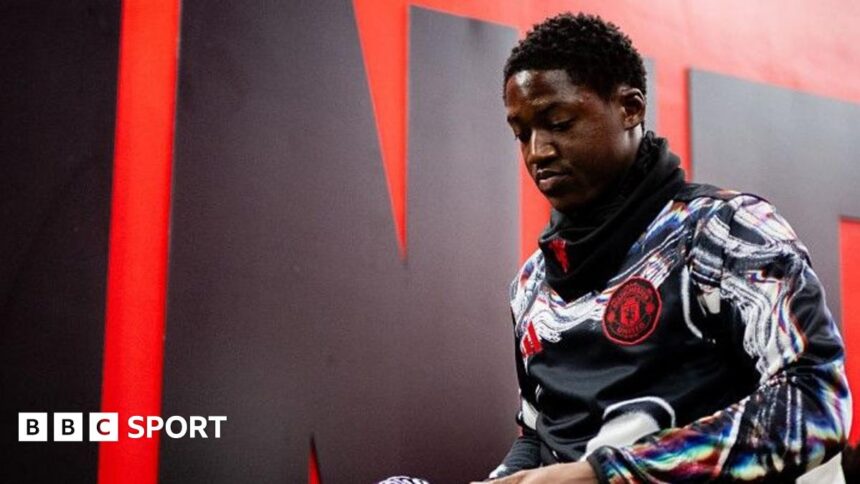
This brings us to the specific case of Kobbie Mainoo. The midfielder’s elegant composure and technical prowess have made him the poster boy for the academy’s current potential. His arrival in matchday squads has been met with palpable excitement, a hope that he could be the antidote to a chaotic midfield. Amorim’s repeated his reasons for not giving Kobbie Mainoo an opportunity from the start, likely centering on physical readiness, defensive discipline, or simply the weight of expectation.
Yet, as United’s established midfielders have struggled for consistency, the calls for Mainoo have grown louder. Each passing match where an underperforming veteran is selected ahead of him becomes a data point in the argument against Amorim’s caution. The fanbase’s question is simple: if not now, during a season of transition and struggle, then when? If a talent as universally hailed as Mainoo cannot find minutes, what signal does that send to the next JJ Gabriel watching from the stands?
Predictions: A Summer of Reckoning and Pathways
The trajectory of this issue will define Amorim’s early legacy at Old Trafford. Our analysis points to a critical summer and season ahead.
- The Record Will Stand, But Pressure Will Mount: Amorim will almost certainly keep the homegrown player in the squad, likely through a rotational defender or a substitute goalkeeper. However, the demand for a homegrown starter will intensify with each transfer window.
- Mainoo’s Make-or-Break Pre-Season: The upcoming summer tour will be pivotal for Mainoo and peers like Alejandro Garnacho. A strong showing could force Amorim’s hand, making the academy talent an undeniable option rather than a hopeful prospect.
- Strategic Loan Moves vs. Integration: We may see a club strategy emerge where the brightest talents like Mainoo are given short-term loans to Premier League rivals to prove their mettle, a practice common elsewhere but fraught with risk at a club craving its own heroes.
- The Torpey Effect: The long-term solution lies with Stephen Torpey’s rebooted academy. Success will be measured not just by producing talent, but by producing players whose profiles are tailored to the first-team’s tactical blueprint.
Conclusion: Tradition is Not a Museum Piece
Ruben Amorim is correct in his assertion that a thriving academy is about more than one season’s team sheet. The investments and appointments show a strategic view. However, at Manchester United, the academy is not just a development center; it is the soul of the club. The proud record that dates back to 1937 is not a dusty artifact to be preserved under glass, but a living, breathing contract with the supporters. It is a promise that the club’s identity and its competitive ambitions are intertwined.
Amorim’s pragmatic defense of his use of midfielder Mainoo and others may hold water in a boardroom presentation. But in the stands of Old Trafford, faith is sustained by proof. That proof has always been a local kid, seizing his moment, making the difference. The record may remain unbroken, but for it to truly live, Amorim must soon find a way to move a homegrown name from the sacred bench to the hallowed pitch. The future, and the faith of United’s legion, depends on it.
Source: Based on news from BBC Sport.
Image: Source – Original Article