Amorim’s Agony: United’s Defensive Disarray Costs Dearly in Bournemouth Thriller
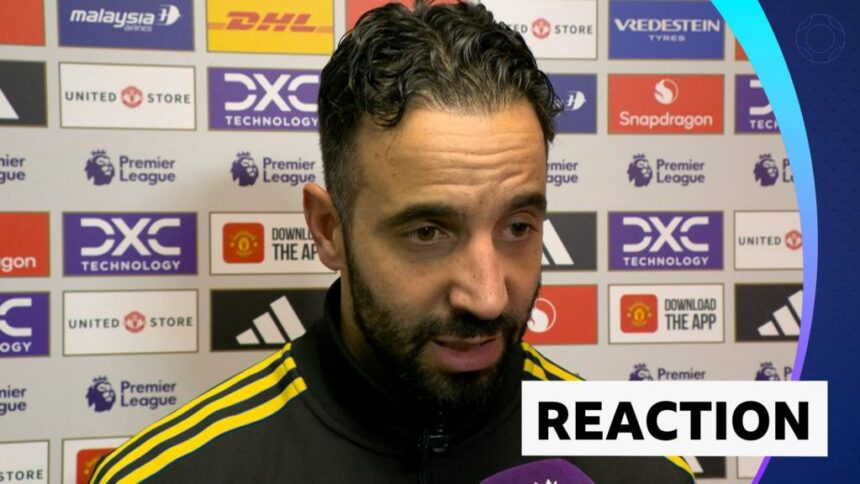
In the storied history of the Premier League, Old Trafford has witnessed its fair share of classics. Yet, the helter-skelter, error-strewn spectacle that unfolded on Saturday will be remembered less for its quality and more as a damning indictment of a Manchester United side in profound defensive crisis. After a breathless 4-4 draw with Bournemouth, a visibly frustrated manager Ruben Amorim cut a forlorn figure, stating his team had unequivocally “lost two points.” This was not a rallying cry from a point gained, but the lament of a coach who watched his side lead three times at the Theatre of Dreams, only to be pegged back each time by a vibrant and clinical Cherries outfit.
A Rollercoaster of Errors: The Match in Microcosm
The narrative was set early. United, predictably porous, fell behind to a Dominic Solanke strike that sliced through a passive defense. The response, led by the irrepressible Bruno Fernandes—who bagged a brace—and goals from Alejandro Garnacho and a Rasmus Højlund header, showcased the attacking potential simmering within the squad. Each time United edged ahead, however, a shadow of insecurity loomed. Bournemouth’s equalizers, from Justin Kluivert and a second from Solanke, were gifts born of catastrophic defensive lapses and non-existent midfield protection.
The climax was a perfect summary of the modern United paradox. In the 95th minute, a moment of individual brilliance from Fernandes seemed to have snatched a barely-deserved win. Yet, in the 100th minute, the house of cards collapsed once more. A penalty, conceded needlessly, was converted coolly by Bournemouth’s Dango Ouattara. The final whistle blew on chaos, leaving Amorim really disappointed and the home support in a state of bewildered silence.
Anatomy of a Crisis: Where It’s All Going Wrong for Amorim’s United
To label this a “fun game,” as some neutrals might, is to miss the point entirely. For Amorim and United, this was a forensic expose of systemic failures. The Premier League draw felt like a defeat because it highlighted issues that run far deeper than a single result.
- Defensive Fragility as Identity: The center-back partnership, regardless of personnel, appears devoid of understanding or leadership. The full-backs are caught perpetually between attack and defense, leaving cavernous spaces in behind. There is no organized defensive line, just a collection of individuals reacting to danger, often too late.
- The Midfield Void: United’s engine room offers zero protection. The lack of a disciplined, positionally-aware holding midfielder allows opponents to transition directly onto the back four with alarming ease. Bournemouth’s attacks frequently originated from United losing possession in advanced areas, with no defensive counter-weight in place.
- Psychological Collapse: Most concerning for Amorim will be the mental fragility. Each time United scored, they immediately invited pressure. There was no game management, no tactical nous to see out a lead. This points to a lack of on-pitch leadership and a squad struggling to execute a coherent game plan under duress.
Amorim’s post-match critique was pointed. His mention of “lost two points” is a manager’s code for unacceptable game management. The attacking verve, while promising, is rendered meaningless by a foundation built on sand.
The Road Ahead: Tough Questions and a Defining Finale
This result effectively extinguishes any faint hopes of a top-four challenge. The focus now shifts squarely to whether United can salvage a Europa League spot and, more importantly, how Amorim approaches a critical summer. The Manchester United boss faces a monumental task.
Immediate Fixes vs. Long-Term Build: Amorim must find a short-term solution to stop the bleeding. This could mean a drastic shift to a more conservative, compact system, sacrificing some attacking flair for basic solidity. In the long term, the summer transfer window is paramount. The squad requires a surgical overhaul, with a world-class defensive midfielder and at least one elite center-back as non-negotiable priorities.
Player Accountability: While recruitment is key, Amorim must also demand more from his current squad. Established stars, particularly in defense, are underperforming. His man-management will be tested as he decides who remains part of the project’s core and who is deemed part of the problem.
Prediction for the Run-In: Expect more turbulence. United’s remaining fixtures are littered with teams that will exploit this defensive disarray. The season risks petering out in a cycle of score-draws and frustrating losses unless a fundamental shift in defensive organization occurs. The FA Cup now represents not just silverware, but a vital lifeline for credibility and a potential route back into Europe.
Conclusion: A “Fun Game” That Exposed a Failing Project
The final whistle at Old Trafford told two stories. For Bournemouth, it was a brilliant, character-filled point earned on the road. For Manchester United and Ruben Amorim, it was a stark, unforgiving reality check. This was not a thrilling spectacle of attacking football; it was a chaotic exhibition of defensive incompetence that left their manager really disappointed.
The phrase “lost two points” will echo. It underscores the gap between where United are—a team that cannot defend a lead—and where they aspire to be. Amorim’s project, still in its relative infancy, has been laid bare. The attacking ingredients are there, but without a complete and immediate defensive transformation, the cycle of disappointment will continue. The helter-skelter 4-4 draw against Bournemouth must serve as the catalyst for that change, or it will be remembered as the day the alarm bells at Old Trafford became impossible to ignore.
Source: Based on news from BBC Sport.