Anthony Joshua Knocks Out Jake Paul in a Bizarre Spectacle That Defies Logic
In the end, the record books will show it simply: Anthony Joshua def. Jake Paul via knockout. For the millions who tuned in, expecting either a cathartic demolition or a shocking upset, the reality was something far stranger. What unfolded in the ring was a fight that seemed to actively resist coherence, a glacial-paced oddity that somehow culminated in a violent, satisfying conclusion. The knockout was the period at the end of a sentence written in a language no one could understand. This was not a boxing match; it was a surrealist play staged in a squared circle, leaving fans, pundits, and even the broadcast team scratching their heads in unified bewilderment.
The Great Freeze: A Fight That Refused to Start
From the opening bell, a palpable tension filled the arena—not the tension of impending violence, but of profound awkwardness. The expected firefight was replaced by a cautious, almost ceremonial dance. Anthony Joshua, the former unified heavyweight champion known for concussive power, moved with the hesitancy of a man disarming a bomb. Jake Paul, the YouTube provocateur turned pugilist, mirrored this caution, his usual brash aggression replaced by a stiff, respectful distance.
The first three rounds were an exercise in minimalism gone wrong. Punches were not thrown with malice, but as tentative probes, most retracted before they could land. The sound of the crowd shifted from anticipatory roars to a confused murmur, then to outright boos. Renowned broadcaster Mauro Ranallo, never one to mince words, voiced the collective frustration. "This is an embarrassment," he stated bluntly on air. "There is little to no offense in what we are witnessing." The cold, hard data from Compubox confirmed his assessment:
- Anthony Joshua: 13 landed punches out of 62 thrown through three rounds.
- Jake Paul: A mere 6 landed punches out of 21 thrown in the same span.
This wasn’t a tactical chess match; it was a stalemate on a board where both players refused to move. The question hung in the air: Were they afraid of each other, or was something else at play?
Expert Analysis: Deconstructing the Dissonance
To understand this baffling event, one must separate the physical outcome from the narrative performance. Expert analysis points to a catastrophic clash of stakes and styles that created a perfect storm of inertia.
For Joshua, the risk-reward equation was perilously skewed. A clean, dominant win was expected; anything less would be a career-altering disaster. A loss would be unthinkable. This pressure seemed to paralyze his instinct to attack. He was not fighting for glory, but to avoid infamy. Conversely, for Jake Paul, survival and respect were the only goals. Engaging in a firefight with a proven Olympic and world champion was suicidal. His game plan, therefore, was one of extreme risk aversion—to simply last as long as possible.
The result was a boxing match where both participants were primarily defending their reputations, not attacking their opponent. The fundamental contract of prizefighting—mutual aggression—was broken. This created a vacuum that no amount of pre-fight hype could fill. The knockout win, when it finally came, felt less like a culmination of battle and more like a sudden release of the immense tension that had been built not through action, but through its utter absence.
The Sudden Thaw: A Knockout From Nowhere
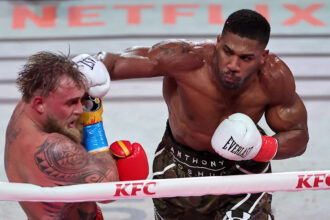
The transition from farce to finish was as jarring as it was swift. Near the end of the fifth round, the static charge of inaction finally sparked. Perhaps frustrated, perhaps seeing a fleeting opening, Joshua finally let his hands go. A stiff one-two broke through Paul’s high guard. The "Problem Child" staggered, his eyes glazing over. The predator instinct in Joshua, dormant for 11 minutes, ignited.
He pursued Paul to the ropes, not with wild abandon, but with a chilling, methodical precision. A right hook, a left uppercut, and a final, crushing straight right hand sent Paul collapsing to the canvas. The referee didn’t bother with a count. It was over. The satisfying ending had arrived, but it felt disconnected from the 20 minutes that preceded it. The roar of the crowd was one of relief as much as celebration. The bizarre narrative had been punctuated by a definitive, violent full stop, proving that even in a fight that made no sense, Anthony Joshua’s power made perfect sense.
Predictions and Fallout: What Does This Mean for Boxing’s Future?
This event will be dissected for years as a landmark moment in the era of crossover boxing. Its implications are complex and far-reaching.
For Jake Paul: The knockout loss, ironically, may do little to damage his marketability. He survived, albeit awkwardly, with an elite heavyweight for several rounds and took the defeat on his shield. His narrative can now pivot to the "valiant underdog who dared to try." Expect him to return to fights against MMA stars and aging veterans, where the spectacle is more guaranteed.
For Anthony Joshua: The victory is a statistical footnote, a bizarre detour on his path back to a world title. While a win is a win, the perplexing nature of the performance may raise more questions about his mindset than it answers. The focus must immediately return to the legitimate heavyweight contenders waiting in the wings.
For the Sport: The fight is a cautionary tale. It exposed the inherent fragility of these spectacle-driven events. When both fighters have more to lose than to gain in terms of reputation, the contest can wither on the vine. The head-scratching nature of the bout may lead promoters and networks to reconsider how these matches are made, potentially demanding clauses that ensure a minimum level of engagement to protect the product for fans.
Conclusion: A Victory Hollowed by Bewilderment
Anthony Joshua left the ring with his hand raised and his record intact. Jake Paul left with a loss but likely with his business prospects unharmed. The fans, however, left with a peculiar emptiness. They witnessed the satisfying ending they craved—the viral star put to sleep by the elite champion—but the path to that moment was so baffling and bizarre that it hollowed out the triumph.
This fight will be remembered not for the knockout, but for the profound silence that preceded it. It was a criticized spectacle that highlighted the sometimes-absurd intersection of sporting merit and entertainment economics. In the end, Anthony Joshua knocked out Jake Paul in a fight that made no sense, providing a perfect, confusing metaphor for modern boxing itself: a predictable ending arrived at through the most unpredictable, and unsatisfying, means imaginable.
Source: Based on news from Deadspin.
Image: CC licensed via de.wikipedia.org