Anthony Joshua Ends the Experiment: A Ruthless Knockout of Jake Paul Silences the Critics
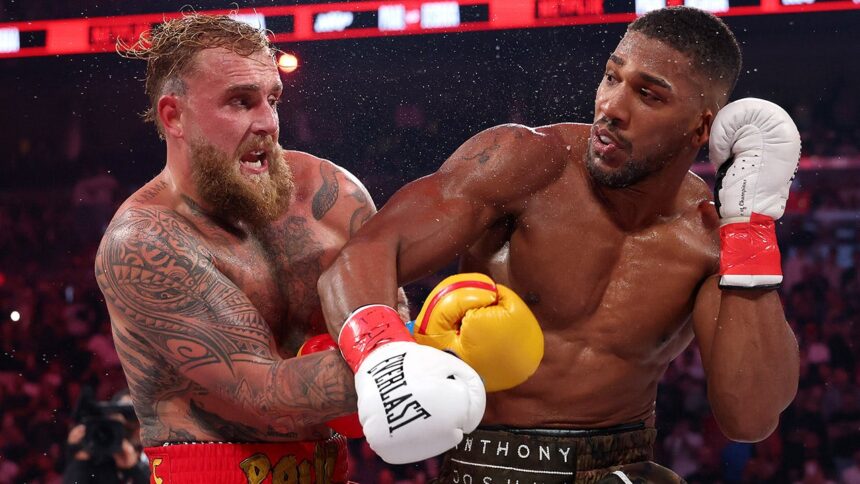
The spectacle finally met reality. In a night that blurred the lines between boxing’s traditional hierarchy and its brash, new-age carnival, Anthony Joshua reasserted the immutable laws of the sport with devastating clarity. On Friday night at Miami’s Kaseya Center, the former two-time unified heavyweight champion of the world knocked out YouTube sensation-turned-prizefighter Jake Paul in the sixth round, delivering a clinical and brutal lesson in elite-level boxing. The event, streamed globally on Netflix, promised a cultural moment but concluded with a stark, physical statement: there remains a chasm between a world-class athlete and a dedicated novice, no matter how large the platform or how confident the talk.
The Buildup to the Bell: Hype vs. Heritage
The promotion for Joshua vs. Paul was a masterclass in modern sports entertainment. Jake Paul, undefeated against a carefully curated list of MMA fighters and aging athletes, spoke with the unwavering belief of a disruptor. He promised to shock the world, to expose a declining Joshua, and to cement his own legacy as more than a sideshow. Anthony Joshua, meanwhile, carried the quiet, simmering intensity of a man with something to prove—not to Paul, but to the boxing world that had watched him navigate recent career turbulence. The heavyweight bout was framed as a crossroads: the survival of boxing’s old guard versus the coronation of its controversial new king.
From the opening bell, the narrative began to unravel. Joshua, looking focused and physically supreme, established his jab early, measuring Paul with a tool the younger fighter had scarcely faced. Paul showed heart and surprising composure, attempting to use his awkwardness and sporadic aggression. For the first few rounds, he earned respect simply by being competitive. Yet, the fundamental differences were glaring:
- Power Disparity: Every Joshua jab snapped Paul’s head back; every Paul punch was absorbed with ease by the Brit’s granite frame.
- Technical Gap: Joshua’s footwork and economy of movement contrasted with Paul’s wider, more energy-expending style.
- Ring IQ: Joshua systematically broke down his opponent, while Paul hunted for a single, fight-altering “lucky shot.”
The Fifth-Round Onslaught and the Inevitable End
The fight’s turning point, and its most dramatic sequence, came in the fifth round. After studying Paul for twelve minutes, Anthony Joshua smelled blood in the water. A perfectly timed straight right hand sent Paul crashing to the canvas. He rose on unsteady legs, only to be met with a relentless barrage. A second knockdown followed, a product of a vicious left hook to the body and a right uppercut that nearly ended the night. Somehow, displaying a toughness that cannot be denied, Jake Paul survived the round. The bell rang, saving him from a certain knockout, but it was a stay of execution, not a pardon.
As the sixth round began, the outcome felt ordained. Joshua, a predator who had wounded his prey, moved in with calm precision. He no longer needed to hunt; he simply needed to collect. A final combination, punctuated by a thunderous right hand, sent Paul down for a third and final time. The referee waved off the contest without a count. The boxing spectacle was over. The elite fighter had done exactly what was expected of him.
Expert Analysis: What This Means for Both Fighters’ Legacies
For Anthony Joshua, this victory serves multiple crucial purposes. It is a massive financial win, undoubtedly. But more importantly, it is a resounding confidence booster and a reminder of his destructive capabilities. Joshua didn’t just beat Jake Paul; he dismantled him in a way that was both professional and punishing. This performance, under immense global spotlight, reaffirms his status at the very top tier of the heavyweight division and sets the stage for a monumental 2026. Calls for fights against the likes of Tyson Fury, Oleksandr Usyk (for a third time), or the rising contenders will grow louder. Joshua proved he remains a major draw and a lethal force.
For Jake Paul, the defeat is a reality check, but not a career-ender. His courage in the ring is undeniable. He stepped in with a legitimate, top-three heavyweight and lasted into the sixth round—a feat in itself. However, the fight exposed the ceiling of his current ability. The path forward is now clear: if he is serious about boxing as a primary career, he must abandon the “celebrity boxing” circuit entirely. He must face legitimate, ranked boxers his own size and age, build his skills over years, and work his way up the traditional rankings. The “disrupter” narrative has hit its limit; the only way forward is through the sport’s front door.
Predictions for the Future of Crossover Boxing
The Joshua vs. Paul fight will be analyzed as a watershed moment for the business of boxing. It demonstrated the colossal financial power of influencer-driven events, but it also reaffirmed the sporting hierarchy. We can expect several consequences:
- The Bar is Raised: Future crossover fights will need to be more logically matched. The public appetite for pure novelty may wane after seeing a one-sided elite vs. novice affair.
- Legends as Gatekeepers: Established stars like Joshua may occasionally take these mega-fights, but they will serve as final, lucrative tests for the influencers. Lose, and the influencer’s boxing credibility vanishes.
- Jake Paul’s Pivot: Paul will likely return to fights against other influencers or retired MMA stars. A direct path to a world title, once a talking point, now seems a distant fantasy without a complete, grueling rebuild.
- Anthony Joshua’s Return to the Summit: Joshua immediately re-enters the conversation for the biggest fights in sport. His focus will shift entirely back to legacy-defining bouts within the traditional boxing landscape.
Conclusion: The Natural Order Restored
In the end, the Kaseya Center witnessed less a fight and more a demonstration. Anthony Joshua, with the weight of a nation and a skeptical sport on his shoulders, performed his role flawlessly. He treated Jake Paul not as a peer, but as a formidable obstacle in a unique high-reward, high-risk business venture. He showed respect by not toying with him; he ended matters as soon as he decisively could. Jake Paul earned a different kind of respect—for his courage, his conditioning, and his willingness to risk everything in a genuinely dangerous pursuit. But the story of the night, and the lasting image, is of Joshua’s raised arms, a champion reminding the world of his place, while the boxing world, perhaps relieved, nods in agreement. The spectacle was fun, but the natural order, for now, remains firmly intact.
Source: Based on news from Fox Sports.