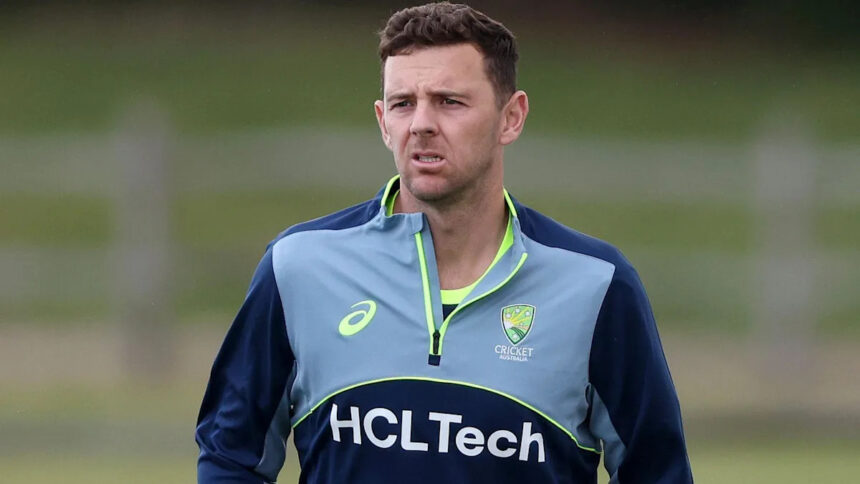
Australia’s T20 World Cup Campaign Rocked as Josh Hazlewood Ruled Out
In a crushing blow to their title defence, the Australian men’s cricket team has been forced to officially rule premier fast bowler Josh Hazlewood out of the upcoming ICC Men’s T20 World Cup. The veteran seamer, a linchpin of Australia’s pace attack across all formats, has lost his race against time to overcome a lingering combination of injuries. This development throws a significant spanner in the works for the Australian selectors and captain Mitchell Marsh, stripping the squad of one of the world’s most economical and reliable T20 bowlers on the eve of the tournament in the Caribbean and the USA.
The news, while feared, confirms the worst for Australian fans. Hazlewood has been sidelined since mid-November, missing the entire home Test summer against Pakistan and the West Indies, as well as the recent tour of New Zealand. His absence leaves a gaping hole in an attack that was banking on his trademark precision and powerplay prowess to navigate the challenging conditions of a World Cup.
A Gamble That Didn’t Pay Off: The Timeline of a Setback
Australia’s selectors had initially taken a calculated risk, naming Hazlewood in their 15-man squad with the hope that he would be available for the crucial latter stages of the tournament. The plan was built around a gradual rehabilitation from his hamstring and Achilles tendon issues, targeting a return during the Super 8s phase. However, the body’s timeline and the demands of elite sport rarely align perfectly.
Cricket Australia national selector Tony Dodemaide delivered the sobering update, highlighting the medical reality that forced their hand. “We were hopeful Josh would be back to match fitness by the Super 8s stage but the latest indications [are] he is still some time away,” Dodemaide stated. He emphasized that the decision, while difficult, was rooted in long-term responsibility. “Trying to accelerate his recovery to get him fit to play a part in the latter stages would carry too much of a risk,” Dodemaide added, acknowledging the potential for a more serious, long-term setback if they pushed the 35-year-old too hard.
This conservative approach, while frustrating in the short term, underscores a modern management philosophy: protecting a vital asset for future campaigns, including the Test calendar. The decision confirms that Hazlewood’s injury is more complex than initially projected, requiring a patient and comprehensive recovery.
Analyzing the Void: What Australia Loses Without Hazlewood
Josh Hazlewood’s value in T20 cricket cannot be overstated. In a format often dominated by batters and mystery spin, he is a master of consistency and pressure. His absence is a multi-faceted blow to the Australian setup:
- Powerplay Supremacy: Hazlewood is arguably the best powerplay bowler in world cricket. His ability to land the ball on a perfect length, seam it both ways, and choke scoring in the first six overs is a foundational strategy for Australia.
- Death Bowling Intelligence: While not a 150kph yorker specialist, Hazlewood’s nous at the death, using variations of pace and clever wide yorkers, has become increasingly effective. His experience in high-pressure moments is irreplaceable.
- Economy and Control: In T20s where economy rates can spiral, Hazlewood’s career economy of 7.43 is exceptional. He builds pressure that other bowlers feed off, creating wicket-taking opportunities at the other end.
- Big-Match Temperament: A veteran of 41 T20Is and countless high-stakes IPL and international games, Hazlewood’s ice-cool demeanor in crunch situations is a psychological asset for the team.
The cumulative effect of losing these qualities forces a strategic rethink. The balance of the attack, carefully constructed around Hazlewood’s reliability, must now be recalibrated.
Next Man Up: The Contenders and Reshaped Bowling Attack
With Hazlewood officially out, the spotlight turns to who will step into the breach. Australia has a travelling reserve in the form of quick Ben Dwarshuis, a left-arm option who offers a different angle. However, the direct replacement in the playing XI is less clear-cut and will likely depend on conditions.
The remaining pace battery features the fiery Pat Cummins, the ever-improving Mitchell Starc, and the all-round capabilities of Marcus Stoinis and Mitchell Marsh. Nathan Ellis, renowned for his death-bowling skills, now assumes an even more critical role as the third specialist seamer. His ability to execute under pressure will be tested like never before.
This shift may also prompt Australia to lean more heavily on their spin resources. Adam Zampa’s leg-spin becomes the central bowling weapon, while Glenn Maxwell’s off-break and the part-time options of Travis Head could see more overs. The selection conundrum now revolves around whether to replace like-for-like with another specialist quick or to bolster the batting or spin departments, trusting the remaining pacers to carry a heavier load.
World Cup Implications and Australia’s Path Forward
This setback undoubtedly alters the T20 World Cup landscape. Australia, already in a tough group with England, Namibia, Scotland, and Oman, must find a new bowling identity quickly. Hazlewood’s absence weakens their strongest suit—a formidable, varied pace attack—and places greater onus on their sometimes-inconsistent batting lineup to post bigger totals.
From a tournament-wide perspective, other contenders like England, India, and the West Indies will see this as a significant weakening of the defending champions. It opens a window of opportunity and slightly shifts the pre-tournament power dynamics.
For Australia’s campaign to succeed, several things must now happen:
- Mitchell Starc must rediscover his white-ball rhythm and lead the attack with early wickets.
- Nathan Ellis must seamlessly transition from squad player to key, bankable operator.
- The batting power-hitters, notably David Warner, Glenn Maxwell, and Tim David, must fire consistently to give the bowlers a larger margin for error.
- Captain Mitchell Marsh’s leadership and tactical acumen will be tested in managing a reshuffled bowling unit.
A Bitter Pill for the Road to Defence
The ruling out of Josh Hazlewood is a severe early setback for Australia’s T20 World Cup ambitions. It is a stark reminder of the fine margins and brutal physical demands of the modern cricket calendar. While the selectors’ caution is prudent for Hazlewood’s future, its immediate cost is high. Australia’s title defence, already a challenging prospect in the unpredictable T20 format, has just become considerably steeper.
The team now faces the ultimate test of squad depth and resilience. Can they adapt, reconfigure, and overcome the loss of a cornerstone player? The answer to that question will define their Caribbean campaign. The World Cup is won not just by star power, but by the strength of the collective. Australia’s mettle, and their ability to turn this adversity into a unifying force, will be under the microscope from the very first ball.
Source: Based on news from Yahoo Sports.