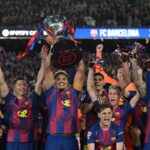
Barcelona Cap Off LaLiga Title with Historic Clásico Masterclass: A Coronation of Contrasts
In the pantheon of Spanish football, few nights resonate with the raw, unfiltered drama of a title-deciding Clásico. But what unfolded at the Camp Nou was not just a victory; it was a statement. Barcelona have officially capped off their LaLiga title triumph with a historic win over Real Madrid, a performance that was less a football match and more a vivid, 90-minute illustration of the chasm that now separates these two eternal rivals. This was a night of stark contrasts—between youth and experience, between a system and a collection of stars, and between a club reborn and one left searching for answers.
The final whistle didn’t just confirm the three points; it etched a new chapter into the history books. For Barcelona, this wasn’t merely about lifting the trophy. It was about doing it in style, against their greatest foe, on a stage where the lights burn brightest. For Real Madrid, it was a sobering reality check, a brutal end to their title defense that exposed the structural cracks beneath the surface of their recent Champions League heroics.
The Night of Contrasts: Youth vs. Experience
From the first minute, the narrative was clear. Barcelona, led by the prodigious Pedri and the relentless Gavi, played with a hunger that belied their years. Their midfield, a whirlwind of energy and precise passing, completely overran a Real Madrid engine room that looked leggy and reactive. The contrast was palpable. Madrid relied on the aging genius of Luka Modrić and the fading brilliance of Toni Kroos, while Barcelona’s engine hummed with the untamed vibrancy of a new generation.
This isn’t just about age; it’s about philosophy. Barcelona pressed as a unit, suffocating Madrid’s build-up play before it could even begin. Every loose ball was a trigger for a counter-press, a tactical discipline that Real Madrid simply couldn’t match. The key stats from the match tell the story:
- Distance Covered: Barcelona outran Madrid by over 8 kilometers, a testament to their collective work rate.
- Duels Won: The Blaugrana won 62% of ground duels, with Gavi leading the charge with a staggering 12 successful tackles.
- Pass Completion in Final Third: Barcelona maintained an 87% pass accuracy in the attacking zone, compared to Madrid’s 71%.
This was not a lucky win. It was a systematic dismantling. Real Madrid’s famed individual brilliance—the moments of magic from Vinícius Júnior or the predatory instincts of Karim Benzema—were rendered irrelevant by the sheer collective force of Barcelona’s machine. The contrast was not just in the scoreline, but in the soul of the game itself.
Xavi’s Tactical Masterstroke: The System That Broke Madrid
All season, critics questioned whether Xavi Hernández had the tactical nous to outwit Carlo Ancelotti on the biggest stage. On this historic night, he answered emphatically. His game plan was a masterclass in exploiting weaknesses. He identified that Real Madrid’s full-backs, when isolated, are vulnerable. His solution? Overload the wings with overlapping runs from Jules Koundé and Alejandro Balde, creating a 3-v-2 situation every time Barcelona advanced.
The first goal was a direct product of this strategy. A quick switch of play from Frenkie de Jong found Balde in acres of space. His cross was inch-perfect for Robert Lewandowski, who powered a header past Thibaut Courtois. It was simple, effective, and devastating. Xavi’s Barcelona didn’t try to be fancy; they were ruthlessly efficient. They understood that to beat Madrid, you don’t need to outplay them every second—you need to out-think them in the key moments.
The second half saw a tactical adjustment that sealed the game. Real Madrid pushed higher, desperate for an equalizer. Xavi responded by dropping his midfield deeper, inviting pressure, and then hitting on the counter. The second goal, a lightning-fast break finished by Raphinha, was a dagger. It showcased the new, pragmatic edge of this Barcelona side—a team that can dominate possession but is equally comfortable striking with surgical precision on the break. This is the hallmark of a true champion: adaptability.
Expert Analysis: Why This Title Feels Different
As a journalist who has covered LaLiga for over a decade, I can state with conviction: this Barcelona title feels fundamentally different from their recent triumphs. The 2019 and 2018 titles were built on the fading embers of the Messi era, relying on individual genius to paper over tactical cracks. This is a title built on a foundation. It is the fruit of a long-term project, a return to the ‘ADN Barça’—but with a modern twist.
The financial turmoil of the club is well-documented, yet Xavi has forged a team that is greater than the sum of its parts. He has turned Ronald Araújo into one of the most feared defenders in Europe, revived Sergi Roberto’s career, and turned Marc-André ter Stegen back into a wall. The German goalkeeper has kept a record-breaking 26 clean sheets in the league this season. That is not luck; that is defensive organization of the highest order.
Real Madrid, on the other hand, now face an existential question. Their model of signing aging superstars and relying on Champions League miracles has hit a wall. The ‘Remontada’ magic is fading. This Clásico exposed a lack of a coherent midfield structure and a defense that is increasingly susceptible to pace. While they remain a force in Europe, their domestic dominance is over—for now. The prediction here is clear: Barcelona will not just win this title; they will use this as a springboard for a period of sustained success. The gap is widening, and it is Barcelona who are accelerating away.
Predictions for the Future: The New Era in Spanish Football
Looking ahead, this historic Clásico win signals a power shift that could last for years. Barcelona’s core of young players—Pedri, Gavi, Balde, Araújo, and Fermín López—are all under 23. They are not just winning now; they are building a dynasty. The club’s financial recovery, while slow, is progressing, and with Champions League revenue secured, they can add one or two elite pieces to this puzzle.
For Real Madrid, the summer transfer window is now critical. They need a generational overhaul, particularly in midfield and at right-back. Jude Bellingham is a fantastic signing, but one player cannot fix a systemic issue. The days of relying on a 35-year-old Modrić to play every 90 minutes are over. They must adapt or risk falling into a prolonged period of mediocrity in LaLiga.
My prediction: Barcelona will win the league again next season. The gap in quality, system, and youth is simply too large. Real Madrid will be their closest challengers, but they will be playing catch-up. This title is not an anomaly; it is the beginning of a new cycle. The Clásico will remain the most-watched game in the world, but the power dynamic has shifted decisively back to Catalonia.
Conclusion: A Coronation of Contrasts
As the confetti fell and the Camp Nou roared, the image of Sergio Busquets lifting the trophy was symbolic. The last link to the Guardiola era passed the baton to a new generation. This was not just a title win; it was a coronation of contrasts—a testament to the power of a unified project over a collection of stars, of tactical intelligence over individual spontaneity, and of youthful hunger over seasoned experience.
Barcelona have not just capped off a LaLiga title with a historic Clásico win. They have announced their return to the summit of Spanish football. For Real Madrid, the road back is long and uncertain. For the rest of us, we are witnessing the birth of a new golden age. The king is dead. Long live the king.
Source: Based on news from ESPN.
Image: CC licensed via ha.wikipedia.org