Barcelona Secures F1 Future: Circuit de Catalunya to Host Races Until 2032 in Historic Spa Rotation
The roar of Formula 1 engines will continue to echo through the hills of Montmeló for the foreseeable future. In a landmark deal that resolves one of the sport’s most delicate calendar puzzles, the Circuit de Barcelona-Catalunya has secured its place on the F1 calendar until at least 2032. The agreement, however, comes with a revolutionary twist: the iconic Spanish track will enter into a historic rotation agreement with the legendary Circuit de Spa-Francorchamps, safeguarding the futures of two of motorsport’s most revered venues. This strategic move by Formula 1 ensures that fans do not lose a classic circuit, while allowing the calendar to evolve and incorporate new destinations.
A Deal Forged in Tradition: Preserving Two Pillars of F1
For years, the expanding F1 calendar and the sport’s commercial demands have placed historic European circuits under existential threat. The news that Barcelona had lost the Spanish Grand Prix title to Madrid from 2026 sent shockwaves through the paddock, casting a long shadow over the Circuit de Catalunya’s future. Similarly, Spa’s place was perennially questioned due to logistical and weather challenges. F1’s solution is a masterstroke in diplomatic scheduling. Rather than choosing one over the other, the sport has brokered a shared Grand Prix slot.
This means that from 2026, European motorsport fans will witness a biennial showcase of two distinct racing philosophies. The Barcelona-Catalunya Grand Prix will light up the calendar in June of 2026, 2028, 2030, and 2032. In the alternating years, the Belgian Grand Prix at Spa will take center stage in 2026, 2027, 2029, and 2031. This rotation model is a clear acknowledgment that while new street circuits offer glamour, the soul of Formula 1 remains deeply connected to these purpose-built temples of speed.
- Barcelona-Catalunya GP Years: 2026, 2028, 2030, 2032
- Spa-Francorchamps GP Years: 2026, 2027, 2029, 2031
The Ultimate Test: Why Barcelona Remains Indispensable
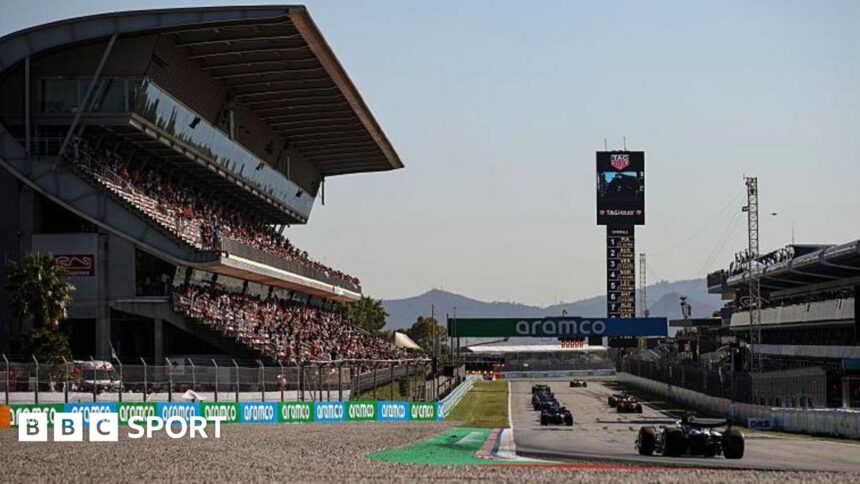
Losing the “Spanish Grand Prix” moniker is a symbolic blow, but Barcelona’s value to Formula 1 is immeasurable and goes far beyond a name. The Circuit de Catalunya is, quite simply, the sport’s universal benchmark track. For decades, it has been the default venue for pre-season testing, its demanding layout providing the most comprehensive data on a car’s performance. Its mix of long, high-speed corners, technical slow-speed sections, and a crucial main straight offers a complete examination of chassis aerodynamics, mechanical grip, and power unit efficiency.
This is the track where championships are often hinted at in winter testing. More importantly, it is a track where driver skill is supremely tested. The statistics speak to its demanding nature and the elite talent required to conquer it. Only the very best have tamed it repeatedly. Both Michael Schumacher and Lewis Hamilton have stood atop its podium a staggering six times each, a shared record that underscores its status as a champion’s circuit. To lose such a critical performance barometer would have been a severe loss for teams, drivers, and purist fans alike.
Analysis: The Strategic Genius of the Rotation Model
This rotation deal is more than just a convenient fix; it’s a strategic blueprint for Formula 1’s future. Firstly, it mitigates financial pressure on both promoters. Hosting a Grand Prix is astronomically expensive, and a biennial event allows for longer lead times in planning, ticket sales, and infrastructure investment. For local economies, it creates a “must-see” event scarcity, potentially boosting tourism impact in the “on” years.
Secondly, it protects the sport’s heritage while allowing for growth. With Las Vegas, Miami, Madrid, and likely other new venues joining the fray, something had to give. This model allows F1 to have its cake and eat it too—introducing new, commercially lucrative races without outright axing historic ones. It sets a potential precedent for other classic circuits under threat. Could we see a future where other iconic tracks share a slot? This Barcelona-Spa pact proves that creative calendar management is possible.
Finally, it enhances the specialness of each event. A Belgian Grand Prix at Spa will no longer be an annual expectation but a cherished, irregular spectacle. The same goes for Barcelona. This scarcity will heighten anticipation and could lead to even more vibrant race-day atmospheres, as fans flock to experience a classic that isn’t guaranteed to return the following spring.
Predictions: A New Chapter for the Catalan Circuit
With its future secure until 2032, the Circuit de Catalunya can now plan for a new era. The renamed “Barcelona-Catalunya Grand Prix” will need to forge its own identity distinct from the Madrid event. We can expect a heightened focus on Catalan culture and innovation, potentially transforming the race weekend into a broader festival celebrating the region. The circuit itself may also see targeted modifications. While its layout is sacred for testing, the race has sometimes been criticized for processional outcomes. The security of a long-term deal could empower promoters to explore minor track alterations to boost overtaking, especially with the 2026 new regulations in mind.
For the drivers and teams, its alternating presence will change preparation dynamics. The loss of annual data will place a greater premium on simulation work and adaptability. When F1 does return to Barcelona, it will be a fascinating litmus test of car development, with two-year gaps providing stark comparisons. The battle to challenge the Schumacher-Hamilton record of six wins will become an even more intriguing subplot, with fewer opportunities to add to the tally.
Conclusion: A Victory for the Heart of Formula 1
The announcement that Barcelona will host F1 until 2032 is a profound relief for purists. But the true victory is the innovative manner in which it was achieved. By tethering its fate to that of Spa-Francorchamps, Formula 1 has demonstrated a commitment to its history that many feared was waning. This is not a story of one circuit surviving at the expense of another; it is a story of two legends being preserved for a new generation. The Barcelona-Spa rotation is a complex but elegant solution to a modern problem, ensuring that the grueling, technical challenge of Montmeló and the majestic, thrilling sweep of the Ardennes Forest remain integral chapters in the ever-evolving story of Formula 1. The sport’s future calendar will be bigger and more global, but thanks to this deal, it will still have a soul.
Source: Based on news from BBC Sport.