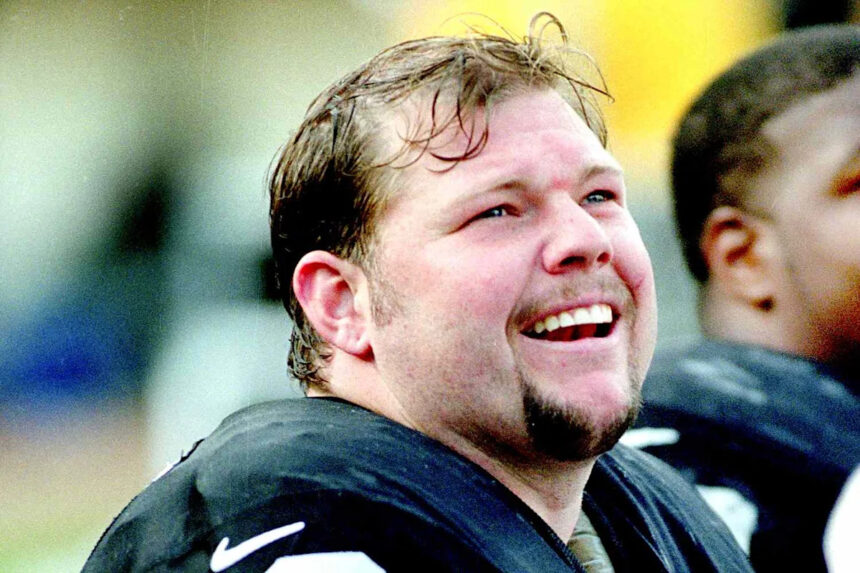
Barret Robbins, Former Oakland Raiders All-Pro Center, Dies at 52
The football world is reflecting on the complex and tragic life of Barret Robbins, the former Oakland Raiders All-Pro center who died at age 52. Robbins, whose career was defined by both elite performance and profound personal struggle, passed away peacefully in his sleep, as confirmed by his family and former teammates. His death closes a chapter on one of the NFL’s most poignant and cautionary tales, a story of immense talent overshadowed by a public battle with mental health that culminated in his infamous disappearance on the eve of Super Bowl XXXVII.
A Star’s Ascent and the Shadow of Struggle
Selected by the Oakland Raiders in the second round of the 1995 NFL Draft out of TCU, Barret Robbins embodied the Raiders’ storied commitment to power and intimidation in the trenches. He did not start a game as a rookie, but through relentless work, he transformed himself into the league’s premier center by the early 2000s. In 2002, his performance peaked as he anchored an offensive line that paved the way for a league-leading rushing attack, earning First-Team All-Pro and Pro Bowl honors. Robbins was the undisputed, All-Pro center for a Raiders team that marched to an AFC Championship and a berth in Super Bowl XXXVII.
Yet, beneath this professional success, a fierce and private battle was raging. Robbins had been diagnosed with bipolar disorder, a condition largely unmanaged and misunderstood within the high-pressure environment of professional sports at the time. Teammates and coaches were aware of his erratic behavior at points, but the full scope of his mental health problems was not publicly known. The collision between his private agony and public duty was set for the biggest stage in sports.
The Super Bowl Disappearance: A Career’s Turning Point
The defining moment of Barret Robbins’ life and career occurred in San Diego on January 25, 2003, the Saturday before the Super Bowl. After missing team meetings and a walk-through practice, Robbins was discovered missing from the team hotel. A frantic search ensued, with reports later indicating he had embarked on a hours-long binge in Tijuana, Mexico. He was found disoriented and intoxicated in his hotel room the next morning, mere hours before kickoff.
The Raiders, in a decision that remains debated, deactivated him for the game. A shell-shocked team, already facing a formidable Tampa Bay Buccaneers defense coached by their former mentor Jon Gruden, was routed 48-21. The absence of their All-Pro offensive lineman and emotional leader was a devastating blow. “It’s unfortunate that his life was never the same after he was not allowed to play in the Super Bowl!” lamented Hall of Fame wide receiver Tim Brown upon news of Robbins’ death.
The fallout was immediate and severe. The incident was initially framed as a simple act of irresponsible partying, a narrative that cruelly masked the reality of a mental health crisis. Robbins was publicly shamed, becoming a national punchline. The Raiders released him before the next season, and his NFL career was effectively over.
A Descent into Legal Trouble and a Search for Stability
In the years following the Super Bowl, Robbins’ life spiraled further, marked by a series of legal problems that highlighted his ongoing struggle. The most severe incident came in 2005 when, during a drug-fueled episode, he was shot by Miami Beach police after allegedly attempting to break into a vacant building. He was charged with attempted murder, though those charges were later dropped. He pleaded guilty to lesser charges and served prison time.
- 2005: Shot by police in Miami Beach, leading to multiple felony charges and prison time.
- Mental Health Diagnosis: His bipolar disorder was formally cited in court proceedings, shifting the public narrative toward understanding his actions as symptoms of illness.
- Later Years: Robbins lived a largely private life, reportedly working to manage his health and rebuild relationships with his family, including his wife and daughters.
This period transformed Robbins from a sports cautionary tale into a broader symbol of the consequences of untreated mental illness, especially within the macho culture of professional football. The conversation began to shift from “What was he thinking?” to “Why wasn’t he getting help?”
Legacy and Lessons: Beyond the Headlines
Barret Robbins’ death prompts a complex reckoning with his legacy. He was undeniably one of the most physically gifted centers of his era, a Raiders star whose on-field intelligence and ferocity were revered by teammates. Yet, his story is inextricably linked to a single, catastrophic night that unraveled everything.
From a sports journalism and expert analysis perspective, Robbins’ career represents a massive “what if.” What if the NFL and his team had more robust mental health protocols in 2003? What if his condition had been managed with the same urgency as a torn ACL? His case, along with others, has directly led to positive change. Today, the NFL has significantly enhanced its mental health resources, employing independent behavioral health clinicians and promoting awareness. Teams are now, in theory, better equipped to identify and support players in crisis.
Predictions for how he will be remembered are twofold. For a generation of fans, he will always be the player who vanished before the Super Bowl. But for the league and those advocating for athlete welfare, his life is a tragic, foundational case study. His story is now taught as part of the imperative to prioritize psychological well-being alongside physical training.
A Final Rest
Barret Robbins’ passing at 52 is a somber end to a life of extreme highs and devastating lows. He was a former Oakland Raiders titan who reached the pinnacle of his profession, only to be consumed by a disease that neither he nor the world around him fully understood at the time. The heartfelt tributes from former teammates like Tim Brown speak to the man they knew and loved in the locker room, a leader whose struggle evoked empathy more than anger in retrospect.
His death is not just the loss of a former athlete; it is a reminder of the fragile humanity behind the helmet. The hope is that the difficult lessons from the life of Barret Robbins continue to resonate, ensuring that future athletes facing similar demons find a path to help long before they find themselves lost on the eve of their greatest moment. In the end, as Brown simply stated, he deserves his peace.
Source: Based on news from Yahoo Sports.