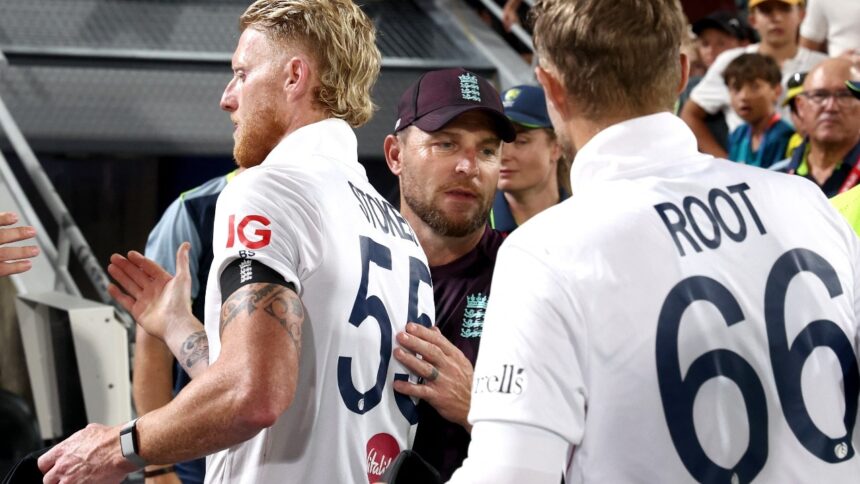
Bazball Has Failed, McCullum Must Go: Boycott’s Blistering Verdict on England’s Ashes Letdown
The Ashes urn remains in Australian hands, sealed with a ruthless efficiency that has left England’s ‘Bazball’ revolution facing its most existential crisis. In the wake of another decisive collapse, the once-celebrated philosophy is no longer being questioned in whispers but condemned in roars. Leading the charge is one of English cricket’s most iconic and stubborn voices, Sir Geoffrey Boycott, who has delivered a scathing obituary for the era, insisting the experiment is over and its architect, Brendon McCullum, must depart.
Boycott’s column in *The Telegraph* is not mere criticism; it is a forensic dismantling of a mindset he believes has curdled from confident to arrogant. While acknowledging the initial “shot in the arm” McCullum and captain Ben Stokes provided, Boycott argues the method has “run its race,” becoming a predictable and flawed dogma that superior opponents like Australia have gleefully exploited. This is no longer a debate about style; it is, according to its fiercest critic, a verdict on failure.
The Unraveling of a Revolution: From Saviour to Stubborn Dogma
There is no denying the initial impact. When Brendon McCullum and Ben Stokes joined forces in 2022, they transformed a moribund, fearful England Test team into a juggernaut of aggression. The Bazball philosophy was a cultural reset: chase anything, fear nothing, prioritize entertainment and momentum above all else. For a year, it worked spectacularly, stringing together a historic run of victories and filling grounds with a newfound buzz.
However, Boycott’s central thesis is that this approach contained the seeds of its own downfall, especially against the highest-quality opposition. What began as a liberating mindset hardened into an inflexible doctrine. The refusal to adapt, to sometimes dig in, to play the situation rather than the brand, was hailed as bravery but is now being painted as hubris.
“Confidence has drifted into arrogance,” Boycott asserts, pinpointing the fatal flaw. In the Ashes crucible, where patience and tactical nuance are as vital as aggression, England’s one-note strategy appeared naive. The aggressive approach became a series of reckless dismissals at critical moments, gifting Australia initiative after initiative. The revolution, built on attacking the opposition’s best bowlers, had no answer when those bowlers were world-class operators like Pat Cummins, Mitchell Starc, and Nathan Lyon, who simply waited for the inevitable errors.
Boycott’s Case: Why the McCullum Era Must End
For Boycott, the evidence is incontrovertible. Retaining the Ashes was the ultimate benchmark, and England have failed, with the Ashes defeat in Adelaide serving as the definitive proof of concept failure. His call for McCullum to go is not just about results but about fundamental cricketing principles. He argues the setup has:
- Devalued Defence: In eradicating fear of failure, they also eradicated the essential skill of defensive batting, leaving batters technically and mentally unequipped for tough sessions.
- Ignored Context: Failing to adapt to match situations, pitch conditions, and the quality of the attack. Every day was treated as a “day five” chase, a thrilling but unsustainable model.
- Created a Leadership Echo Chamber: With Stokes a fervent disciple of McCullum’s vision, Boycott suggests there has been no internal challenge to the orthodoxy, leading to repeated, unlearned mistakes.
- Overlooked Bowling: The focus on manic batting has overshadowed the development of a world-class bowling attack capable of taking 20 wickets in all conditions, the true hallmark of great teams.
“It is obvious that Bazball has run its race,” Boycott writes, a line that will echo through English cricket’s corridors of power. His solution is a clean break: a new coach with a more nuanced, adaptable philosophy to partner Stokes or his successor.
The Crossroads: What’s Next for English Test Cricket?
The England and Wales Cricket Board (ECB) now faces a monumental decision. Do they double down on the entertainment-first model, believing a refinement of Bazball is possible? Or do they heed Boycott’s warning and seek a recalibration, blending the positive intent with the old-fashioned virtues of game management?
Potential paths forward include:
- The Refinement Route: McCullum and Stokes stay, but with a mandate to incorporate greater situational awareness. This would require a public admission of inflexibility, a difficult step for such charismatic leaders.
- The Clean Break: Accepting the cycle has ended. McCullum’s contract is up in 2025; an early, amicable parting could be framed as his mission to change attitudes being complete, needing a different technician to build the next team.
- The Hybrid Model: Appointing a coach known for tactical acumen and technical batting prowess—a figure like former England captain Andrew Strauss or a respected county strategist—to install a “Bazball 2.0” with a stronger defensive foundation.
The stakes are immense. The next World Test Championship cycle begins soon, and England’s schedule is relentless. The fear is that without change, familiar failures will indeed repeat, not just against Australia but in the spinning crucibles of India and the seaming tracks of New Zealand.
Verdict: A Necessary Provocation or Nostalgic Rage?
Geoffrey Boycott’s broadside will be dismissed by some as the rant of a traditionalist who never embraced the modern game. Yet, its power lies in its timing and its unassailable core fact: England lost. And they lost key moments not through bad luck, but through a repeated pattern of self-inflicted wounds born from their chosen style.
Whether McCullum goes or not, Boycott has successfully framed the heavier scrutiny the philosophy now warrants. The conversation has shifted from “How thrilling!” to “Is this sustainable?” The Ashes is the ultimate audit, and the balance sheet shows a deficit in wisdom alongside the credit for entertainment.
English cricket stands at a crossroads. One signpost, championed by Boycott, points back towards a fusion of resilience and flair. The other points forward on the same Bazball path, believing its failures are merely growing pains. The ECB’s choice will define the next decade. The revolution captured hearts, but as Boycott coldly concludes, in the arena that matters most, it has failed. The blistering attack from a legend may be the catalyst for change English cricket desperately needs, or the epitaph for an era that was thrilling, but ultimately, not quite enough.
Source: Based on news from India Today Sport.