Real Madrid’s Midfield Maestro: Jude Bellingham Sidelined for a Month with Hamstring Injury
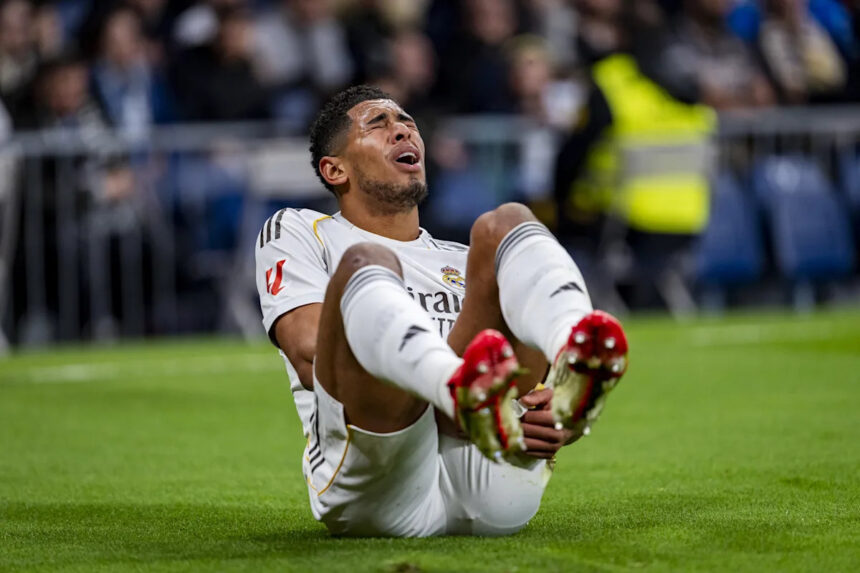
The Santiago Bernabéu held its breath in the 8th minute. Jude Bellingham, the talismanic heartbeat of Real Madrid’s season, pulled up sharply, a hand clutching the back of his left leg. The collective groan from the stands was audible. In that moment, a shadow was cast not just over a routine LaLiga fixture against Rayo Vallecano, but over the crucial weeks to come. As confirmed by the club’s official medical report, Real Madrid will now be without their top scorer for approximately one month due to a significant hamstring injury, a blow that tests the squad’s famed resilience at a pivotal point in the campaign.
The Diagnosis: Decoding the Semitendinosus Setback
Following comprehensive tests by the Real Madrid Medical Services, the specific injury has been identified as a lesion to the semitendinosus muscle. This is one of the three muscles that make up the hamstring group, crucial for explosive running, deceleration, and flexibility. The club’s succinct statement, “awaiting evolution,” is standard medical protocol, but the one-month timeline indicates a moderate-grade strain. This type of hamstring injury typically involves a partial tear of the muscle fibers, requiring a careful rehabilitation protocol to prevent re-injury—a common risk with such setbacks.
The incident itself was innocuous yet telling. Chasing a through-ball from young Franco Mastantuono, Bellingham stretched without any direct contact from an opponent, the classic non-contact mechanism of a soft-tissue overload. His immediate recognition of the severity and his substitution was a prudent move, likely preventing a more catastrophic tear. The timing, however, could hardly be worse.
The Void in the Lineup: Matches and Momentum at Stake
Bellingham’s absence creates a substantial tactical and creative chasm in Carlo Ancelotti’s side. The Englishman’s transformation into a prolific, game-winning attacking midfielder has been the story of the season. His loss will be felt acutely across multiple competitions:
- Champions League Round of 32 vs. Benfica: The most immediate and high-stakes impact. Bellingham’s big-game temperament and clutch goal-scoring would have been central to navigating this tricky European tie.
- LaLiga Fixtures: A demanding sequence of league games against Valencia, Real Sociedad, Osasuna, and Getafe. These are precisely the types of matches where Bellingham has broken stubborn defenses, securing vital points in a tight title race.
Beyond the raw numbers—his team-leading goal tally—it’s his intangible influence that will be missed: the late runs into the box, the defensive pressure from the front, and the sheer gravitational pull he exerts on opposition defenders, which creates space for teammates. The upcoming schedule is a minefield, and Madrid must now traverse it without their chief navigator.
Ancelotti’s Chessboard: The Camavinga Conundrum and Tactical Reshuffle
Carlo Ancelotti, a master of squad management, now faces one of his most significant tests of the season. The direct replacement in the starting lineup appears to be Eduardo Camavinga. The French dynamo offers immense athleticism, defensive solidity, and progressive ball-carrying from a more advanced position. However, the role will demand adaptation. Camavinga does not possess Bellingham’s innate goal-poaching instincts or his volume of final-third touches. This shift necessitates a broader tactical recalibration.
We can expect two primary adaptations:
- Collective Goal-Scoring Responsibility: The burden must shift. Vinícius Júnior and Rodrygo will need to elevate their output, while midfielders like Federico Valverde and Toni Kroos may be encouraged to take more speculative efforts from distance.
- System Flexibility: Ancelotti could revert to a more traditional 4-3-3, with Camavinga as a left-sided #8, or even grant more minutes to Arda Güler in a creative role. The Italian’s genius lies in fitting the system to his available pieces, not the other way around.
This period also places a spotlight on the squad’s depth, a hallmark of this Madrid era. It’s a moment for others to step into the void and prove the team’s success is not built on one superstar, but on a collective of them.
The Silver Lining: Forced Rest and the Final Sprint
In the relentless grind of a modern elite season, a mid-term injury, while devastating, can sometimes carry an unintended benefit: forced physical and mental rest. Bellingham has been an ever-present workhorse since his arrival, carrying the offensive load for both club and country. A one-month layoff, if managed perfectly, could see him return in April refreshed and re-energized for the season’s final, decisive sprint.
April and May are when trophies are truly won. The Champions League quarter-finals (should they advance), the final stages of LaLiga, and the Copa del Rey final loom. A fully fit and recuperated Bellingham at that juncture could be worth the short-term pain. The key is ensuring his rehabilitation is meticulous, avoiding the temptation to rush him back. The long-term view must prevail, even amidst short-term pressure.
Jude Bellingham’s hamstring injury is a seismic event in Real Madrid’s season, a narrative twist that challenges their domestic and European ambitions. It exposes the team’s reliance on his unique skill set but also presents an opportunity for the squad to demonstrate its champion pedigree. For the next month, the Bernabéu will watch as Ancelotti’s men adapt, as Camavinga seeks to imprint his own style on the role, and as the collective strives to keep the momentum alive. The coming weeks will test Madrid’s mettle, but history tells us this is a club that often finds its greatest strength precisely when faced with adversity. The stage is now set for others to become heroes, all while the world waits for the return of the crown jewel.
Source: Based on news from Yahoo Sports.