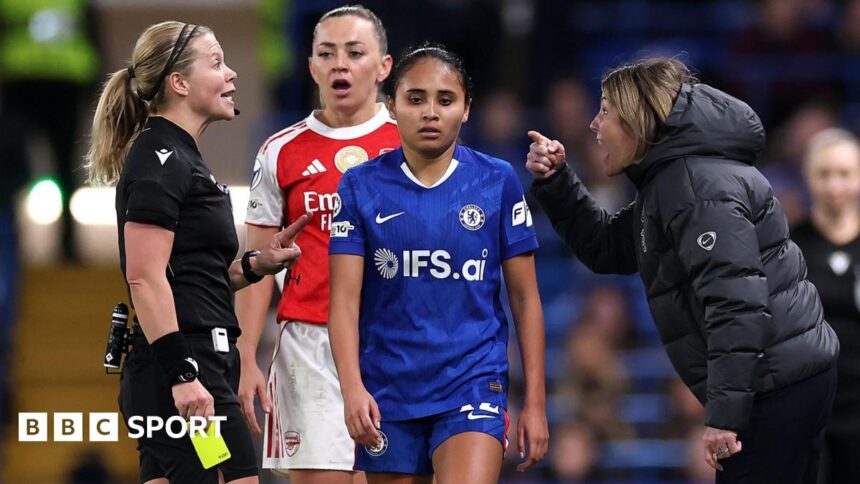
Bompastor’s Fury: The VAR Hair-Pull Incident That Ended Chelsea’s European Dream
The line between passion and petulance is often razor-thin in football, but rarely is it as literally pulled as it was at Stamford Bridge. In the dying embers of a pulsating UEFA Women’s Champions League quarter-final, with Chelsea desperately chasing a miracle, a moment of sheer frustration from Arsenal’s Katie McCabe has ignited a firestorm of controversy. The Irish international’s hair-pull on Alyssa Thompson, missed by officials and unchecked by VAR, has left Chelsea boss Sonia Bompastor seething and the football world debating the very integrity of the game’s officiating standards at its highest level.
A Costly Tug in the Twilight of a Classic
The context is everything. Trailing 2-1 from the first leg, Chelsea fought valiantly, scoring a 96th-minute goal to lead 1-0 on the night and trail 3-2 on aggregate. The Bridge was electric, belief surging through the stands and onto the pitch. In the 119th minute, with seconds remaining, Chelsea launched one final, hopeful ball. American winger Alyssa Thompson, a fresh-legged substitute, was poised to break clear, a potential dagger for Arsenal or the catalyst for a last-gasp equalizer. As she turned, Arsenal captain Katie McCabe, caught out of position, reached out. Her hand did not go for the ball, nor did it make shoulder-to-shoulder contact. Instead, it clutched a handful of Thompson’s hair, yanking the Chelsea player backward and halting the attack in its tracks.
The decision from Danish referee Frida Mia Klarlund was a free-kick, but nothing more. No yellow card was brandished. Crucially, the Video Assistant Referee (VAR) room remained silent, offering no recommendation for an on-field review. The final whistle blew moments later, sealing Arsenal’s passage to the semi-finals. What should have been a post-match focus on a heroic Arsenal rearguard action instantly shifted to a glaring officiating omission.
Bompastor’s Blistering Critique: A Coach Defending Her Legacy
Sonia Bompastor, a Champions League winner both as a player and a manager, did not mince her words in the aftermath. Her anger was not the heat-of-the-moment rant of a defeated coach, but the cold, calculated fury of a leader who felt her players had been fundamentally wronged. “My players do not deserve that level of refereeing,” she stated, a sentence that will echo through the corridors of UEFA. Her argument was multifaceted and damning:
- Clear Obvious Error: Bompastor framed the incident as a textbook VAR intervention scenario—a serious missed incident directly impacting a critical phase of play.
- Professional Disrespect: The act itself, a hair pull, was seen as an affront to the sport’s professionalism. “It is not just a foul; it is an action that does not belong on a football pitch,” she implied.
- Legacy at Stake: For a team of Chelsea’s caliber, chasing the ultimate prize, to have their journey potentially altered by such an oversight was presented as an institutional failure.
Bompastor’s comments transcend this single match. They are a direct challenge to the consistency and competence of officiating in the women’s game, which has worked tirelessly to be viewed on equal footing with the men’s competition. “At this level, in the quarter-final of the Champions League, we expect the maximum,” she asserted. The implication was clear: her team did not receive it.
Expert Analysis: Was McCabe Lucky? Dissecting the Laws
By the strict letter of the law, McCabe’s escape was nothing short of astonishing. Law 12 categorizes “holding an opponent” as a direct free-koff offence. The International Football Association Board (IFAB) guidelines explicitly state that holding includes the hair or shirt. The question then becomes one of sanction.
For a red card to be issued, the action must be deemed either serious foul play or violent conduct. Violent conduct is defined as an act “when not challenging for the ball, or… in a manner not considered a genuine attempt to play the ball.” McCabe was not challenging for the ball; she was stopping a counter-attack by any means necessary. The act was deliberate, off-the-ball, and with no intent to play football. Many former referees and pundits have unanimously concluded this met the threshold for violent conduct—a red card offence.
The VAR protocol is designed for exactly this: to correct “clear and obvious errors” in match-changing situations for red card incidents. That VAR did not even recommend a review is the most perplexing element. It suggests either a catastrophic failure in communication and judgment in the VAR booth or a wildly lenient interpretation of violent conduct that sets a dangerous precedent. For Arsenal, it was a monumental let-off; for the credibility of the competition’s officiating, it was a significant blow.
Ripple Effects: Predictions for WSL and European Football
This incident will not be forgotten as the season reaches its climax. The ramifications will be felt on several fronts:
- WSL Title Race Tension: With Chelsea and Arsenal locked in their perennial domestic battle, this incident pours gasoline on an already fierce rivalry. The next league encounter will be fraught with added emotional charge, and referees will be under a microscope.
- UEFL Scrutiny and Pressure: UEFA will face intense pressure to review its VAR protocols and training for officials in the women’s game. Consistency across men’s and women’s competitions is a constant demand, and this incident highlights a glaring discrepancy.
- Psychological Impact: For Chelsea, the sense of injustice could either deflate a season or forge a siege mentality. For Arsenal and McCabe, the “escape” narrative may linger, but it also brings a warning about future conduct under heightened scrutiny.
- Precedent Setting: Will hair-pulling now be treated with the seriousness it warrants? Or has this incident inadvertently set a tolerance level? The next similar incident will be a major test for referees worldwide.
Conclusion: More Than Just a Foul, A Test for the Game’s Growth
The image of Alyssa Thompson’s head snapping back, halted by a hand in her hair, is a powerful and ugly one. It symbolizes a moment where the game’s spirit was compromised. Sonia Bompastor’s anger is justified not merely because her team lost, but because the mechanisms designed to protect the fairness of the sport failed at its most critical juncture.
This was more than a missed red card. It was a failure of the VAR system, a challenge to the definition of violent conduct, and a stark reminder that as the women’s game grows in prestige and pressure, the demands on its officiating must escalate in tandem. The Champions League semi-finals will proceed without Chelsea, but the debate ignited by Katie McCabe’s hair-pull will continue to hang over the competition. For the health and credibility of football, the response from governing bodies must be as clear and obvious as the error they failed to correct.
Source: Based on news from BBC Sport.