Bompastor’s Battle Cry: A Disallowed Goal Ignites a Broader Fight for Respect in Women’s Football
The roar that erupted from the Chelsea section of the Emirates Stadium was visceral, a surge of belief that their Women’s Champions League quarter-final was dramatically back on. Defender Veerle Buurman had powered home a header, seemingly halving Arsenal’s 2-0 lead just before half-time. But within seconds, that roar was stifled, replaced by a chorus of bewildered outrage. The referee’s whistle blew, the goal was chalked off, and in that pivotal moment, more than just a scoreline was called into question. It became the catalyst for Chelsea manager Sonia Bompastor to issue a powerful, pointed demand for the women’s game: more respect.
A Controversial Call That Changed the Complexion of the Tie
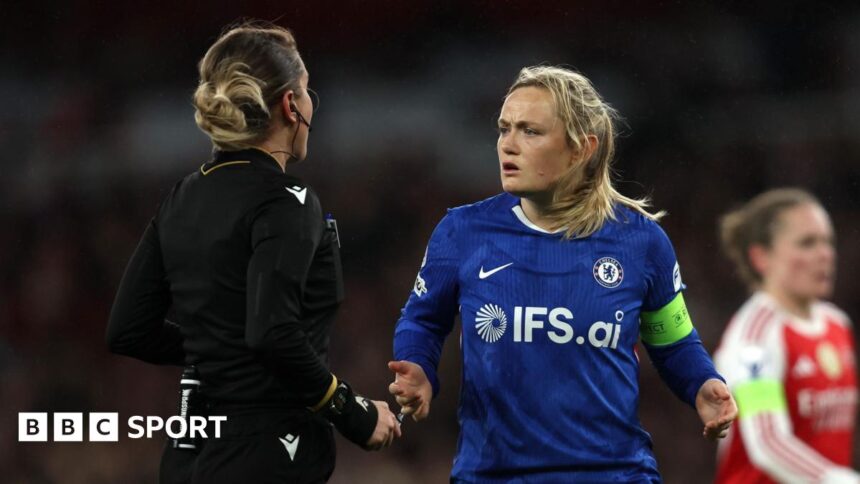
Chelsea’s 3-1 defeat to Arsenal in the first leg was a heavyweight clash befitting the stage, but the narrative was irrevocably shaped by a 44th-minute decision. From a Chelsea corner, Buurman rose highest to nod the ball past Manuela Zinsberger. However, referee Ivana Martincic deemed the defender had pushed Arsenal’s Laia Codina in the back. The decision was immediate and, in the eyes of many observers, bewilderingly soft.
The contact appeared minimal, a routine tussle for positioning seen on countless set-pieces in any football match, men’s or women’s. The disallowance felt like a disproportionate intervention. Pundits in the aftermath were united in their criticism. Former England internationals and seasoned analysts dissected the replay, with consensus leaning heavily towards a legitimate goal. As one noted on broadcast, “I think she’s made an obvious error”, a sentiment echoed across social media and post-match analysis. This wasn’t just a marginal offside call reliant on millimetres; it was a subjective judgment that robbed the contest of a potentially transformative moment.
For Bompastor and her team, the psychological and tactical impact was seismic. Instead of heading into the break at 2-1 with momentum, they trailed by two. Arsenal, buoyed by the let-off, would extend their lead in the second half, leaving Chelsea with a mountain to climb in the return leg. The French manager’s frustration was palpable post-match, but she channeled it into a broader, more significant argument.
Bompastor’s Broader Point: Officiating Standards and Systemic Respect
Sonia Bompastor, a Champions League winner both as a player and a manager, did not merely lament a bad call. She connected it to a persistent, underlying issue. “We need more respect for the women’s game,” she stated, her words carrying the weight of experience. Her point transcended a single referee’s performance, touching on the standard of officiating and the resources dedicated to it at the elite level.
Her argument hinges on consistency and investment. As the women’s game experiences unprecedented growth—with record crowds, soaring broadcast deals, and heightened technical quality—the infrastructure supporting it must keep pace. This includes:
- Full-time professional pathways for elite women’s referees to match the athleticism and speed of the modern game.
- Consistent application of VAR technology across all major women’s competitions, ensuring the same level of scrutiny as the men’s game.
- Investment in specialized training and development for officials operating at the Champions League and international level.
“We are in a quarter-final of the Champions League,” Bompastor reminded everyone. The implication was clear: the stakes are just as high, the pressure just as intense, and the decisions just as consequential. To have such a pivotal moment decided by what many saw as an error born of a lack of feel for the game felt symbolic of a gap that still exists between the sport’s professional presentation and its officiating frameworks.
Beyond One Match: A Recurring Theme in the Women’s Game
The incident at the Emirates is not an isolated one. Discussions around officiating consistency have become a recurring theme in women’s football. Managers and players frequently voice concerns over a perceived lack of flow and understanding in decision-making. When critical errors occur in high-profile matches, they undermine the sporting integrity that teams work tirelessly to uphold.
This creates a double standard. The women’s game is lauded for its technical brilliance, competitive drama, and growing commercial power, yet its participants can sometimes feel they are operating with a variable rulebook. The demand from figures like Bompastor is not for preferential treatment, but for parity in professionalism. It is a call to ensure that the off-field structures—from refereeing to medical support to logistical planning—match the world-class quality on the pitch.
Investing in officiating is a direct investment in the product’s credibility. When fans debate a brilliant tactical move or a stunning goal, rather than a controversial refereeing decision, the sport reaches its full potential. Bompastor’s comments, therefore, serve the interests of everyone invested in football’s growth.
The Road Ahead: Implications and Predictions
The immediate footballing consequence is a daunting task for Chelsea. Overturning a 3-1 deficit against an Arsenal side brimming with confidence will require a historic performance at Stamford Bridge. The disallowed goal will undoubtedly be referenced as a key moment, a source of motivation for the Blues. They must channel their sense of injustice into a flawless tactical display.
On a macro level, Bompastor’s public stance is likely to amplify a growing conversation within UEFA and other governing bodies. Pressure will mount to accelerate the professionalization of refereeing in the women’s game. We can predict:
- Increased scrutiny on officiating appointments for marquee women’s matches.
- Faster rollout and integration of VAR in competitions where it is currently absent or inconsistently applied.
- A renewed focus from refereeing bodies on developing a dedicated, elite cohort of women’s match officials.
The Champions League, as the sport’s pinnacle club competition, must set the standard. Errors will always be part of football—they are in the men’s game every week—but the system must be robust enough to minimize them and professional enough to withstand the scrutiny.
Conclusion: A Watershed Moment for Professional Standards
Sonia Bompastor’s post-match comments were more than the frustrated musings of a manager on the wrong end of a result. They were a calculated, necessary intervention from a respected leader in the game. By framing a specific officiating error within the context of systemic respect for women’s football, she elevated the discussion.
The disallowed goal for Veerle Buurman may or may not define this Champions League tie. But Bompastor’s powerful response has the potential to define a shift in how the game is managed off the pitch. True equality in football isn’t just about equal pay or stadiums; it’s about equal expectation, equal resources, and equal competence in every facet of the sport. When a controversial decision in a major match sparks a conversation about investment and professionalism, it signals that the women’s game is no longer asking for a seat at the table—it is demanding that the entire table be built to the highest possible standard. The whistle at the Emirates may have denied Chelsea a goal, but it also sounded a call to action that the football world cannot ignore.
Source: Based on news from BBC Sport.