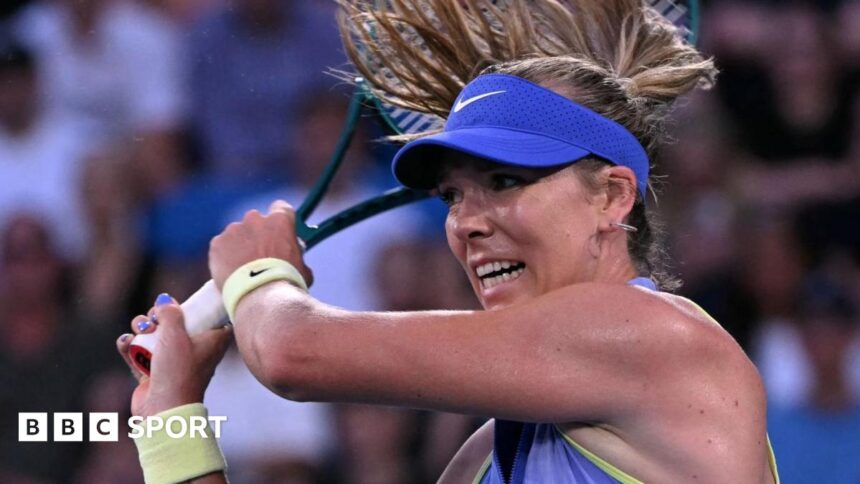
Boulter’s Australian Open Journey Ends Swiftly as Bencic Delivers Masterclass
The sun beats down relentlessly on Melbourne Park, a crucible where dreams are forged and, often, swiftly tempered. For Katie Boulter, her unexpected main-draw appearance at the Australian Open concluded with a harsh lesson in the gulf between the tour’s elite and its hopeful challengers. Handed a brutal first-round assignment against Olympic champion Belinda Bencic, the British number two was outclassed in a straight-set defeat that laid bare the challenges ahead, despite a flicker of defiant resistance.
The 6-0, 6-4 scoreline in favor of the Swiss 10th seed tells a tale of two sets: one of sheer dominance, the other of a stubborn refusal to capitulate. For Boulter, ranked 113th in the world, this was a stark reminder of the level required to consistently thrive at the sport’s pinnacle, a level she has glimpsed but struggled to hold since being surpassed as British number one by Emma Raducanu.
A Dream Draw Turns Rapidly into a Nightmare
Katie Boulter’s presence in the first round was itself a minor victory. As a last-minute entry following a withdrawal, she was spared the grueling three-round qualifier—a physical and mental reprieve. However, the lottery of the draw delivered a formidable opponent in Belinda Bencic, a player whose clean, aggressive ball-striking and tactical maturity have cemented her as a top-ten fixture.
From the first ball, the mismatch was palpable. Bencic, moving with purpose and striking with impeccable timing, unleashed a barrage of winners. Boulter, perhaps overawed by the occasion and the caliber of opposition, found no rhythm, no answer to the Swiss star’s precision.
- First Set Domination: Bencic conceded a mere eight points in the entire opening set, wrapping it up in a devastating 26 minutes. Boulter’s serve was neutralized, her groundstrokes rushed into errors.
- Technical Superiority: The Swiss’s ability to take the ball early and redirect it with depth pinned Boulter behind the baseline, robbing her of any offensive initiative.
- Psychological Blow: A “bagel” set at this level is more than a scoreline; it’s a profound statement of control that can shatter confidence.
The opening act was less a tennis match and more a clinical demonstration, leaving spectators wondering if a similarly swift conclusion was inevitable.
The Flicker of Fight: Boulter’s Second-Set Resurgence
To her immense credit, Katie Boulter did not fold. The true measure of a competitor is often taken in adversity, and the Briton emerged for the second set with a recalibrated mindset. She began to find her first serve, stepped into the court with more conviction, and started to engage in the extended rallies that Bencic had previously shortened.
The pivotal moment arrived with Boulter trailing 4-3. Harnessing a newfound aggression, she broke the Bencic serve for the first time, unleashing a forehand winner to level the set at 4-4. The roar from her supporters was one of pure belief—here was evidence that the gulf could, momentarily, be bridged.
This period of resistance was crucial. It proved Boulter possesses the weaponry to trouble top players when her game clicks. Her powerful forehand, when given time to set up, is a legitimate threat. However, maintaining that level against an opponent of Bencic’s quality is the ultimate challenge. The Swiss star, momentarily rattled, simply reset. She held serve comfortably before applying relentless pressure on Boulter’s next service game, ultimately converting her second match point to seal victory.
“I found my feet in the second set and showed what I can do,” a disappointed but clear-eyed Boulter stated afterwards. The statement underscores the narrative of her current career phase: flashes of high potential, searching for the consistency to sustain it.
Expert Analysis: The Gap Between Promise and Permanence
Boulter’s performance is a microcosm of the battle faced by many talented players outside the top 50. The loss to Belinda Bencic highlighted several key areas for development:
First-Strike Tennis: Bencic dominated the “0-2 shot” rallies. In modern tennis, the ability to win points quickly off serve or return is non-negotiable at the elite level. Boulter’s second serve, in particular, was targeted mercilessly in the first set, allowing Bencic to start points on the front foot.
Movement and Court Positioning: The Swiss’s superior footwork and anticipation allowed her to control the center of the court. Boulter was too often reactive, pushed deep and wide, leaving her playing defensively rather than dictating.
Mental Fortitude at Crucial Junctures: While her second-set fightback was admirable, closing out a set against a top seed requires an unshakable belief. At 4-4, the momentum was with Boulter, but Bencic’s experience and quality shone through in the pivotal moments—a skill honed through deep runs at majors and winning an Olympic gold medal.
Boulter’s path back to the top 100, and beyond, hinges on addressing these granular aspects. She has proven she can beat top-50 players on her day, but constructing a game plan resilient enough to withstand the pressure of a Bencic for two full sets is the next step.
Looking Ahead: Predictions for Boulter’s 2024 Season
This straight-set first-round loss in Melbourne, while disappointing, is not a catastrophe. It is a data point, albeit a sharp one. The 2024 season for Katie Boulter must be built on a foundation of consistent competition and ranking accumulation.
- Immediate Focus: Expect Boulter to target lower-tier WTA events and ITF tournaments to bank ranking points and rebuild confidence. Stringing together match wins is the most urgent priority.
- Grass-Court Priority:
The British summer on grass represents her most significant opportunity. Boulter’s game is tailored for the surface, and her title win in Nottingham in 2023 is proof of her capability. A strong grass season could propel her back towards the top 80. - Physical Resilience:
A history of injury has disrupted Boulter’s progress. A primary, non-negotiable goal for her team must be maintaining full fitness throughout the arduous season. - The Domestic Dynamic:
The shadow of Emma Raducanu reclaiming the British number one spot adds an intriguing subplot. This internal rivalry, if viewed healthily, could provide additional motivation for Boulter to push her limits.
Prediction: If she remains healthy, Boulter has the game to steadily climb back into the world’s top 70 by year’s end. Her power is a permanent asset, but the refinement of her movement, return game, and point construction will determine how high that ceiling truly is.
Conclusion: A Harsh Lesson, Not a Final Chapter
Katie Boulter’s exit from the Australian Open was a story of stark contrasts. For 26 minutes, she was rendered helpless by one of the world’s best. For the next 45, she stood toe-to-toe with her, offering a compelling glimpse of the player she aspires to be every week. The straight-set loss to Bencic was less a failure and more a precise calibration of the work required.
In the unforgiving landscape of professional tennis, such lessons are invaluable. The challenge for Boulter and her team is to deconstruct this performance, isolate the technical and tactical adjustments needed, and rebuild with the grass-court season as a clear beacon. The fight she showed in the second set is the ember she must now fan into a consistent flame. The journey from talented contender to established tour force is a marathon of incremental gains, and for Katie Boulter, that marathon continues beyond the Melbourne sun.
Source: Based on news from BBC Sport.