KMI Panel Verdict: Referee Rob Jones Blundered as Brian Brobbey Should Have Been Sent Off Against Tottenham
The fallout from Sunderland’s pulsating victory over Tottenham Hotspur on 12 April has taken a definitive and damning turn. The Premier League’s Key Match Incidents (KMI) panel has delivered a scathing verdict on the officiating at the Stadium of Light, ruling that Brian Brobbey should have been sent off for a reckless challenge that ultimately ended the season of Tottenham defender Cristian Romero.
In a decision that has reignited the debate around consistency in Premier League refereeing, the independent panel concluded that referee Rob Jones erred by not producing a second yellow card for the Sunderland striker. The incident, which occurred in the 63rd minute, has left Tottenham fans seething and has placed the spotlight firmly on the threshold for dangerous play in the modern game.
The Incident: A Nudge That Changed the Season
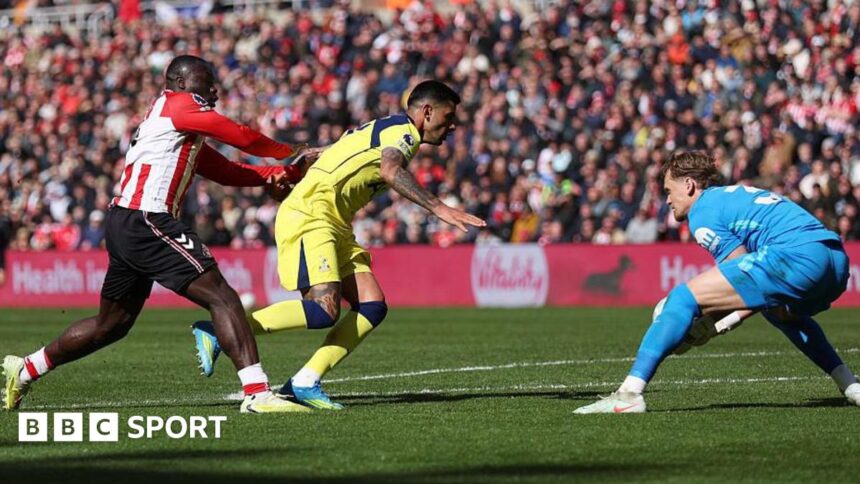
For those who missed the live action, the sequence unfolded moments after Sunderland had taken a 1-0 lead through Nordi Mukiele. The Stadium of Light was rocking, and the home side was pressing for a second. In the 63rd minute, a loose ball was played through the centre of the pitch. Brian Brobbey gave chase, with Tottenham’s Cristian Romero initially in a good defensive position.
What happened next has been dissected by pundits, fans, and now, the official KMI panel. Romero, a World Cup winner renowned for his aggressive defending, intelligently slowed his run, positioning his body to shield the ball back to goalkeeper Antonin Kinsky. It was a routine defensive maneuver. However, Brobbey did not relent. Instead of pulling out of the challenge, the Sunderland forward made a deliberate nudge into the back of Romero.
The contact was not a full-blooded tackle, but it was unnecessary and dangerous. The nudge caused Romero to lose his balance, crashing directly into his own goalkeeper, Kinsky. The collision was heavy. Kinsky was winded, but the real casualty was Romero. The Argentine defender immediately clutched his knee, his face contorted in agony. The diagnosis later confirmed the worst: a season-ending knee injury.
KMI Panel Verdict: “Clear and Obvious” Second Yellow Card
The Premier League’s Key Match Incidents panel is an independent body tasked with reviewing contentious refereeing decisions after each matchweek. Their assessment of the Brobbey-Romero incident was unequivocal. According to reports from the panel’s briefing, the consensus was that referee Rob Jones made a clear and obvious error.
The panel’s reasoning is critical. They noted that Brobbey was already on a yellow card, having been booked earlier in the first half for a tactical foul. The second incident, the nudge on Romero, was not considered a red-card offense for serious foul play (violent conduct or excessive force), but it was deemed a clear booking for reckless play.
Why? Because Brobbey had no intention of playing the ball. Romero had full control of the space. The Sunderland striker’s only objective was to disrupt the defender, and he did so with a shoulder-to-back contact that was careless and without regard for the opponent’s safety. The KMI panel ruled that this met the threshold for a yellow card under Law 12 (Fouls and Misconduct). Therefore, Brobbey should have been sent off.
Let’s break down the key points from the panel’s ruling:
- Second Yellow Card Required: The panel unanimously agreed that the nudge on Romero constituted a bookable offense.
- No Red Card for Serious Foul Play: The panel distinguished this from a straight red, noting the force was not excessive. However, this does not excuse the failure to issue a second yellow.
- Negligence of Referee: Rob Jones was criticized for failing to apply the “double jeopardy” rule correctly. He saw the contact but judged it as a 50/50 challenge, which the panel disputed.
- Impact on the Game: The panel acknowledged that the decision directly influenced the match dynamics, as Sunderland were able to keep their main attacking threat on the pitch.
Expert Analysis: Why This Matters Beyond One Match
As a veteran observer of the Premier League, I can tell you that this verdict is not just about one bad call. It exposes a systemic flaw in how referees manage players who are already on a yellow card. There is an unwritten, and frankly dangerous, tendency among officials to give a “benefit of the doubt” to a player who is walking a disciplinary tightrope. This incident proves why that philosophy is flawed.
Rob Jones had a clear opportunity to manage the game. Brobbey’s first yellow was for a tactical foul on James Maddison. It was cynical, but not violent. The second incident was different. It was a challenge that had a direct causal link to a serious injury. Even if the nudge itself was not malicious, the outcome was catastrophic.
The argument that “it was just a nudge” misses the point entirely. In the modern game, a player shielding the ball is considered to be in a position of vulnerability. Any contact from behind, especially when the attacker has no chance of winning the ball, is a foul. And when that foul is committed by a player already on a yellow card, the referee’s duty is clear: show the second yellow card.
This verdict also raises questions about the consistency of the KMI panel itself. While they got this call right, the fact that it took an independent review to state the obvious highlights a lack of accountability for match-day officials. Referees are human, but the margin for error in high-stakes Premier League matches is razor-thin. A season-ending injury to a player of Romero’s caliber—a key figure in Tottenham’s defensive structure—should have been prevented by a simple, correct application of the laws.
Predictions: The Ripple Effect for Sunderland and Tottenham
What happens now? For Brian Brobbey, he escapes retrospective punishment. The KMI panel’s ruling is a review, not a disciplinary action. The FA cannot issue a ban for an incident that was seen and judged (even incorrectly) by the referee in real-time. However, this verdict places a massive target on Brobbey’s back. Every referee in the league will now be hyper-aware of his disciplinary record. He will get no more “benefit of the doubt” for the remainder of the season.
For Sunderland, this is a lucky escape. They won the match 2-1, a result that significantly boosted their push for European football. Had Brobbey been sent off, they would have faced a 30-minute defensive siege with ten men. The KMI verdict taints that victory slightly. Opponents and pundits will now argue that Sunderland’s win was aided by an officiating error. Manager Regis Le Bris will have to manage the narrative carefully, acknowledging the luck without undermining his team’s performance.
For Tottenham Hotspur, the frustration is palpable. They have lost a world-class defender for the season due to a challenge that should not have been allowed to happen. The club will feel aggrieved, and rightly so. This incident will fuel their ongoing campaign for better protection of players. Expect to see Ange Postecoglou use this verdict in his pre-match press conferences to put pressure on the PGMOL (Professional Game Match Officials Limited) for the remainder of the campaign.
Looking ahead, the Premier League must use this as a teaching moment. The KMI panel’s findings should be distributed to all referees as a case study. The message must be clear: a player on a yellow card is not immune from a second booking for a routine foul. The “soft” yellow card for a tactical foul should not be the only time a referee acts. Reckless challenges that endanger opponents, regardless of force, must be punished with a second yellow every single time.
Conclusion: A Lesson in Accountability
The verdict that Brian Brobbey should have been sent off is a damning indictment of the officiating standards in a crucial Premier League fixture. It is a story of a referee who froze in the moment, a player who got away with a reckless act, and a defender who paid the ultimate price for that negligence.
While Sunderland fans will celebrate the three points, the footballing world must look at this incident with a critical eye. The KMI panel has done its job in providing clarity, but clarity is cold comfort for Cristian Romero, who faces a long rehabilitation. The real test now is whether the Premier League and its referees learn from this. If a player can nudge an opponent into his own goalkeeper, cause a season-ending injury, and walk away without a second yellow card, then the system is broken.
This verdict is not a victory for Tottenham. It is a stark reminder that in the heat of battle, the laws of the game must be applied without fear or favor. Rob Jones had one job: to see the obvious. He failed. And the Premier League is poorer for it.
Source: Based on news from BBC Sport.