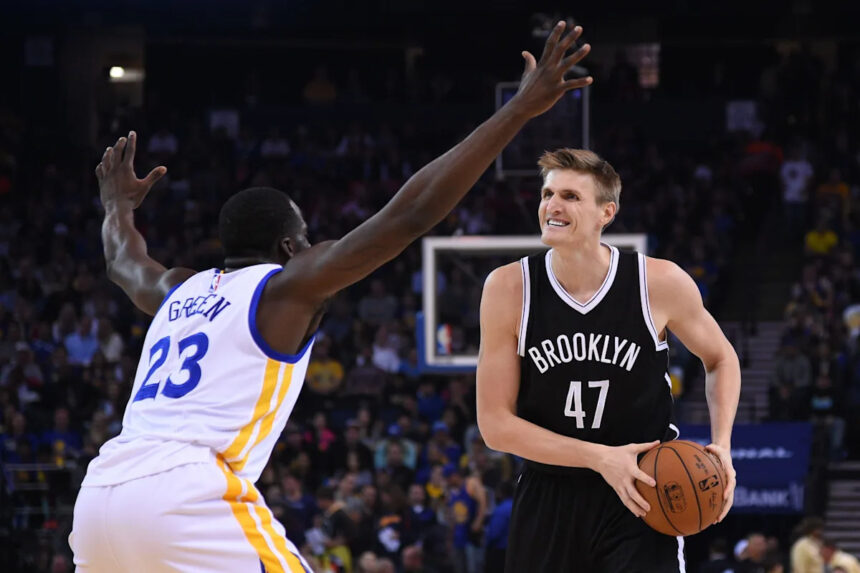
The No. 47 in Brooklyn Nets History: Andrei Kirilenko’s Curious Final Act
In the sprawling tapestry of the Brooklyn Nets franchise—a history woven across the ABA and NBA with over 600 players donning 52 different jersey numbers—certain digits carry more narrative weight than others. The number 47 is not one of the storied ones. It lacks the retired reverence of a No. 5 (Jason Kidd) or the iconic pop culture status of a No. 7. Instead, it is a number of singularity, worn by just one player in the team’s half-century-plus existence. That player was Andrei Kirilenko, the Russian forward whose two-season stint in black and white from 2013 to 2015 remains one of the most intriguing and complex final chapters in modern Nets lore. His tenure, brief and overshadowed by a superteam’s implosion, encapsulates an era of grand ambition and stark reality for the franchise.
From Soviet Prospect to NBA All-Star: The AK-47 Builds His Legacy
To understand Kirilenko’s Nets chapter, one must first appreciate the formidable player he was. Drafted 24th overall in 1999 by the Utah Jazz as a raw 18-year-old from Izhevsk, Russia, Kirilenko became a cult hero and defensive terror. His nickname, “AK-47” (a nod to his initials, birthplace, and jersey number), was a perfect metaphor for his game: versatile, relentless, and impactful on both ends. In Utah, he blossomed into a 2004 All-Star and perhaps the league’s most unique stat-sheet stuffer. He was a defensive savant capable of guarding all five positions, leading the league in blocks in 2005 and earning three All-Defensive Team selections. His offensive game was a blend of sharp cuts, opportunistic finishes, and a surprising playmaking flair. Kirilenko wasn’t just a role player; he was a foundational Swiss Army knife in an era increasingly specializing in specific tools.
After a decade in Utah, a stint in Russia during the 2011 lockout, and a season with the Minnesota Timberwolves, Kirilenko arrived at a crossroads in the 2013 offseason. He was 32, his athletic prime behind him, but his basketball IQ and defensive instincts remained elite. It was at this moment the Brooklyn Nets, under the aggressive ownership of Mikhail Prokhorov, came calling with a pitch that was equal parts basketball and business.
The Brooklyn Gamble: A Discount for a Dream
The summer of 2013 was the zenith of the Nets’ “win-now at all costs” philosophy. The franchise had just acquired future Hall of Famers Paul Pierce and Kevin Garnett to join Deron Williams, Joe Johnson, and Brook Lopez, creating a roster with a staggering $180 million payroll and tax bill. Into this high-pressure crucible stepped Kirilenko, who signed a two-year deal for the taxpayer mid-level exception, starting at just $3.1 million. The contract immediately raised eyebrows across the league. Kirilenko had opted out of a $10 million player option with Minnesota to take this deal, a move that sparked speculation and an eventual NBA investigation (which found no wrongdoing) given Prokhorov’s Russian ties and Kirilenko’s wife’s business connections.
Basketball-wise, it was seen as a masterstroke of value acquisition. On paper, Kirilenko was the perfect complementary piece for a veteran contender: a defensive stopper who could cover for older legs, a smart cutter who didn’t need plays called for him, and a versatile forward who allowed for endless lineup flexibility. He was the ultimate luxury for a team aiming for a championship. His choice of the uncommon No. 47 in Brooklyn—a departure from his famous 47 in Utah, which was retired for him in 2016—felt like a symbolic fresh start for the final act of his career.
Key Expectations for Kirilenko with the 2013-14 Nets:
- Defensive Versatility: Use his length and IQ to guard elite wings and provide weak-side help.
- Glue Guy Role: Energize the second unit with hustle, passing, and intelligent off-ball movement.
- Championship Experience: Provide a steady, professional presence in a high-expectation locker room.
- Injury Insurance: Offer reliable minutes as Pierce and Garnett managed their regular-season workload.
A Chapter Defined by What Could Have Been
Kirilenko’s Nets tenure, unfortunately, became a metaphor for the entire superteam experiment: promising on paper, derailed by reality. Persistent back spasms limited him to just 45 games in his first season. While he showed flashes of his old self—his defensive activity was palpable, and his 2.1 steals per 36 minutes that season was a career-high—he could never find a consistent rhythm or role in a disjointed team that never clicked. The Nets, after a dismal start, rallied for a playoff berth but were a team of moments, not momentum.
When he was on the court, his value was evident. He wasn’t the shot-blocking force of his Utah days, but his defensive intelligence and length disrupted passing lanes and allowed the Nets to switch seamlessly. Offensively, he was a connector, making the extra pass and moving without the ball. But the narrative was dominated by his contract, his injuries, and the team’s underwhelming performance. The dream of a championship dissolved in a second-round playoff loss to the Miami Heat, a series where Kirilenko, still hampered, played limited minutes.
The 2014-15 season was an even sadder epilogue. With Pierce gone and the team in decline, Kirilenko appeared in just seven games before being sidelined and ultimately agreeing to a contract buyout in February 2015. His Nets career ended not with a bang, but with a quiet negotiation. He retired from the NBA thereafter, leaving the No. 47 jersey as a solitary, curious entry in the franchise’s media guide.
Legacy of the Lone No. 47: A “What If” Jersey
Andrei Kirilenko’s No. 47 with the Brooklyn Nets is not a jersey that will be hung from the Barclays Center rafters. Statistically, his contributions were minimal: 4.4 points, 3.2 rebounds, and 1.1 steals per game over 65 total appearances. Yet, its significance is historical and symbolic. It represents a specific, fever-dream era of Nets basketball—a time of Russian ownership, astronomical spending, and star-chasing that aimed for the stars but fell painfully short.
Kirilenko was the canary in the coal mine for that project. His signing, hailed as a savvy coup, became entangled in controversy. His intended role as the versatile lynchpin was undermined by the aging roster’s inflexibility and his own body’s betrayal. The jersey stands as a reminder that even the most perfectly conceived role player acquisitions are futile if the foundational stars don’t align, both in health and in harmony.
For collectors and historians, the Kirilenko Nets jersey is a rare artifact. It is the only No. 47 ever issued by the franchise, a number forever tied to a unique player’s curious final NBA stop. It bridges the gap between the hard-nosed, fundamental basketball of his Utah prime and the glossy, high-stakes spectacle of the Prokhorov-era Nets.
Conclusion: The Final Echo of AK-47
In the grand, chaotic history of the Brooklyn Nets, Andrei Kirilenko’s two-year stint is a fascinating footnote. His No. 47 is not a symbol of triumph, but of transition and tempered expectations. It marks the end of a distinguished career for one of international basketball’s most influential pioneers and the end of a specific, reckless ambition for a franchise. While the Nets’ superteam experiment is often remembered for its marquee names like Garnett and Pierce, the story of Kirilenko—the discount superstar who arrived with perfect timing only to find a team out of sync—is perhaps more telling. The jersey remains a single-thread in the franchise’s vast quilt, a quiet testament to a plan that looked brilliant in July but unraveled by the following spring, and to a player whose true impact in Brooklyn will always be measured in what he was brought in to do, rather than what circumstances ultimately allowed him to achieve.
Source: Based on news from Yahoo Sports.