Olympic Dreams Derailed: Mark McMorris Exits Big Air After Devastating Practice Crash
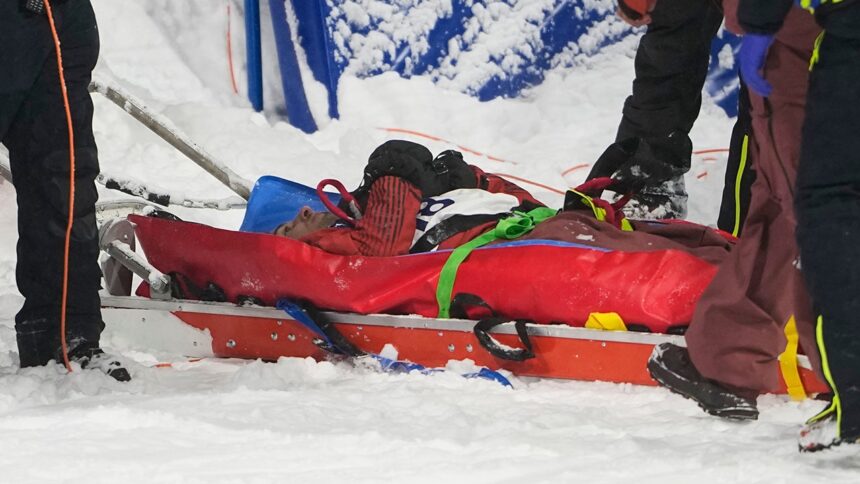
The thin air of Livigno, Italy, was pierced not by the triumphant shouts of a landed trick, but by the chilling silence that follows a hard crash. In a moment that reshaped the snowboard big air competition at the 2026 Milan Cortina Winter Olympics, Canadian legend Mark McMorris, a gold medal favorite, saw his campaign end before it could officially begin. The three-time Olympic medalist suffered a severe crash during a training session on Wednesday, February 4th, resulting in a stretcher evacuation and a brief hospital visit, forcing his withdrawal from the event. This shocking turn of events casts a shadow over the games and ignites a poignant conversation about the razor-thin line between peak performance and peril in elite action sports.
The Crash That Silenced a Nation
The scene on the training slope was one of stark contrast. Against the backdrop of the majestic Italian Alps, where athletes strive for flight, the sight of medical personnel carefully loading a motionless Mark McMorris onto a stretcher served as a sobering reminder of the sport’s inherent dangers. Witnesses described the crash as a high-impact landing following an ambitious trick attempt. The force of the spill was significant enough to require immediate, cautious extraction from the course.
McMorris, who claimed big air gold at the 2021 World Championships and boasts a career decorated with X Games medals and Olympic hardware, was widely seen as a central figure in the event’s narrative. His absence doesn’t just remove a top contender; it alters the entire dynamic of the competition. The Canadian team confirmed his withdrawal later that day, stating the athlete was “alert and receiving excellent care” but would be unable to compete. The specific nature of his injuries has not been fully disclosed, but the protocol indicated a serious concern.
The Agony of the “What If”: Mental Fortitude vs. Physical Reality
McMorris’s devastating crash arrives amidst a parallel storyline of Olympic resilience involving another winter sports icon: skier Lindsey Vonn. The three-time Olympic medalist recently revealed her audacious plan to attempt a comeback to the Olympic stage despite having ruptured her ACL. This bold proposition prompts expert analysis on the limits of the human body and spirit in high-stakes sports.
Sports medicine expert Dr. Rick Lehman provided context, assessing such a scenario. “An ACL rupture is a significant structural injury. The timeline for return to high-level pivoting and impact sports is typically 9-12 months, and that’s with optimal healing and rehabilitation,” Dr. Lehman noted. “Competing at the Olympic level with a recent rupture would involve extraordinary risk—not just of re-injury, but of compensatory injuries to other parts of the knee or leg due to altered mechanics.”
However, Dr. Lehman also highlighted the intangible factor. “Athletes like Vonn, and McMorris for that matter, possess a mental toughness that is off the charts. Their ability to compartmentalize pain and fear is what makes them champions. The decision often comes down to risk tolerance. Is the chance at Olympic glory worth the potential for long-term joint health consequences?” This exact calculus of risk is what every action sport athlete makes on every jump, a reality thrown into brutal focus by McMorris’s accident.
Analyzing the Impact: Sport, Safety, and the Future
The immediate repercussions of McMorris’s crash are multi-layered:
- Competitive Void: The big air podium is now wide open. Rivals who may have mentally prepared to beat the best must now recalibrate, while the event loses one of its most progressive and stylish riders.
- Team Canada’s Morale: As a veteran leader and medal anchor, McMorris’s absence is a profound emotional and strategic blow to the Canadian squad.
- Safety Protocols in Spotlight: Every crash of this magnitude prompts review. Questions will be asked about course conditions, jump design, and the ever-evolving protective equipment available to athletes who consistently push the envelope of physics.
This incident also forces a broader reflection on the evolution of snowboarding. As tricks become more complex—involving multiple rotations and dizzying axes—the kinetic forces upon a failed landing grow exponentially. The sport’s governing bodies and engineers walk a constant tightrope, designing courses that allow for progression while minimizing catastrophic risk. Athletes, meanwhile, walk their own tightrope every time they drop in.
Looking Ahead: Recovery and Legacy
For Mark McMorris, the path forward is one of recovery. His career has already been a testament to resilience, most famously his remarkable comeback from a life-threatening crash in 2017. This Olympic setback, while heartbreaking, is a chapter in a story defined by overcoming adversity.
Predictions for his future are necessarily cautious but lean optimistic based on his history. The snowboarding community will eagerly watch for updates on his health and his spirit. Will this fuel a drive for the 2030 Games, or will it prompt a philosophical shift? Only time will tell.
For the 2026 Olympic big air competition, a new champion will be crowned in Livigno. They will stand atop the podium, their journey realized. Yet, the shadow of the “what could have been” with McMorris in the mix will linger. His crash is a stark, unwelcome plot twist in these Games, a reminder that behind the thrilling spectacle of soaring snowboarders lies a foundation of immense courage and accepted risk.
The pursuit of Olympic glory is often framed as a battle against competitors. In truth, it is a constant negotiation with gravity, with one’s own limits, and with fate. Mark McMorris’s withdrawal is a somber lesson in that reality. As the big air event continues, the riders will undoubtedly charge in his honor, pushing the boundaries he helped expand. Their flights, however, will be undertaken with a renewed, silent awareness of the fine line they all walk—between aerial grace and a hard, unforgiving stop on the snow below.
Source: Based on news from Fox Sports.