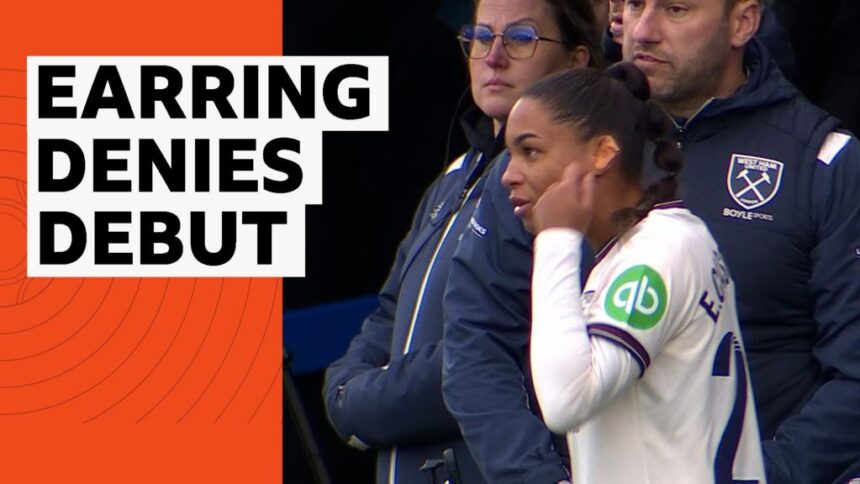
Earring-Gate: Estelle Cascarino’s Bizarre WSL Debut Denial Sparks Safety vs. Sanity Debate
The theatre of football is built on moments of high drama: last-minute winners, contentious red cards, and heroic saves. Rarely, however, does the pivotal scene involve a piece of jewelry. For West Ham United’s new signing, French international Estelle Cascarino, her long-awaited Women’s Super League debut this past weekend was thwarted not by injury, form, or tactical nuance, but by a stud in her ear. This surreal administrative hiccup has ignited a fiery debate across the women’s game, questioning the balance between unwavering safety protocols and common-sense pragmatism.
The Incident: A Debut Delayed by Diameter
As West Ham prepared to face Everton, manager Rehanne Skinner included summer acquisition Estelle Cascarino in the matchday squad. The 26-year-old defender, arriving from Manchester United, was poised for her first competitive minutes in claret and blue. However, as captured in post-match discussions by pundits Nia Jones and Fara Williams on the Women’s Football Show, the moment unraveled at the last possible second.
Cascarino, reportedly wearing a small stud earring, was denied entry onto the pitch by the match officials. The reason was a steadfast adherence to the International Football Association Board (IFAB) Law 4, which states: “All items of jewelry (necklaces, rings, bracelets, earrings, leather bands, rubber bands, etc.) are forbidden and must be removed.” Despite appeals from the West Ham staff, the officials held firm. Cascarino’s debut was shelved, leaving the player, the team, and fans in a state of bewildered frustration.
This content, as highlighted in the key facts, is a talking point dominating analysis segments, underscoring its significance beyond a mere team selection note.
Expert Analysis: The Rule, The Risk, and The Reality
The analysis from former players like Nia Jones and Fara Williams is crucial here. They bring a practitioner’s lens to a bureaucratic dilemma. The rule itself is not new and is rooted in player safety. The risks are tangible:
- Laceration Hazards: Earrings can be torn out, causing severe injury to the earlobe or becoming a projectile.
- Snagging Danger: During aerial duels or tussles, jewelry can catch on an opponent’s kit or equipment.
- Uniformity of Application: The rule must be applied equally to prevent any ambiguity or claims of preferential treatment.
However, the expert critique centers on proportionality and preparation. Williams and Jones likely pointed to the pre-match inspection protocol. Why was this not identified and resolved in the tunnel or dressing room before the teamsheet was finalized? The last-minute nature of the decision suggests a systemic failure in communication between officials and team staff.
Furthermore, the debate ventures into the realm of modern body modifications. As Jones alluded to in discussion, the world of sports medicine has solutions. The use of hypoallergenic tape to securely cover a stud is a common, IFAB-sanctioned workaround for players with newly pierced ears that cannot be removed without the hole closing. Was this option explored and dismissed, or was it a case of zero-tolerance inflexibility?
A Deeper Issue: Perception and Professionalism in the WSL
This incident, while seemingly minor, touches on deeper nerves within the women’s game. The WSL has fought tirelessly for recognition, professional standards, and respect. Adherence to the laws of the game is a part of that professionalism. Yet, there’s a concurrent fear of the narrative.
Does “Earring-Gate” inadvertently feed a diminishing, pedantic narrative about the women’s game, distracting from the quality of football? Or does a firm, uniform application of the rules, regardless of timing or stature, reinforce its serious, professional stature? The optics are delicate. For Cascarino, a seasoned professional, it becomes an absurd introduction to her new league. For the officials, it’s a strict interpretation of their mandate.
The key learning outcome for clubs must be heightened diligence. Sports scientists and equipment managers will now double and triple-check every player for any potential infraction before they leave the dressing room, treating jewelry checks with the same gravity as shin pad inspections.
Predictions: Ripple Effects and Future Protocols
The fallout from this event will be immediate and procedural. We predict the following developments:
- League-Wide Memorandums: The FA WSL is likely to issue a clarification to all clubs, reminding them of Law 4 and emphasizing that player preparedness is a club responsibility.
- Enhanced Pre-Match Checks: Expect a more formal, documented check by a designated official or the fourth official in the tunnel, similar to the glove and shin pad check, to avoid last-minute surprises.
- Player Education Focus: Clubs will internally reinforce the rules with players, especially new signings or younger players transitioning from academy levels where oversight may differ.
- No Rule Change, But a Softer Application: The core rule will not change—safety is paramount. However, we may see a more collaborative approach where officials and team medics work together on acceptable taping methods *before* kickoff, preventing a capable player from being sidelined.
For Cascarino and West Ham, the focus will swiftly shift to next weekend. Her debut, now laden with this strange backstory, will arrive with even more anticipation. One can bet her ears will be conspicuously bare, and her performance will be the only topic of discussion post-match.
Conclusion: Safety First, But Sanity a Close Second
Estelle Cascarino’s denied debut is a modern football fable. It underscores that in an era of multi-million-pound transfers and global broadcasts, the game can still be halted by the smallest of details. The safety rationale behind Law 4 is unassailable and must remain sacrosanct. Player welfare is non-negotiable.
However, this incident highlights a critical need for improved processes and pragmatic solutions within the framework of the rules. As experts like Fara Williams and Nia Jones have emphasized, professionalism cuts both ways: it requires players to be ready and officials to manage situations with foresight. The hope is that this bizarre moment serves as a catalyst for clearer protocols, ensuring that future dramas are reserved for the actions of feet and heads, not for the accessories worn upon them. The WSL’s growth deserves headlines for its football, not its jewelry disputes, and a swift, sensible resolution will ensure that remains the case.
Source: Based on news from BBC Sport.