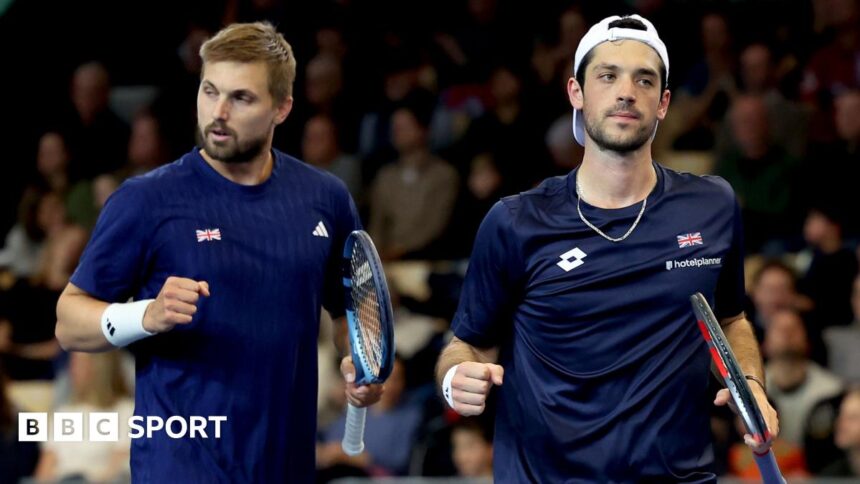
Cash & Glasspool Weather Oslo Storm to Secure Davis Cup Progress for Great Britain
In the echoing, intimate cavern of the Oslo Tennis Arena, the weight of expectation can sometimes feel heavier than any grand slam pressure. For Great Britain’s doubles specialists, Julian Cash and Lloyd Glasspool—a pair forged in a breakout 2025 season—their Davis Cup qualifying tie against Norway was supposed to be a straightforward stepping stone. Instead, it became a nerve-shredding masterclass in resilience, a reminder that national pride can transform underdogs into giants, and that composure is the ultimate championship currency. Surviving a monumental scare, Cash and Glasspool eventually triumphed 6-2, 2-6, 7-6(5) to seal an unassailable 3-0 lead for GB, booking their place in the final qualifying round and proving their partnership is built on more than just raw talent.
From Routine to Rumble: The Oslo Plot Twist
On paper, this was a mismatch of staggering proportions. Julian Cash and Lloyd Glasspool, fresh from their Wimbledon triumph and riding a wave of confidence, faced Norway’s Viktor Durasovic and Nicolai Budkov Kjaer—a makeshift duo with combined experience paling in comparison to the British pair’s sterling reputation. The first set went entirely to script. Cash’s razor-sharp net play and Glasspool’s thunderous serving dictated terms, breaking the Norwegian resolve twice to canter to a 6-2 lead. The path to a routine victory seemed clear and well-lit.
Then, the plot twisted. Unleashed by the fervent home support and with nothing to lose, Durasovic and Budkov Kjaer began to play the match of their lives. The Norwegian pair’s strategy shifted perceptibly:
- Aggressive returning: They began to read the Glasspool serve, taking it early and targeting the feet of the advancing Cash.
- Flawless execution: Their unorthodox play, featuring daring lobs and angled volleys, completely disrupted the GB rhythm.
- Capitalizing on tension: As errors crept into the British game, the Norwegians grew in belief, breaking serve twice to level the match.
The British duo, so fluid earlier, appeared momentarily paralysed by the sudden shift in momentum. The 2-6 second set loss was not just a setback; it was a full-blown crisis in the context of a Davis Cup rubber.
The Tie-Break Crucible: Where Experience Told
The deciding set was a tense, edgy affair, with service holds becoming monumental tasks. The Norwegian duo, ranked 491st and 1,187th in doubles respectively, continued to defy logic, matching their celebrated opponents shot for shot. The pressure within the arena was palpable, every point met with roars or gasps. For Cash and Glasspool, this was the ultimate test of their partnership’s maturity—a test not of skill, but of nerve.
Failing to convert break points, they were forced into the lottery of a championship tie-break. Here, the experience of their 2025 season became invaluable. In the high-stakes cauldron, their big-match temperament finally edged ahead.
- Cash’s Net Dominance: At 4-4 in the breaker, Cash poached decisively, cutting off a cross-court attempt with a volley winner that shifted the mini-break advantage.
- Glasspool’s Serving Clutch: Facing down match point at 6-5, Glasspool delivered a unreturnable serve down the T, a moment of pure technical execution under extreme duress.
The 7-5 tie-break victory was less a celebration and more a profound relief. They had stared into the abyss of a shocking defeat and found a way to win ugly—a hallmark of all great teams.
Expert Analysis: What This Scare Means for GB’s Davis Cup Hopes
While the 3-0 scoreline suggests dominance, this doubles rubber revealed crucial insights for British captain, Leon Smith. The victory is a significant positive, but the journey there exposed areas for growth.
The Positives: The partnership’s resilience is now proven. Winning when not playing your best is a critical skill in team competition. Furthermore, handling hostile Davis Cup atmospheres is unique, and this trial by fire in Oslo will harden them for future away ties. Their ability to reset after a disastrous second set and compete in the clutch moments underscores their champion mentality.
The Concerns: There was a noticeable dip in intensity and tactical flexibility after the first set. The Norwegians’ tactical adjustment—targeting the middle and exploiting the Brits’ movement—went unanswered for too long. Against a more established doubles pair in the next round, such a lapse could be fatal. It also highlights the pressure of being heavy favourites, a psychological hurdle they must manage more effectively moving forward.
Looking Ahead: Predictions for the Final Qualifying Round
With this hurdle cleared, Great Britain advances to the 2025 Davis Cup Finals Qualifying Round, where they will likely face a far sterner test, potentially against a seeded nation. The performance in Oslo provides a clear roadmap.
First, the Cash-Glasspool partnership remains the cornerstone of the British team’s doubles strategy. Their chemistry and big-game pedigree are undeniable assets. However, this scare will serve as a vital wake-up call. Expect them to return with a sharper, more adaptable game plan, respecting every opponent regardless of ranking.
Second, this tie reaffirmed the importance of strong singles performances—which GB achieved through Jack Draper and Cameron Norrie—to build a cushion. In the next round, that cushion may be essential. The team will need to be bulletproof from the first ball, as the margin for error shrinks dramatically against the world’s best.
Conclusion: A Win Forged in Grit
Great Britain’s victory over Norway will be recorded in the history books as a 3-0 win. But the story, the one that matters for the future, was written in the tense, thrilling 98 minutes of that doubles rubber. Julian Cash and Lloyd Glasspool avoided a scare of seismic proportions not with flawless tennis, but with grit, experience, and cold-blooded execution when it mattered most. For a nation with rich Davis Cup history, these are the wins that build character. They were reminded that the Davis Cup spirit can elevate any opponent, but in the end, their own quality and resolve saw them through. This was not a day for pretty tennis; it was a day for winning tennis. And as they look towards the final qualifying round, that hard-earned lesson may prove to be their most valuable asset.
Source: Based on news from BBC Sport.