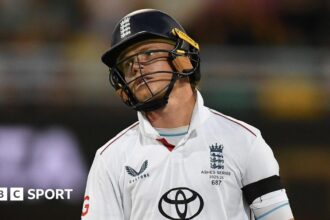
Chaotic Pope Innings Epitomizes England’s Batting Malaise in Adelaide
The Ashes, cricket’s oldest rivalry, is often decided not by a single moment of brilliance but by the accumulation of small, self-inflicted wounds. On a pivotal day two in Adelaide, England’s batting order did not so much walk to the crease as march onto a collective rake. And at the vanguard of this painful, repetitive slapstick was Ollie Pope, whose frenetic, 10-ball stay perfectly crystallized the confusion at the heart of England’s failing philosophy. As Sky Sports’ Nasser Hussain termed it, a “chaotic” innings that set a tone of reckless abandon, ultimately leading to another crushing batting failure and ceding vital ground to a ruthless Australian side.
The Anatomy of Chaos: Pope’s 10-Ball Parable
To understand England’s day, one must dissect Pope’s brief parable of an innings. Promoted to the critical number three spot, his role was clear: stabilize, support his captain, and build a foundation. What transpired was the antithesis. Facing Mitchell Starc, Pope’s first scoring shot was an uppish flick through mid-wicket—a harbinger of the edginess to come. He then survived a dropped chance, a moment that should have granted a life and a lesson in caution. Instead, it seemed to accelerate the panic.
His dismissal was a masterpiece of poor decision-making. Facing Nathan Lyon’s first ball of a new spell, Pope charged down the wicket, not to smother the spin, but to launch an aggressive, cross-batted hoick across the line. He was beaten in the flight, the ball spinning past his edge, leaving Alex Carey with a simple stumping. It was a shot devoid of situational awareness, technical discipline, or logical purpose. It was, in a word, chaotic.
Nasser Hussain’s analysis cut to the core: “That was a chaotic little innings from Pope… It set the tone for the rest of the innings.” This wasn’t just criticism of a young batter; it was an indictment of the environment that fosters such an approach under immense pressure.
A Domino Effect of Dismissals: Tone Becomes Reality
As Hussain predicted, Pope’s chaos proved contagious. The tone was not just set; it was amplified. What followed was a procession of England batters seemingly compelled to match the disorder, as if a calm, constructed Test match innings had become an alien concept.
- Joe Root’s Frustration: The world-class captain, shouldering the burden of the entire lineup, fell attempting a forceful drive off Cameron Green, a shot born of the mounting pressure and lack of partners at the other end.
- Ben Stokes’ Misjudgment: The hero of Headingley played an uncharacteristically loose drive to a wide delivery from Starc, a rush of blood mirroring the team’s collective impatience.
- Jos Buttler’s Aborted Attack: Even the normally fluent Buttler seemed caught between minds, unable to impose his counter-attacking game or dig in, eventually falling to the persistent Lyon.
Each dismissal shared a common thread: a batting failure rooted in a lack of game-awareness and an inability to adapt to the match situation. Australia’s bowlers, expertly led by Pat Cummins, simply had to wait and execute their disciplined plans, knowing the errors would come. The England collapse was not forced; it was volunteered.
Philosophy vs. Reality: The Root of the Problem
This repeated batting failure forces a harsh examination of England’s much-discussed approach. The intent to be positive is not inherently flawed, but its dogmatic application becomes a fatal weakness when it divorces itself from context. Test cricket, especially in an Ashes series in Australia, is a war of attrition. It demands a dual mindset: the resilience to absorb pressure and the clarity to capitalize when the opportunity arises.
England currently possesses only the latter, and even that is misfiring. Pope’s dismissal against Lyon was not positive intent; it was reckless disregard. The Ashes 2023-24 campaign is revealing a stark truth: a philosophy is only as good as the technical skill and temperamental fortitude of the players executing it. When under the cosh, England’s batting lacks a defensive gear, a “floor” to their performance. They are all ceiling, and when that ceiling cracks, the collapse is total.
This top-order fragility places an unsustainable burden on Joe Root and a still-recovering Ben Stokes. The middle and lower order, however spirited, are consistently asked to rescue rather than reinforce.
The Road Ahead: Predictions and the Need for a Reset
With the series poised and England’s batting in disarray, the path forward looks treacherous. The pink-ball Test in Adelaide, with its challenging twilight period, has already exposed these flaws. The remaining Tests will offer different but equally stern examinations.
Predictions for the remainder of the series are bleak unless immediate change occurs. Australia now possesses not just a lead, but a profound psychological edge. They have seen the blueprint to England’s undoing: apply scoreboard pressure, bowl with discipline, and wait. England’s batters seem programmed to play into their hands.
For England to salvage pride or even dream of retaining the urn, a tactical reset is non-negotiable. This does not mean abandoning aggression, but layering it with smart cricket and game management. It means players like Pope must be empowered to play the situation, not a caricature of “the brand.” The leadership group must foster an environment where a gritty, 30-ball defensive innings is valued as highly as a flamboyant fifty.
Conclusion: More Than Just an Innings
Ollie Pope’s 10-ball chaos will be logged in the scorebook as a mere 5 runs. But its significance is monumental. It was a microcosm of England’s Ashes journey so far: brimming with intent but starved of wisdom, aggressive in motion but fragile in foundation. It highlighted a systemic issue within the batting unit that transcends individual talent.
As the shadows lengthened over the Adelaide Oval, England’s hopes of a first-innings fightback had evaporated, not in a blaze of Australian glory, but in a fog of their own making. The Ashes 2023-24 may well be remembered for many things, but for England, the defining image could be that of a young batter, charging headlong into the void, setting a tone from which there was no return. Until they learn to temper their chaos with control, their batting failures will remain a predictable, and deeply disappointing, refrain.
Source: Based on news from Sky Sports.