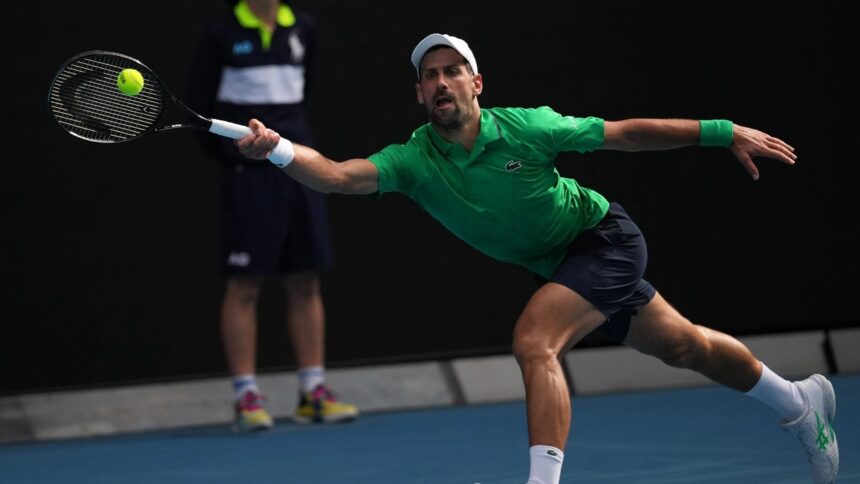
Chasing Sincaraz? Novak Djokovic’s Fiery Australian Open Retort Exposes Tennis’ Generational Tension
The air in the Rod Laver Arena press conference room, usually thick with the scent of sweat and accomplishment, turned suddenly electric with a different energy: defiance. Novak Djokovic, having just secured a bittersweet passage to the 2026 Australian Open semi-finals after Lorenzo Musetti’s injury retirement, fixed a steely gaze upon a reporter. The question posed—how did it feel to be chasing Jannik Sinner and Carlos Alcaraz—was not met with statistical nuance or polite deference. It was met with the full force of a champion’s pride, a moment that laid bare the complex, often uncomfortable, narrative shift gripping men’s tennis.
A Question of Respect: Djokovic Draws a Line in the Sand
On Wednesday, January 28, 2026, Novak Djokovic’s path to a record-extending 13th Australian Open final was cleared, though not in the manner he would have wished. Leading by two sets, the talented Italian Lorenzo Musetti was forced to retire, sending Djokovic through. Yet, the post-match interrogation proved more challenging than the match itself. When a journalist framed Djokovic’s current position as one of pursuit behind the “Sincaraz” duo—the portmanteau encapsulating the era of Sinner and Alcaraz—the 38-year-old’s response was immediate and pointed.
He acknowledged Sinner and Alcaraz as “the top dogs at the moment,” a gracious nod to their recent dominance. But the notion of “chasing” was a bridge too far. Djokovic perceived the query as disrespectful, not merely to his present form, but to the colossal legacy he has built over nearly two decades. This was not just a player defending a bad day; this was an all-time great rejecting the premature writing of his sporting obituary.
“I have been in this game long enough to know that narratives shift with every tournament,” Djokovic stated, his tone a blend of irritation and authority. “To speak of chasing anyone dismisses the 15 years where I was the one being chased. It dismisses the work it took to get here, now, at this stage of my career.”
Legacy vs. The Present: The Unforgiving Tennis Timeline
Djokovic’s irritation is a symptom of a larger sports media phenomenon: the relentless pivot to “what’s next.” In focusing on the vibrant, thrilling rivalry of Sinner and Alcaraz, who have split the last several majors, the context of Djokovic’s unprecedented longevity is often compressed. His retort was a forceful reminder of that context.
Consider the sheer scale of the achievement he referenced:
- 24 Grand Slam titles, a record he still holds.
- Over 400 weeks at World No. 1, a feat that may never be matched.
- A 15-year period of consistent dominance, facing and overcoming two other generational talents in Federer and Nadal.
- A record 10 Australian Open titles won prior to this 2026 campaign.
For Djokovic, sitting in a Grand Slam semi-final—his 49th—the framing of his journey as a chase is a fundamental misreading of his career arc. He is not an upstart; he is the benchmark. His presence in the latter stages of majors, even as his physical prime recedes, is a testament to a mastery of sport science, mental fortitude, and tactical evolution that the tour has never seen. To reduce that to a supporting role in the Sincaraz narrative feels, in his view, like a profound disrespect towards his achievements.
Expert Analysis: The Psychology of a Champion in Transition
Sports psychologists often note that for legendary athletes, the final stage of a career is the most psychologically complex. The external world begins to tell a story of decline, while the internal competitive fire burns as fiercely as ever. Djokovic’s press conference moment is a textbook case.
“What we witnessed was not simply anger, but a reassertion of identity,” explains Dr. Anya Petrova, a performance psychologist who has worked with elite athletes. “Djokovic has built his entire persona on being the hunter, the disruptor, the one who overcomes. The ‘chasing’ framing flips that script entirely, placing him in a reactive, subordinate position. His pushback was an instinctive defense of the champion mindset that has brought him this far. He is negotiating his place in a new hierarchy without conceding the throne of his own legacy.”
This incident also highlights the media’s tricky role. While tracking the rise of Sinner and Alcaraz is valid and exciting, the question exposed a lack of finesse in navigating a legend’s twilight. The generational tension in tennis is real, but it is a dialogue between equals in accomplishment, not a simple handover of power. Djokovic’s message was clear: measure me against my entire body of work, not just the last two seasons.
Predictions: What Djokovic’s Fire Means for the Semi-Final and Beyond
History shows that a provoked Novak Djokovic is a dangerous Novak Djokovic. This public display of pride is unlikely to weaken his resolve; if anything, it weaponizes it. As he prepares for his semi-final, he carries not just the ambition for another title, but the weight of a corrected narrative.
- Immediate Impact: Expect a hyper-focused, intensely motivated Djokovic in the semi-final. He will use any perceived slight as fuel, channeling that energy into his preparation and on-court intensity.
- The Sincaraz Dynamic: Should he advance to a potential final against either Sinner or Alcaraz, the storyline is now supercharged. It will no longer be a simple “old vs. new” tale, but a clash framed by Djokovic’s explicit rejection of that very narrative. The psychological edge becomes a central battleground.
- Long-Term Legacy: This moment will be seen as a key pivot in how Djokovic’s late career is perceived. It signals his unwavering belief that he remains a central actor, not a supporting one. Whether he wins this title or not, he has forcefully stated that his era is not over until he decides it is.
Conclusion: The Unchased Champion Writes His Own Ending
The brief, tense exchange in Melbourne was more than a headline-grabbing soundbite. It was a manifesto. Novak Djokovic, perhaps the greatest competitor tennis has ever seen, issued a stern reminder that his story is still being written, on his own terms. While the dazzling games of Jannik Sinner and Carlos Alcaraz rightly command the spotlight for defining the future, the past and present remain powerfully embodied by the man they must still conquer.
To speak of chasing is to misunderstand the journey. Djokovic is not chasing Sincaraz; he is chasing history, chasing the limits of his own longevity, and chasing the right to define the conclusion of his own epic saga. The reporter’s question may have been about the new order, but Djokovic’s answer was a thunderous declaration that the old king, irked and ignited, still very much resides in his castle. The Australian Open semi-finals just became a stage for legacy defense, and the tennis world should adjust its lenses accordingly.
Source: Based on news from India Today Sport.