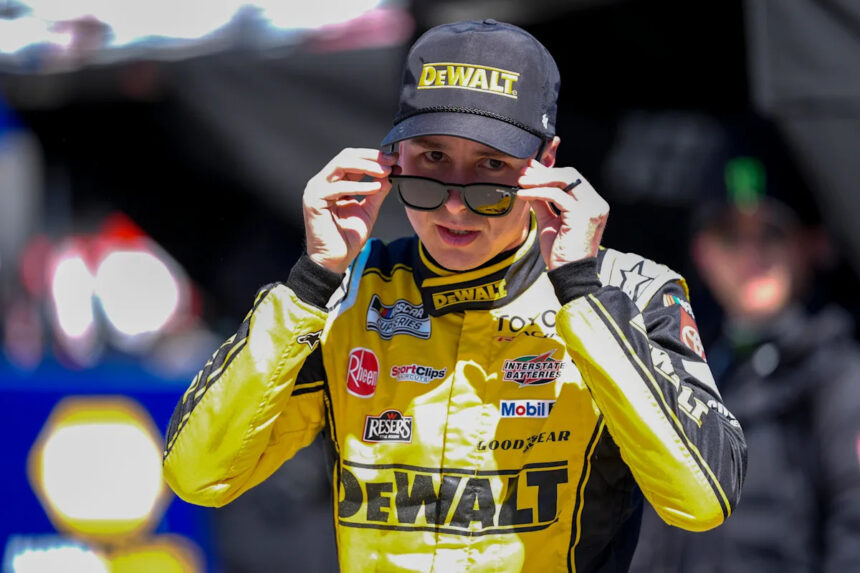
Christopher Bell’s Gritty Martinsville Recovery Signals Progress for 2026 Season
The essence of a championship-caliber driver isn’t defined by flawless dominance, but by the ability to salvage a result from the brink of disaster. At Martinsville Speedway in March 2026, Christopher Bell authored a textbook chapter in resilience. What began as a Sunday struggle on the Virginia paperclip transformed into a testament to teamwork and tenacity, culminating in a hard-fought seventh-place finish that felt more significant than the stat sheet might suggest. For Bell and the No. 20 Joe Gibbs Racing team, this wasn’t just a top-ten; it was a declaration of growth at a track that has historically been a thorn in their side.
From Struggle to Strategy: The No. 20 Team’s Mid-Race Rebound
The opening stages of the Martinsville race were far from ideal for Bell. Mired deep in the field, the handling of his Toyota Camry was a handful, lacking the forward bite and rotational speed needed to attack the tight corners of the famed short track. In a race where track position is king, falling behind early can often spell a long, frustrating afternoon. However, the hallmark of elite organizations like Joe Gibbs Racing is their capacity for in-race adaptation.
Bell’s crew chief, a pivotal yet unnamed strategist in this comeback, began orchestrating a series of critical adjustments during pit stops. Each visit to pit road was an opportunity to chip away at the car’s deficiencies. Through air pressure changes, track bar adjustments, and wedge tweaks, the No. 20 slowly evolved from a backmarker into a contender. Bell’s post-race comments highlighted this critical transformation. “I was super happy with the adjustments on our Camry,” Bell stated, emphasizing the collaborative effort. “We got more competitive throughout the race – the beginning part of the race was a really big struggle.” This mid-race metamorphosis is a core strength Bell will lean on as the 2026 season progresses.
Bell’s Candid Assessment: A Top-Five Car at Its Peak
True competitors are never fully satisfied, and Bell’s analysis of his Martinsville run was a balanced mix of appreciation and ambition. He acknowledged the quality of the final result while seeing the clear potential that slipped away in the final stint. His post-race reflections provide a fascinating glimpse into a driver’s real-time learning process on one of NASCAR’s most technical circuits.
“Overall, I’m happy. We ran seventh. I would obviously love more, but it was a competitive Martinsville race for us,” Bell said. He then pinpointed the car’s peak performance window: “When we were at our best, I felt like we were in the top-five for sure.” This admission is crucial; it confirms the team’s setup and adjustments ultimately hit the mark. The final run fade, however, offered its own lesson. “We just got a little bit worse in the last run, but I did a lot of learning today and will hopefully be better next time.” This focus on continuous improvement, even after a solid finish, is what separates good teams from great ones.
Conquering the Demons: Why Seventh at Martinsville Matters More
To fully appreciate Bell’s Martinsville result, one must understand his historical challenges at the track. For Bell, Martinsville, along with Darlington Raceway, has represented a notable hurdle in his otherwise impressive Cup Series career. A review of his past performances reveals finishes outside the top 15 more often than not at the .526-mile oval. Therefore, navigating a problematic start to secure a seventh-place finish isn’t merely a good day—it’s a breakthrough.
This performance is particularly significant within the 2026 schedule context. As one observer noted, Bell likely won’t have a tougher two-track stretch throughout the rest of the 2026 NASCAR season than the combination of Darlington and Martinsville. To emerge from this gauntlet with a strong top-ten at his statistical weak link provides immense psychological momentum. It proves that the team’s off-season work and simulation data are translating to real-world performance where it matters most. Key takeaways from this milestone run include:
- Overcoming Early Adversity: Proving the team can fix a ill-handling car during the race, a critical skill for playoff events.
- Short Track Progress: Demonstrating tangible improvement at a track type that is essential for championship success.
- Mental Fortitude: Shaking off a poor start to focus on methodically climbing through the field, a sign of veteran maturity.
- Data Collection: Bell’s “lot of learning” comment indicates gathered insights that will be invaluable for the fall Martinsville playoff race.
Looking Ahead: Bristol and the 2026 Championship Picture
With the Martinsville challenge successfully navigated, the circuit now turns to a venue where Christopher Bell has proven to be a master: Bristol Motor Speedway. Bell is a previous winner on the high-banked concrete bullring, and his fall performance there last season was dominant. The shift from the flat, brake-heavy Martinsville to the high-speed, tire-management chaos of Bristol plays directly into Bell’s diverse skill set.
The momentum from a gritty top-ten at a tough track can fuel a team’s confidence. For Bell, Bristol represents a prime opportunity to convert this positive direction into a statement victory. A strong run there would firmly establish the No. 20 team as a consistent threat across all track types, a necessity for any driver eyeing the 2026 Cup Series title. Furthermore, within the Joe Gibbs Racing stable, performances like Martinsville keep the internal competition fierce. While teammates may have had stronger results on that particular day, Bell’s ability to maximize a difficult situation is a championship trait that doesn’t go unnoticed.
A Foundation Built on Resilience
Christopher Bell’s 2026 Martinsville tale is not one of victory lane celebrations, but of something perhaps more foundational: proven progress. In a sport where weaknesses are exploited mercilessly, Bell and his team confronted a historical challenge head-on, refused to settle for a mediocre finish, and clawed their way to a result that could pay dividends in October. This seventh-place finish serves as a powerful data point in Bell’s evolution from a driver of flashes of brilliance to a consistent, week-in, week-out threat. As the 2026 season rolls toward the playoffs, remember this gritty afternoon in Virginia. It may well be remembered as the day Christopher Bell turned a former weakness into a newfound strength, solidifying his status as a legitimate championship contender who can win on any given Sunday—even on the days he starts with an uphill battle.
Source: Based on news from Yahoo Sports.