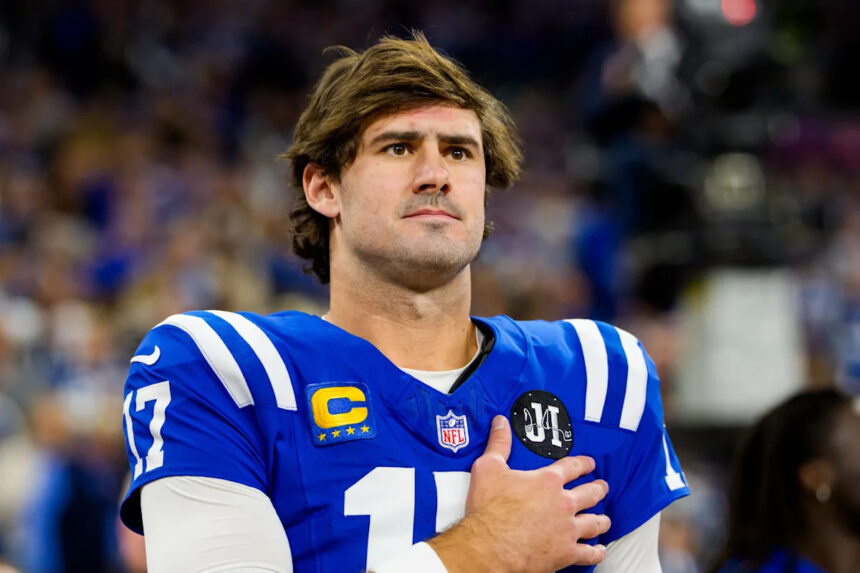
Colts Place Transition Tag on Daniel Jones: A Calculated Gamble or Quarterback Purgatory?
The Indianapolis Colts have made their first major move of the 2025 offseason, but it’s one that raises more questions than it answers. As reported by NFL Network’s Tom Pelissero, the franchise has placed the transition tag on quarterback Daniel Jones after the two sides failed to reach a long-term contract agreement. This decision locks Jones into a one-year, $37.833 million deal for the upcoming season unless a new pact is signed, while granting the Colts the right to match any offer sheet he receives from rival teams. In the high-stakes poker game of NFL quarterback contracts, Indianapolis has just made a fascinating, non-committal bet.
The Transition Tag: A Tool of Temporary Truce
The use of the transition tag is a relatively rare maneuver in today’s NFL, especially for a starting quarterback. Unlike the more restrictive franchise tag, which guarantees two first-round picks as compensation if a player leaves, the transition tag is a softer tool. It essentially creates a five-day negotiating window for Jones to test his market value with other teams, with the Colts holding the ultimate right of first refusal.
This strategy reveals the Colts’ front office calculus:
- Financial Flexibility: The one-year tag number, while significant, is lower than an exclusive franchise tag would have been and avoids a massive, immediate long-term cap hit.
- Market Validation: It allows the Colts to see what other teams truly believe Jones is worth, providing an external valuation to inform their own negotiations.
- Bridge Solution: It keeps a productive quarterback in the building for at least one more season, maintaining continuity while the team potentially evaluates future options in the draft or elsewhere.
However, it’s a double-edged sword. It introduces uncertainty into the team’s most important position and risks creating a “lame duck” scenario where Jones plays under a contract neither side truly wanted.
Daniel Jones’ Resurgence and Heartbreaking End in Indy
To understand the Colts’ hesitation to commit fully, one must examine the tantalizing but truncated 2024 season Daniel Jones authored. After a tumultuous tenure with the New York Giants, Jones found a surprising rhythm in Indianapolis under head coach Shane Steichen’s quarterback-friendly system.
The statistics tell a story of a player hitting his stride:
- Career-High Efficiency: Jones posted a 68% completion rate and a 100.2 passer rating, both personal bests.
- Improved Consistency: His 63.0 QBR and 238.5 passing yards per game demonstrated a new level of week-to-week reliability.
- Winning Record: He led the Colts to an 8-5 record as a starter, including a stunning 7-1 start that had Indianapolis atop the AFC South for much of the season.
This was the version of Jones the Giants hoped for when they drafted him sixth overall in 2019. His play was defined by smart decisions, accurate throws, and effective management of the game. Yet, the narrative changed irrevocably in a Week 14 loss to Jacksonville. A torn Achilles not only ended his season but cast a long shadow over his future. The subsequent scramble—bringing a retired Philip Rivers out of mothballs for an 0-3 stint—highlighted the team’s fragility without him and ultimately sank their playoff hopes.
The Achilles Heel: Injury History and Long-Term Concerns
The torn Achilles is the specter hanging over these contract negotiations. For a quarterback whose game incorporates mobility and the ability to drive off his back foot, it’s a particularly concerning injury. While modern medicine has improved recovery outcomes, the history of quarterbacks returning to peak form after an Achilles tear is sparse.
This injury compounds an existing narrative around Jones’ durability. His time in New York was marred by various ailments, including a neck injury that cost him games. The Colts are now tasked with projecting the future of a 27-year-old quarterback coming off one of the best stretches of his career, but also one of the most significant injuries an athlete can face. Investing $200+ million guaranteed in that scenario is a risk that gives any front office pause. The transition tag acts as a prove-it deal on a grand scale: prove the Achilles is healed, prove the 2024 performance was the new norm, and *then* the long-term security will follow.
What’s Next for Jones and the Colts?
The immediate future is a waiting game. Jones and his representatives will now canvas the league for an offer sheet. Given the quarterback market, his age, and his recent performance, it is plausible a quarterback-needy team with ample cap space could present a front-loaded deal designed to deter the Colts from matching. However, the Colts have signaled their intent to keep him, at least for 2025, and matching a reasonable offer remains the most likely outcome.
The broader predictions for the Colts’ quarterback room are now in flux:
- Draft Implications: Does this move take Indianapolis out of the running for a top quarterback prospect with their first-round pick? Not necessarily. The tag is a one-year mechanism, and selecting a successor to develop behind Jones remains a logical, if controversial, path.
- Locker Room Dynamics: Playing on a tag can be awkward. The Colts must manage the message carefully to ensure Jones feels supported and motivated, not slighted.
- Contract Deadline: The two sides can continue negotiating a long-term deal until July 15th. If one is reached, the tag comes off. The pressure will build as that date approaches.
Conclusion: A High-Stakes Interim Verdict
The Indianapolis Colts have chosen a path of cautious optimism with Daniel Jones. The transition tag is a declaration that they believe in the quarterback they saw for 13 games in 2024, but not enough to fully invest in the quarterback who has an extensive injury history and only one truly elite season on his resume. It’s a business decision, cold and pragmatic.
For Daniel Jones, this is both a vote of confidence and a challenge. He has the security of a $37.8 million payday and the chance to re-enter the market next year at 28, hopefully fully healthy and with another strong season under his belt. But he also faces the pressure of performing under a microscope, with his long-term financial future still uncertain. The 2025 season in Indianapolis was already going to be about redemption following the injury. Now, it’s also about securing a legacy and a fortune. The Colts have kept their quarterback, but on terms that ensure the most compelling and consequential story of their offseason is far from over.
Source: Based on news from Yahoo Sports.