Crucible Pressure ’50 Times Worse Than Driving Test’: Inside Snooker’s Ultimate Fear Factor
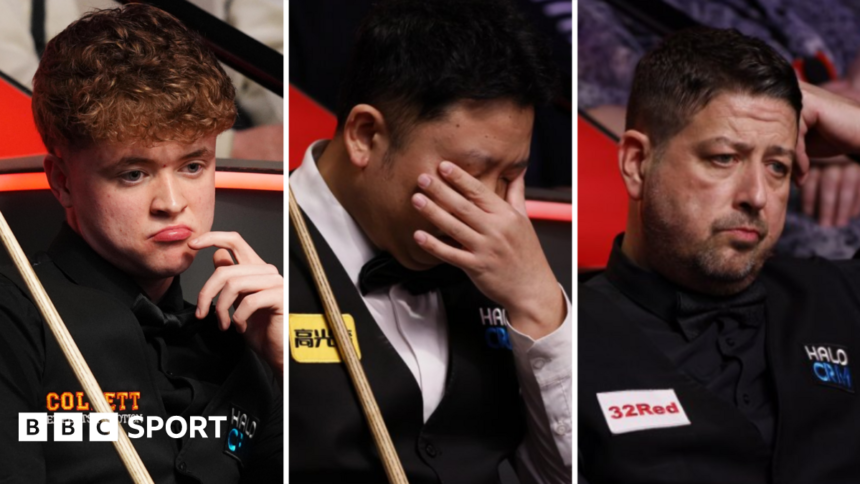
The air is thick with tension. The velvet silence is broken only by the click of ivory and the occasional, almost apologetic cough from the audience. For the 16 players who crashed out of the 2026 World Snooker Championship in the first round, the Crucible Theatre became a house of horrors. Among them were rising star Stan Moody, Chinese cueman Zhang Anda, and two-time finalist Matthew Stevens—all victims of a venue that, according to world number one Judd Trump, amplifies pressure to an almost unbearable degree.
“There’s so much pressure playing at the Crucible, it can’t be replicated at any other venue,” Trump said after his own first-round escape. The current world champion’s words are a stark reminder that even the game’s elite feel the weight of the stage. But just how intense is that weight? We asked a sports psychologist to quantify it. His answer was chilling: “The pressure at the Crucible is roughly 50 times worse than taking your driving test.”
It is a comparison that strips the sport of its glamour and reveals the raw, psychological warfare that unfolds over 17 days in Sheffield. Since 1977, the Crucible Theatre has been snooker’s spiritual home—a compact, 980-seat cauldron where careers are launched and spirits are broken. The crowd is so close they can reach out and touch the players. They can offer them sweets, whisper encouragement, or simply breathe down their necks. For the 16 losers of 2026, that proximity was a curse.
Why the Crucible Breaks Even the Best: The ’50 Times’ Factor
To understand why a driving test—a universally stressful experience—is used as a benchmark, you have to examine the unique psychological cocktail of the Crucible. A driving test lasts about 40 minutes. A first-round match at the Crucible can stretch across two sessions, lasting up to six hours. The margin for error is microscopic.
“In a driving test, you make a mistake, you get a minor fault. You might still pass,” explains Dr. Mark Williams, a sports psychologist who has worked with multiple Crucible champions. “At the Crucible, a single missed black off its spot can cost you a frame. A bad positional shot can hand your opponent a century break. The consequences are immediate and brutal.”
He adds: “The intensity of focus required is vastly different. In a car, you are reacting to external stimuli. In snooker, you are fighting your own internal demons. The silence magnifies every heartbeat, every tremor in your hand.”
The 2026 tournament provided a perfect case study. Stan Moody, the young prodigy tipped for greatness, froze under the lights. His cue action, normally fluid and free, became mechanical and tight. Zhang Anda, a player renowned for his steely composure on the Chinese tour, missed three routine blues in a single frame. And Matthew Stevens, a man who has played in two world finals, looked a shadow of his former self, his body language screaming defeat before the final ball was potted.
This is the Crucible effect. It is not just a venue; it is a psychological pressure cooker that distills the entire season into a single shot. The driving test analogy works because it is a relatable moment of high stakes. But the Crucible multiplies that feeling by a factor of 50—because the stakes are a legacy, a trophy, and a life-changing payday.
Judd Trump’s Warning: Experience Is No Shield
When Judd Trump speaks about pressure, the snooker world listens. The world number one has won everything the sport offers, including the world title in 2019 and 2023. Yet even he admits the Crucible is different. “You can win ten ranking events in a year, but if you lose here in the first round, it feels like a failure,” Trump said in a post-match interview. “The pressure is 50 times worse than any other tournament. It’s not even close.”
Trump’s statement is backed by data. Since 2000, over 40% of top-16 seeds have lost in the first round at the Crucible. That statistic is staggering. In tennis, top seeds rarely lose in the first week of a Grand Slam. In snooker, the Crucible is a great equalizer. The compact arena, the two-table setup in the early rounds, and the relentless TV scrutiny create a perfect storm of anxiety.
For Trump, the key is emotional detachment. “You have to treat it like a practice session,” he once said. But that is easier said than done. The crowd at the Crucible is not passive. They are connoisseurs. They know when a player has missed a safety shot by a millimeter. They groan, they applaud, they shift in their seats. That noise—or the lack of it—can shatter a player’s rhythm.
The 2026 first round saw Matthew Stevens suffer most visibly. The Welshman, now 48, has been a Crucible stalwart for two decades. But age and experience were no match for the venue’s intensity. He lost 10-6 to a qualifier, missing a simple pink in the final frame that would have forced a deciding session. Afterwards, he sat in his chair, head in hands, for a full two minutes. The Crucible had claimed another victim.
How to Survive the Crucible: Lessons from the 2026 Survivors
While 16 players fell, 16 advanced. What did the winners do differently? The answer lies not in technique, but in mental resilience. The Crucible rewards players who can control their breathing, slow their heart rate, and treat each shot as an isolated event. The survivors of 2026 shared common traits:
- Routine over emotion: Players like defending champion Ronnie O’Sullivan (if he plays) rely on pre-shot routines that are identical whether they are 9-0 up or 0-9 down. This creates a psychological anchor.
- Visualization: Top players mentally rehearse their shots before they even get down on the shot. They see the ball going in the pocket before they strike it. This reduces doubt.
- Acceptance of noise: The best Crucible players don’t fight the crowd; they use it. They feed off the gasps and the applause. They treat the theatre as a stage, not a trap.
- Physical conditioning: A six-hour match is an endurance event. Players who are fit—both mentally and physically—maintain their focus longer. The 2026 first round saw several players visibly tiring in the final frames.
For Stan Moody, the lesson is harsh but valuable. At 18, he has time on his side. But his 10-4 loss to a veteran showed that raw talent is not enough. The Crucible demands a cold, calculating mindset. It is a venue that punishes the young and the emotional. Moody will be back. The question is whether he can learn to tame the beast.
Predictions: Who Will Conquer the Crucible in 2026?
Based on the first-round carnage, the path to the title is wide open. The elimination of Zhang Anda removes a dangerous dark horse. The loss of Matthew Stevens denies the tournament a sentimental favorite. But the survivors include players who have mastered the Crucible’s unique demands.
Judd Trump remains the man to beat. His ability to play fearless attacking snooker under pressure is unmatched. He treats the big stage as his playground. But he faces a gauntlet of hungry contenders. Mark Allen, the Northern Irishman, has the grit and the tactical nous to grind out victories in tight matches. Kyren Wilson, the “Warrior,” has the physical stamina and the mental fortitude to go the distance.
However, the dark horse of 2026 could be Jack Lisowski. The Englishman has always possessed the talent but lacked the nerve. His first-round win—a 10-9 thriller—suggests he may have finally found his Crucible composure. If he can replicate that under the single-table setup in the quarter-finals, he could go all the way.
One thing is certain: the Crucible will claim more victims before the final on May 4. The pressure is 50 times worse than a driving test, and for some, it will be a test they fail spectacularly. For the champion, it will be a triumph of will over fear.
Conclusion: The Crucible’s Unforgiving Embrace
The World Snooker Championship is not just a tournament; it is a rite of passage. For Stan Moody, Zhang Anda, and Matthew Stevens, the 2026 first round was a brutal lesson in the sport’s ultimate reality. The Crucible does not care about your ranking, your age, or your past glories. It cares only about the next shot.
Judd Trump’s words echo through the corridors of Sheffield: “It can’t be replicated.” The driving test analogy is a useful shorthand, but it undersells the truth. The Crucible is a place where careers are made and destroyed in the space of a single frame. It is a venue that demands everything you have—and then demands more.
As the tournament moves into the second round, the survivors carry a scar of relief. The losers carry the weight of what might have been. For the 16 who fell, the journey home will be long. For the 16 who remain, the real battle is just beginning. The Crucible’s pressure is not a myth. It is a monster that feeds on doubt. And in 2026, it has already devoured its first feast.
Source: Based on news from BBC Sport.