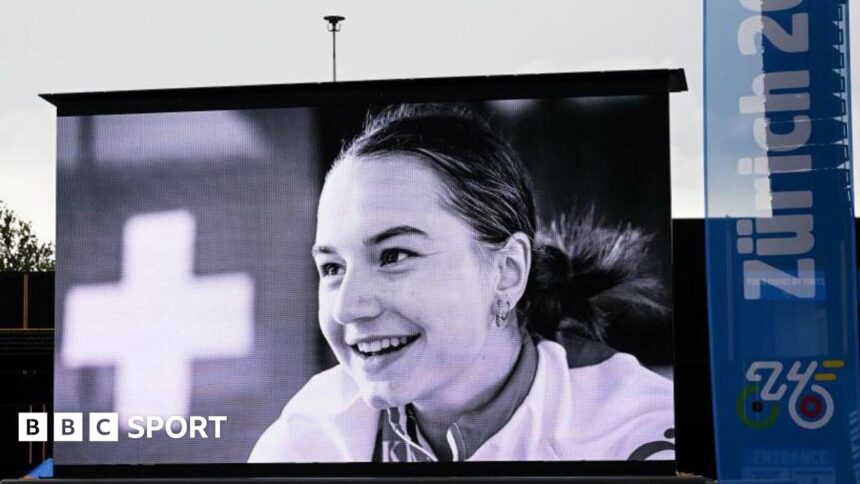
A Tragic Silence: The 82-Minute Search for a Fallen Champion at the World Championships
The roar of the crowd, the whir of carbon wheels on wet asphalt, the focused silence of elite competition—these are the sounds of the UCI Road World Championships. But in a wooded area just meters from the course in Zurich, a devastating silence descended for 82 minutes. The death of 18-year-old Swiss cyclist Muriel Furrer during the junior women’s road race in 2024 is a profound tragedy. The recent investigative finding that she lay unfound for over an hour after her crash adds a harrowing, complex layer to the grief, raising urgent questions about safety protocols, the very nature of risk in road racing, and the unseen vulnerabilities of a sport played out on open roads.
A Promising Career Cut Short on Home Roads
Muriel Furrer was not just another competitor; she was a local talent racing on roads she knew intimately. Hailing from Egg, a municipality within the Zurich canton, the 2024 World Championships were a homecoming. This was her circuit, a chance to shine on a global stage where she first dreamed of cycling. The junior road race in Zurich was a culmination of a young life dedicated to the sport. Witnesses described wet conditions that day, a variable that adds a universal hazard to cycling. According to the investigation by the Zurich Public Prosecutors’ Office, Furrer left the road and crashed into a wooded area. The dense foliage, combined with the trajectory of her crash and the intense focus of the race convoy ahead, meant her location was not immediately apparent. The very fact that the accident occurred close to where she grew up twists the tragedy with a cruel irony, transforming familiar ground into a site of unimaginable loss.
The 82-Minute Gap: Dissecting the Safety Protocol Breakdown
While the legal investigation concluded there was “no evidence of criminal conduct or negligence on the part of the organiser,” the 82-minute discovery window points to a catastrophic failure in operational safety systems. In a world where races are monitored by helicopters, GPS transponders, and dozens of official vehicles, how does a rider remain missing for so long? The breakdown likely occurred at several critical junctures:
- Rider Visibility and Course Design: Roads with significant, unsecured drop-offs into dense vegetation, especially on a descent or corner, present a known high-risk factor. Mitigations like netting, barriers, or spotters are complex on long, open road courses but are increasingly scrutinized.
- Communication Chain Failure: The “last rider” protocol is sacred in cycling. The identification that a rider is missing must trigger an immediate, organized search. The gap suggests this chain—from team cars to race commissaires—failed or was critically delayed.
- Search and Rescue Coordination: Once a rider is identified as missing, the process to locate them in a large, non-contained area like an open road circuit is not as instantaneous as the public might assume. However, 82 minutes indicates a search that lacked precise initial location data, relying on backtracking rather than a pinpoint response.
This incident starkly contrasts with typical crash responses, where medical cars are often on the scene within seconds. It reveals a dangerous blind spot in the sport’s safety net: the crash that happens out of sight.
Expert Analysis: The Inherent and Unmanaged Risks of Road Racing
As a sports journalist, one must analyze this within the continuum of cycling safety. The sport has made strides in reducing concussion risks with improved helmet standards and implementing barriers at finish lines after past fatalities. Yet, the Road World Championships course presents a unique, almost paradoxical challenge: it must be difficult to test the best, but it is held on public roads never designed as a closed sporting arena.
“This tragedy exposes the fundamental tension in road cycling,” says a veteran race director who wished to remain anonymous. “We can make the finish line safe, we can mandate equipment, but we cannot line 160km of roads with air fencing. The Furrer case forces a horrible but necessary question: are we doing enough to manage the risks on the 99% of the course that isn’t the final kilometer?”
The expert points to technology as a potential, albeit partial, solution. Mandatory real-time transponders that signal extreme deceleration or off-course movement, paired with dedicated search vehicles at the rear of the race with explicit monitoring duties, could form a new standard. The legal absolution of the organizer does not equate to an absolution of the sport’s governing bodies from implementing more rigorous, technology-aided safety overhauls.
Predictions and Reforms: How Cycling Must Change
In the wake of Muriel Furrer’s death, the cycling world cannot simply offer condolences and move on. The 82-minute statistic is a clarion call for systemic change. We can predict and advocate for several key reforms that will likely define the next era of race safety:
- Enhanced Rider Tracking: The adoption of more sophisticated biometric and location transponders will become non-negotiable, especially for junior and U23 races. These devices must trigger immediate alerts in race control.
- Revised “Last Rider” Protocols: A dedicated, well-staffed “sweep and security” vehicle, independent of team duties, with the sole purpose of tracking all riders and initiating instant searches for anyone missing, will become standard.
- Course Risk Audits: Beyond evaluating road width and surface, formal audits will now need to meticulously map and mitigate areas where a rider could disappear from view. This could mean mandatory course-side spotters in remote, high-risk sections, even if they are outside the primary spectator zones.
- Cultural Shift in Reporting: There will be a renewed, formal emphasis for all race personnel—from moto drivers to team staff—to report any suspicion of a rider down, even if uncertain. The default must shift from “maybe they pulled out” to “verify their location immediately.”
Conclusion: A Legacy Beyond the Podium
The death of Muriel Furrer is an indelible stain on the 2024 World Championships. That she was killed competing near to where she grew up is a heartbreaking detail. That she was not found for 82 minutes is an institutional failing that the sport must own and address with unwavering commitment. While no criminal negligence was found, the moral imperative for change is overwhelming. Her legacy must be a World Championships, and a sport, that does not just honor the courage of its riders with challenging courses, but protects their lives with an equally challenging and relentless commitment to safety. The silence in those woods must lead to the loudest possible call for reform, ensuring that no rider, at any level, is ever left unfound again. The pursuit of victory can never again eclipse the paramount duty of care.
Source: Based on news from BBC Sport.