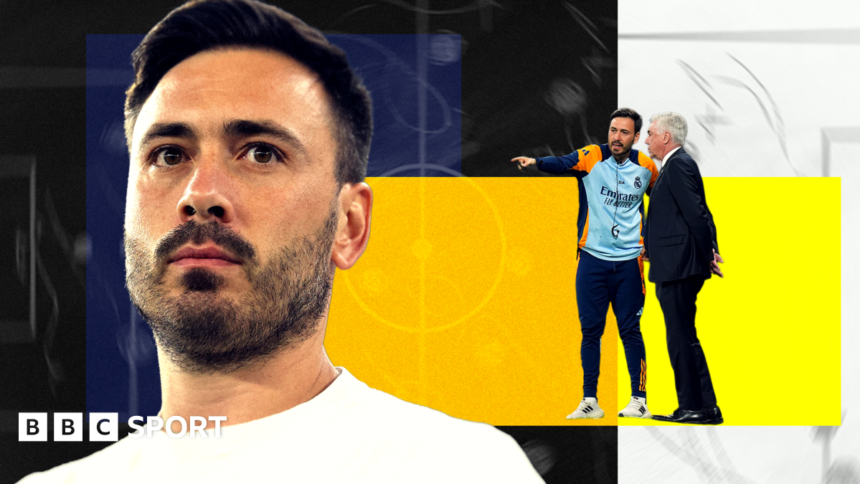
Davide Ancelotti: My Game in My Words – The Architect Behind Brazil’s World Cup Dream
There are football dynasties, and then there is the Ancelotti story. While the world focuses on the serene smile of Carlo Ancelotti—the only manager to win league titles in all five major European leagues—a quieter, sharper force is shaping the tactical future of the most iconic football nation on earth. That force is Davide Ancelotti, the 35-year-old assistant manager of the Brazilian national team. But to dismiss Davide as merely “the boss’s son” is to miss the point entirely. He is the product of a unique footballing education, a man who learned the game from the inside out, starting at an age when most children are still learning to tie their shoelaces. This is his game, in his words—a story of shadows, strategy, and the subtle art of seeing what others miss.
The Education of a Footballing Prodigy: From Buffon to Brazil
Davide Ancelotti did not just watch football; he breathed it. His earliest memory is not of a cartoon or a toy, but of the crisp air of a training ground in Parma, Italy. He was six years old. His father, Carlo, was the manager of a Parma side that was on the cusp of greatness. “The first player I remember meeting was Gianluigi Buffon,” Davide has recalled. “I was just a kid with a ball, and he was this giant. He let me take shots at him.”
Think about that for a moment. A six-year-old boy taking shots against Gianluigi Buffon, a man who would go on to define the very concept of goalkeeping for a generation. But the lesson was not about scoring. It was about observation. While Davide fired the ball, he could turn his head and see the young Lilian Thuram and Fabio Cannavaro—future World Cup winners with France and Italy—practicing the defensive drills that would make them legends.
- Immersive Learning: Davide didn’t just watch drills; he lived them. He absorbed the intensity of Serie A training at an age when most kids are in elementary school.
- Elite Mentors: His first coaches weren’t just his father. They were the players themselves—future Ballon d’Or winners and World Cup champions who treated him as a mascot but taught him like a student.
- Strategic Foundation: Watching Parma’s legendary backline taught Davide the importance of structure, positioning, and the mental game before the physical one.
This was not a normal childhood. It was a masterclass in football intelligence. While other children collected stickers, Davide collected tactical patterns. He saw how Cannavaro would step out of the defensive line to intercept a pass, and how Thuram would use his body to shield the ball. These were not just highlights; they were the building blocks of a footballing philosophy that he would later refine across Europe and now, in South America.
From the Touchline to the Tactical Board: The Ancelotti Method
Many sons of famous managers have tried to follow in their father’s footsteps, but few have succeeded with the quiet authority of Davide Ancelotti. He did not simply inherit a role. He earned it. After a modest playing career that ended early due to injury, Davide transitioned to coaching, joining his father’s staff at Bayern Munich, Napoli, Everton, and finally Real Madrid. It was at Real Madrid that his reputation as a tactical mastermind truly crystallized.
While Carlo Ancelotti is the master of man-management—the smiling uncle who keeps the dressing room happy—Davide is the architect. He is the one who breaks down video, who designs the pressing triggers, and who communicates the complex tactical shifts that modern football demands. In Brazil, this dynamic is crucial. The Brazilian national team is not just a team; it is a cultural institution. The pressure is immense. The expectation is total victory.
Davide’s role is to provide the tactical clarity that allows Brazil’s superstars—like Vinícius Júnior, Rodrygo, and Raphinha—to express their genius within a structured system. He is the bridge between the old-school charm of his father and the data-driven demands of the modern game. “We don’t want to kill the creativity,” Davide has explained in private briefings. “We want to give it a home. A structure that protects them so they can attack with freedom.”
Expert Analysis: This is where the Ancelotti method differs from other European imports. Many coaches come to Brazil and try to impose a rigid European system. Davide and Carlo understand that the Brazilian DNA is about improvisation. Their job is not to replace that DNA, but to wrap it in a layer of defensive security and tactical discipline. Davide’s work on set pieces and defensive transitions at Real Madrid was widely praised. Expect Brazil to be far more organized without the ball than in previous World Cup cycles.
Predictions for the World Cup: How the Ancelotti Duo Will Operate
So, what does this mean for Brazil’s chances at the World Cup? The combination of Carlo’s calm and Davide’s intensity creates a unique coaching ecosystem. Here are three specific predictions for how the Ancelotti team will shape Brazil’s campaign:
- Fluid Formation: Do not expect a static 4-3-3. Davide has been experimenting with a fluid system that morphs into a 3-2-5 in attack, allowing the full-backs to push high while the midfield pivots protect the center. This is a direct evolution of the system used at Real Madrid.
- Set-Piece Evolution: Brazil has historically been vulnerable on set pieces. Under Davide’s influence, expect a drastic improvement. He is a student of the game who studies dead-ball situations with obsessive detail. Brazil will be a threat from corners, not just a liability.
- Youth Integration: Davide’s connection with the younger generation of Brazilian stars, many of whom he coached at Real Madrid (like Vinícius and Rodrygo), is a secret weapon. He speaks their tactical language. This will ensure a seamless transition between the European-based stars and the domestic talents.
The biggest challenge? Managing the psychological weight of the Seleção. Brazil has not won a World Cup since 2002. The pressure is suffocating. Here, Carlo’s experience is invaluable, but Davide’s role as the tactical buffer is equally important. He absorbs the analytical pressure, allowing his father to focus on the emotional state of the squad. It is a partnership of perfect balance: the father who heals, and the son who plans.
Conclusion: The Legacy of the Silent Architect
Davide Ancelotti will never be the headline. He will never be the one lifting the trophy on the podium. But if Brazil wins the World Cup, his fingerprints will be all over the victory. He is the product of a unique upbringing—a boy who took shots against Buffon and watched Cannavaro learn his craft—who has now become one of the most respected tactical minds in the game.
In a world obsessed with celebrity managers and flashy tactics, Davide represents something rarer: substance. He is the quiet voice in the ear of the legend. He is the one who sees the game not as a series of moments, but as a continuous, living puzzle. For Brazil, he is not just an assistant. He is the architect of a new era. The game is in his blood, and now, his game is written in the tactics of a nation. Watch closely. The best is yet to come.
Source: Based on news from BBC Sport.