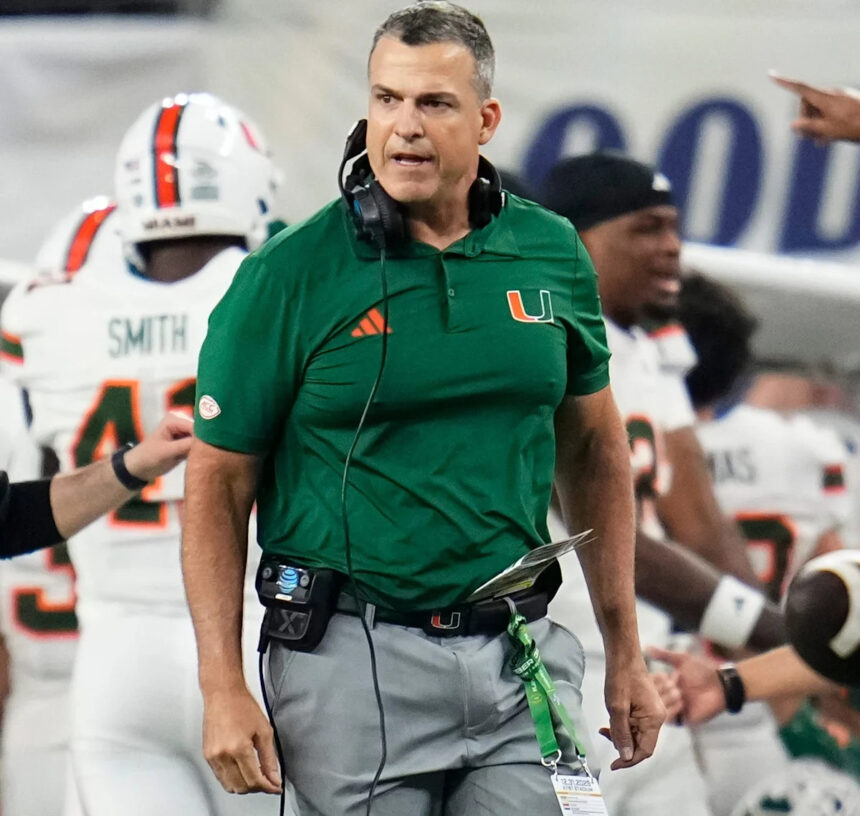
Mario Cristobal’s Miami Legacy: The Player’s Quest and the Coach’s Burden
The image is iconic in college football lore: a swarm of orange and green helmets celebrating on a rain-soaked field in the 1988 Orange Bowl. The Miami Hurricanes had just secured their second national championship in five years, cementing a dynasty. For a young offensive lineman from Miami Columbus High School named Mario Cristobal, watching that game wasn’t just fandom; it was destiny calling. He would soon join that very program, wearing the same uniform as those champions. But decades later, as the head coach of his alma mater, one question lingers for fans and critics alike: Did Mario Cristobal win a national championship at Miami as a player? The answer is pivotal, not as a trivia fact, but as the foundational myth driving one of the most high-stakes rebuilds in modern sports.
The Player’s Era: A Grind in the Trenches, Not a Ring on the Finger
Mario Cristobal’s playing career at the University of Miami spanned from 1989 to 1992. To understand his tenure, one must first understand the context. He arrived in the immediate aftermath of that 1987 championship and played under the legendary Jimmy Johnson and later Dennis Erickson. This was “The U” at its most swaggering, a factory for NFL talent and championship contention.
However, Cristobal’s time as a player did not culminate in a national title. He was a part of formidable teams, including the 1989 and 1991 squads that finished ranked in the top three nationally. The 1991 team, in particular, entered the season as defending co-national champions and was loaded with future pros. Cristobal, a hard-nosed tackle, started for that team and helped pave the way for an explosive offense. Yet, a infamous 17-16 “Wide Right I” loss to Florida State ultimately derailed their championship hopes. They finished the season 12-0 but were denied a share of the title in the polls.
Cristobal’s player legacy is defined by grit, not glory. He was a two-time national champion in the weight room, winning the team’s strength and conditioning award, and earned All-Big East honors. He experienced the pinnacle of the program’s culture—the intensity, the expectation, the standard of excellence—but left without the ultimate player’s prize. This firsthand knowledge of “The Standard” at its zenith, juxtaposed with the near-misses, forged a specific and burning vision for what Miami football should be. It created a powerful, almost romantic, drive to return and finish the job he started as a player, this time from the sideline.
The Oregon Exodus: Why Leave a Powerhouse for a Project?
Cristobal’s decision in December 2021 stunned the college football world. At Oregon, he had built a Pac-12 powerhouse:
- 35-13 record over five seasons, with two Pac-12 championships.
- A victory in the 2020 Rose Bowl, a hallmark achievement for any program.
- A 10-3 record in 2021, with another conference title game appearance.
- Unmatched resources from Nike’s Phil Knight and a modernized facility suite.
He left all that for a Miami program that had become a shadow of its former self. Since that heartbreaking loss to Ohio State in the 2003 BCS title game, “The U” had been adrift:
- Only two 10-win seasons in nearly two decades.
- A revolving door of coaches unable to recapture the magic.
- A palpable disconnect between the program’s storied past and its underwhelming present.
This wasn’t a career move; it was a pilgrimage. Cristobal wasn’t just taking a job; he was answering a call to resurrect a cultural institution. He traded the security of a top-10 program for the monumental challenge and even greater potential of his alma mater. The gamble was clear: achieve legend status by restoring the Hurricanes, or be remembered as the alum who couldn’t fix it.
The Miami Rebuild: Translating “The Standard” into Modern Success
Upon arrival in Coral Gables, Cristobal didn’t promise quick fixes. He launched a cultural overhaul rooted in the physical, no-nonsense identity of those 80s and 90s teams he knew intimately. His blueprint is multifaceted and relentless:
Recruiting at an Elite Level: Cristobal immediately leveraged his deep South Florida ties and reputation as a premier recruiter. He has consistently pulled top-10 recruiting classes, something Miami had not done in the modern era, going head-to-head with national powers for local blue-chip talent. This is non-negotiable; the championship rosters of the past were built on dominating the tri-county area.
Infrastructure Revolution: Understanding that today’s recruits are won with more than tradition, he has been the driving force behind a massive facilities arms race. Miami is investing in a state-of-the-art football operations center, a direct response to the resource gap that had developed between Miami and the true elite. Cristobal experienced Oregon’s cutting-edge environment and is determined to replicate and surpass it at home.
The “Hard Edge” Philosophy: Every practice, every meeting, every drill is infused with the physical and mental toughness Cristobal embodied as a player. The focus is on dominating the line of scrimmage, a hallmark of his Oregon teams and the classic Hurricane squads. This is the core of translating nostalgic “The U” attitude into a tangible, on-field identity.
Championship Predictions: Is Miami on the Title Track?
The ultimate measure of Cristobal’s homecoming will be championship contention. The question isn’t just about winning the ACC, but about competing for the College Football Playoff and, ultimately, the national title. The path is arduous but no longer seems like a fantasy.
The recent national championship predictions that include Miami, often alongside traditional basketball power Indiana in comparative headlines, signal a shifting perception. While such predictions are optimistic, they reflect the tangible momentum Cristobal has generated through recruiting and institutional buy-in.
Realistic Timeline and Hurdles:
- Short-Term (Next 2 Seasons): The expectation is consistent contention for the ACC Championship. Winning the conference is the essential first step to the CFP. The roster must develop depth to withstand the grind of a season.
- Medium-Term (3-5 Years): This is the window where Miami should aim to be a perennial CFP contender. Cristobal’s first full recruiting cycles will be juniors and seniors, and the new facilities will be operational. The cultural foundation should be fully set.
- Major Hurdles: The expanded SEC and Big Ten create a more challenging landscape. Miami must also consistently beat the Clemsons and Florida States of the world, and prove it can win a marquee non-conference game—a hurdle that has tripped them up recently.
The prediction here is that Cristobal will get Miami back to the CFP. His combination of recruiting prowess, cultural understanding, and relentless work ethic is the exact formula required. Whether he can win it all depends on translating top-five recruiting classes into top-five team execution on the biggest stages—a challenge for any coach.
Conclusion: A Legacy Forged in Two Acts
Mario Cristobal did not win a national championship as a Miami Hurricane player. He came agonizingly close, absorbing the championship standard from the inside during the program’s golden age. That unfulfilled quest is the engine of his entire coaching mission. His daring move from Oregon was not a step down, but a leap into a legacy-defining challenge.
He is not trying to recreate the past; that is impossible. Instead, he is mining the core principles of that past—toughness, talent acquisition, and swagger—and rebuilding them with modern infrastructure and a long-term vision. The story of Mario Cristobal and Miami is a two-act drama: the player who helped uphold the standard, and the coach who is betting his career on restoring it to its peak. The first act ended without a ring. The second act, still being written, aims for nothing less than the final, triumphant scene he dreamed of as a young man in the trenches.
Source: Based on news from Yahoo Sports.