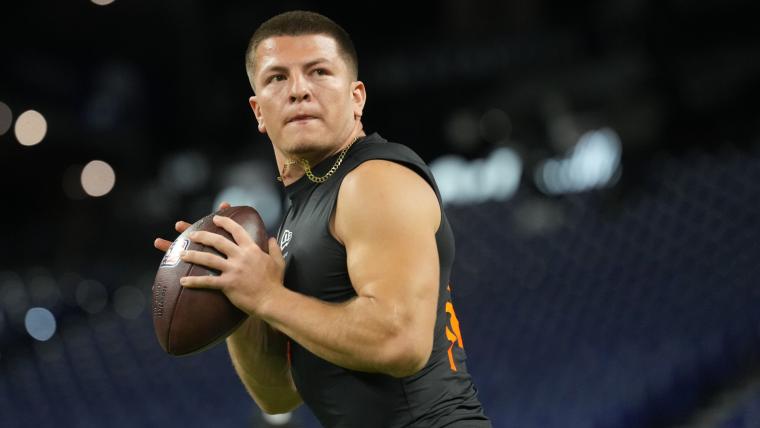
Diego Pavia’s NFL Draft Gamble: A Self-Representation Mistake That Could Cost Millions?
In the high-stakes, multi-billion dollar theater of the NFL Draft, preparation is everything. Prospects spend years honing their bodies, their film, and their minds for the moment their name is called. They surround themselves with coaches, trainers, and, most critically, experienced agents to navigate the perilous waters from college star to professional athlete. Vanderbilt quarterback Diego Pavia, however, is charting a different course—a decision that league insiders are calling a potentially catastrophic miscalculation. In a move that defies conventional wisdom, Pavia has announced he will be representing himself in the lead-up to the 2026 NFL Draft, a gamble that could see his professional dreams slip from the draft board to the undrafted free agent scramble.
The Unprecedented Declaration: “I’m Representing Myself”
The news broke not through a press release or a team announcement, but in a conversation with former NFL coach Jon Gruden. “I’m representing myself,” Pavia stated, a simple phrase that sends shockwaves through the scouting community. His rationale, as reported, stems from his experience negotiating his own return to Vanderbilt this past season. While that situation may have had a satisfactory outcome, equating a college NIL arrangement with the Byzantine complexity of an NFL Draft process and a rookie contract is a profound error in judgment.
Critically, Pavia admitted he had a legal team assisting him during those Vanderbilt talks. The NFL Draft process lacks that built-in safety net. It is a 24/7 whirlwind of combine interviews, private workouts, team visits, and intense media scrutiny, all happening alongside the most critical financial negotiation of a young athlete’s life. An agent acts as a shield, a strategist, and an advocate. By going alone, Pavia is not just taking on the role of negotiator; he is becoming his own full-time public relations firm, logistics coordinator, and legal advisor.
Why Going Agent-Free Is a Monumental Risk for a Day 3 Prospect
To understand the gravity of Pavia’s decision, one must understand his projected draft stock. He is not considered a top-100 pick and is firmly viewed as a Day 3 category selection, meaning rounds 4 through 7. For players in this range, the draft process is less about luxury and more about survival. Teams have fewer resources invested and can afford to pass on a player who presents even minor logistical headaches.
An agent’s value for a Day 3 prospect is immense and multifaceted:
- Relentless Advocacy: Agents work the phones constantly, calling and texting scouts, general managers, and coaches to reinforce their client’s value, especially as the draft enters its later, more unpredictable stages.
- Strategic Positioning: They manage which teams their client visits, gather intelligence on team needs, and craft a narrative that makes their client indispensable.
- Contract Expertise: NFL rookie contracts are slotted, but key details like signing bonus payout schedules, guarantee structures, and offset language require expert negotiation.
- Post-Draft Management: Securing the most favorable situation among multiple undrafted free agent offers, which can be a chaotic free-for-all, is where agents truly earn their keep.
Without this representation, Pavia becomes a ghost in the machine. As teams make their final deliberations in the war room, there is no advocate in his corner making a last-ditch pitch. The terrifying outcome, as experts warn, is that this move may drop him into the undrafted category. The difference between being a late seventh-round pick and an undrafted free agent can be hundreds of thousands of dollars in guaranteed money and a drastically shorter leash to make the roster.
Street Smarts vs. Draft Room Savvy: A Dangerous Miscalculation
Pavia’s confidence is born from a place of self-reliance. The descriptor that he “might be street smart” is apt for a player who has carved his own path. However, the NFL Draft is not the streets; it is a corporate boardroom with its own unspoken rules and ruthless efficiency. What Pavia perceives as saving a standard agent’s fee (typically 3%) on his first contract could end up costing him the entire contract itself.
His success in negotiating with Vanderbilt is a false equivalent. College athletic departments, while sophisticated, are not NFL front offices. The leverage dynamics, the complexity of the NFL Collective Bargaining Agreement, and the sheer number of competing interests are on a different planet. An agent’s network and experience are the tools that level this playing field. By forgoing them, Pavia is stepping into a professional negotiation against seasoned veterans with a significant informational and experiential advantage.
Furthermore, the process is designed for agents. Teams expect to communicate with them. The flood of medical information, interview schedules, and travel logistics is funneled through that channel. By inserting himself as the central point of contact, Pavia risks being overwhelmed by administrative duties when his sole focus should be on training and impressing in workouts.
Predictions and Potential Outcomes for Pavia’s Draft Journey
As the 2026 Draft process unfolds, the consequences of Pavia’s choice will come into sharp focus. Based on historical precedent and the current NFL landscape, several scenarios are likely:
Scenario 1: The Costly Slide. This is the most predicted outcome. As Day 3 progresses, teams with quarterback needs will opt for comparable prospects who are represented by agents they have relationships with. The lack of a champion in his corner leads to Pavia’s name remaining uncalled. He then must hastily navigate the undrafted free agent market alone, likely settling for a less-than-ideal situation with minimal guarantees.
Scenario 2: Last-Minute Course Correction. Recognizing the mounting silence from teams or the complexity of the process, Pavia could reverse course and hire an agent late. While this would be better than nothing, it would be a suboptimal solution. The agent would be playing catch-up in a process where relationships built over years are key, and Pavia’s initial approach may have already raised eyebrows among decision-makers.
Scenario 3: A Team Takes a Flier. A team with a stable quarterback room and a creative offensive coordinator might use a very late pick on Pavia, intrigued by his moxie and viewing the minimal draft capital as a low-risk experiment. Even in this best-case scenario, he enters the league with an immediate disadvantage in contract terms and without the guidance needed to navigate the early years of a career.
Conclusion: A Lesson in Professional Protocol
Diego Pavia’s decision to represent himself is not a sign of strength, but a startling misread of the professional arena he seeks to enter. In an effort to maintain control and preserve his earnings, he has inadvertently introduced massive risk and uncertainty into the most important job interview of his life. The NFL Draft is a ecosystem that operates on relationships, nuanced strategy, and relentless promotion—services a certified agent provides.
While self-belief is a necessary trait for any athlete, there is a stark difference between confidence and hubris. Pavia’s terrible mistake serves as a cautionary tale for future prospects: some battles are not meant to be fought alone. In the cutthroat business of the NFL, the right representation isn’t an expense; it’s an investment in your future, your finances, and your football career. As the 2026 Draft approaches, the league will be watching to see if Diego Pavia’s gamble on himself pays off, or if it becomes a definitive case study in why you hire a guide before entering uncharted territory.
Source: Based on news from Yahoo Sports.