Adrian Newey’s Aston Martin Gamble: A Radical Vision for F1’s New Era
The world of Formula 1 holds its breath when Adrian Newey, the sport’s most revered designer, uses words like “extreme” and “different.” As Aston Martin’s much-hyped 2025 challenger sits shrouded under wraps in Bahrain, awaiting its first real-world test, Newey’s calculated comments have ignited the paddock. His first conceptual imprint on the Silverstone-based team is not just another evolution; it is being billed as a bold, contrarian strike at the new technical regulations. In a sport where convergence is the norm, Newey is signaling a deliberate divergence, setting the stage for a season-defining philosophical clash.
The Veil of Secrecy and a Telling Teaser
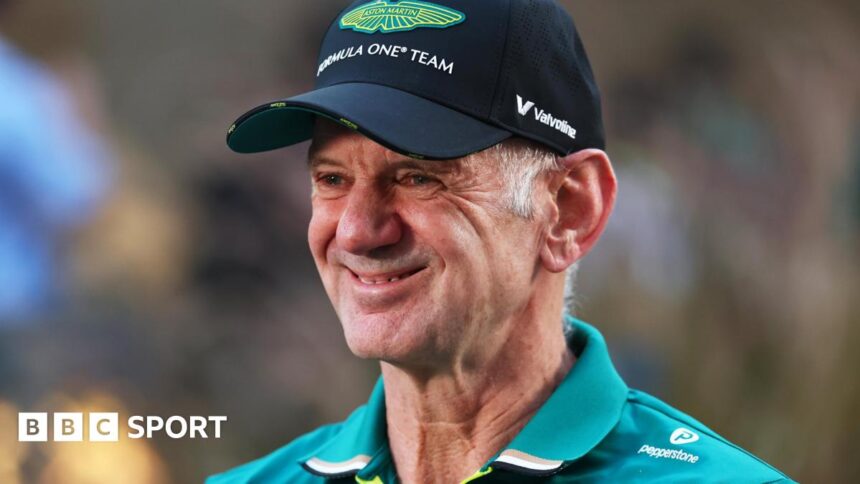
Aston Martin’s season launch in Saudi Arabia was a spectacle of paradox. A lavish event, plagued by technical glitches, ultimately revealed only a livery plastered onto a generic 2026 show car. The real machine, the AMR25, was deliberately absent, a ghost waiting 16 miles away across the causeway in Bahrain. This theatrical secrecy was a masterstroke in anticipation-building, but it was Adrian Newey’s quiet words to the BBC that provided the substantive fuel for speculation. Describing the car as “one of the more extreme interpretations” of the rules and noting “it seems to be a bit different to some of the other solutions”, Newey offered a tantalizing glimpse into his mindset.
This approach is classic Newey. While rival teams like Red Bull, Ferrari, and McLaren have shown their hands with launches that, despite some nuance, followed predictable development paths, Newey hints at a fork in the road. His history is not of incremental gains but of conceptual leaps—think the dominant Red Bull RB19 or the pioneering high-nose designs of years past. His move to Aston Martin as Managing Technical Partner was never about fine-tuning; it was about architecting a revolution. The decision to hide the car physically while teasing its radical nature verbally confirms that Aston Martin believes they have found a unique aerodynamic signature they wish to protect until the last possible moment.
Decoding “Extreme”: What Could Newey’s Vision Entail?
While the car remains unseen, Newey’s language and F1’s current regulatory landscape allow for informed speculation. The 2025 rules are an evolution of the 2022 ground-effect revolution, focusing on managing “out-wash” and reducing dirty air. Most teams have converged on similar sidepod inlet and floor edge solutions. For Newey to call Aston’s approach “extreme,” it suggests a fundamental rethinking of a key aerodynamic component.
- Radical Sidepod Architecture: The most likely canvas for innovation. While others refine the “downwash” or “waterslide” concepts, Newey may have pursued an entirely new inlet shape or internal airflow routing, potentially sacrificing peak cooling efficiency for superior aerodynamic packaging and floor sealing.
- Front Wing and Suspension Integration: Newey has a legendary touch with front-end aerodynamics. An extreme interpretation could involve a novel front wing cascade system or suspension layout designed to manipulate the car’s platform and tire wake more aggressively than competitors.
- Floor Geometry and Vortex Management: The floor is the heart of modern F1 performance. Newey’s “different solution” may lie in the shape of the floor edges, the tunnels, or the use of vortex generators to create a more stable and powerful seal under the car, a high-risk, high-reward area.
The key takeaway is that Newey’s design philosophy often embraces complexity for a performance ceiling others deem unreachable. His extreme interpretation likely seeks to unlock a larger portion of the theoretical downforce permitted by the rules, accepting a potentially narrower operational “window” for a higher peak performance.
The High-Stakes Bahrain Test: Proof or Paradox?
All theories will face the unforgiving scrutiny of the Bahrain International Circuit starting Wednesday. Pre-season testing is not about lap times, but about correlation, reliability, and driver feedback. The central questions surrounding the AMR25 will be:
- Does the Simulator Match Reality? An extreme design can be brilliant in CFD and wind tunnel but fragile on a bumpy, windy track. The first laps will test the correlation between Aston’s virtual models and the physical car.
- What is the Operational Window? Is the car a diva, only fast in perfect conditions with a specific setup, or is it a robust platform? Fernando Alonso’s feedback will be crucial in assessing this.
- Reliability Under Stress: Newey’s masterpieces can sometimes be delicate. The grueling Bahrain test will stress every component, and any fundamental flaw in the radical design could lead to significant downtime.
Success in testing for Aston Martin won’t be topping the timesheets. It will be demonstrating that their different solution is a driveable, reliable, and correlated concept. Failure to do so could mean a long and costly recovery, chasing a more conventional development path already mastered by their rivals.
Predictions: Disruptor or Distraction for the 2025 Season?
The arrival of Newey’s first Aston Martin concept is a pivotal moment for the team and the season. The potential outcomes are starkly defined.
The Disruptor Scenario: Newey’s gamble pays off. The AMR25 proves to be a stable, fast, and innovative machine that unlocks a new performance paradigm. In this case, Aston Martin instantly leaps from the upper midfield to a consistent podium threat, potentially winning races. It would force a mid-season re-think from the established top teams, validating Lawrence Stroll’s massive investment and marking the true beginning of a new competitive force. Fernando Alonso, with a weapon worthy of his talent, becomes a championship dark horse.
The Development Race Scenario: The car shows flashes of genius but is fundamentally tricky. It has a high peak but a narrow operating window, making it qualify well but struggle in race trim. This would place Aston Martin in a fierce development battle, using Newey’s genius to gradually widen the car’s performance window throughout the season. They would likely fight for podiums on specific tracks but lack the consistency to challenge for the constructors’ title.
The Cautionary Tale Scenario: The extreme concept fails to correlate. The team spends the first half of the season understanding and then fundamentally re-designing key aspects of the car, falling deep into the midfield. This would be a severe setback, though with Newey’s long-term involvement, it would likely be a painful lesson rather than a terminal failure.
Conclusion: The Newey Effect Unleashed
Regardless of the immediate outcome in Bahrain, Adrian Newey has already achieved his first objective at Aston Martin: he has made them the center of the technical conversation. By promising an extreme interpretation and a different solution, he has framed the 2025 season as a validation of his unique genius. This is more than a car launch; it is a statement of intent. The Aston Martin AMR25 represents the purest expression of Newey’s aerodynamic artistry in over a decade, unshackled from the legacy systems of his previous team.
When the covers finally come off in the Bahrain pit lane, the F1 world won’t just be looking at a new car. They will be scrutinizing the future trajectory of an iconic team and the next chapter in the career of its legendary architect. The risk is immense, but in Formula 1, revolution, not evolution, writes history. Newey, once again, is playing for the history books.
Source: Based on news from BBC Sport.