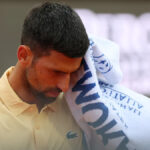
Djokovic Stunned in Rome: Serbian Star Questions French Open Fitness After Brutal Loss
Rome, Italy – The tennis world was sent a seismic shockwave on Monday as Novak Djokovic, the world number one and defending French Open champion, suffered a humbling defeat at the Italian Open. The 36-year-old Serbian, playing his first match in two months after a persistent right shoulder injury, was outplayed and outlasted by a Croatian qualifier 18 years his junior. The result has immediately cast a dark cloud of uncertainty over Djokovic’s readiness to defend his crown at Roland Garros.
For a player who has dominated the clay season for the better part of a decade, the loss was not just a statistical anomaly—it was a physical and psychological alarm bell. The question now echoing through the Foro Italico and beyond is a simple one: Is Novak Djokovic ready for the French Open?
Djokovic himself did not offer a confident answer. In a post-match press conference that was noticeably subdued, the 24-time Grand Slam champion admitted he was “not at 100 percent” and that his preparation for Paris—which begins in just over two weeks—remains a “work in progress.” For a player of his caliber, such ambiguity is rare and deeply telling.
The Croatian Conundrum: A Qualifier’s Day in the Sun
The man who handed Djokovic his first opening-match loss in Rome since 2016 was Luca Mikrut, a 20-year-old qualifier ranked outside the top 200. Mikrut, a left-handed baseliner with a fearless attitude, exploited Djokovic’s lack of match sharpness with surgical precision. The final score—6-4, 6-4—did not flatter the young Croatian; it reflected a match where Djokovic’s legendary defense was a step slow, and his serve lacked its usual venom.
“I have watched Novak my whole life,” Mikrut said after the match, his voice trembling with emotion. “To play him here, on this court, and to win… it is a dream. But I could see he was not moving like the Novak I have seen on TV. I took my chances.”
The statistics painted a grim picture for Djokovic. He won only 55% of his first-serve points, a figure well below his career average on clay. More alarmingly, he converted just 2 of 9 break-point opportunities, a sign that his timing and decision-making—hallmarks of his game—were off. The right shoulder injury, which forced him to withdraw from the Madrid Open and skip the Monte-Carlo Masters, appeared to limit his ability to generate spin on his backhand side, a critical weapon on slow clay.
“I felt pain in certain movements,” Djokovic admitted. “Not the kind of pain that stops you, but the kind that makes you think. And when you think on the court, you are already late.”
Expert Analysis: The Physical Toll of Time and Injury
To understand the gravity of this loss, one must look beyond the scoreline. Djokovic’s dominance has always been built on an almost superhuman ability to recover, to slide, and to extend rallies. Against a younger, hungrier opponent, those physical advantages evaporated.
“This is not just about rust,” explains former world number four and tennis analyst Brad Gilbert. “Djokovic has come back from long layoffs before and looked like a machine. The difference here is the specific nature of the injury. A shoulder issue for a player who relies on a precise, repeatable service motion and a two-handed backhand is a massive red flag. He was clearly protecting it.”
Gilbert points to the second-set collapse as evidence. After leveling the set at 3-3, Djokovic looked poised to take control. Instead, he dropped serve in the next game with two uncharacteristic double faults, followed by a forehand error into the net. The body language was telling: a slump of the shoulders, a long stare at his racket strings, and a visible lack of the fist-pumping intensity that defines his greatest comebacks.
The timing of the injury is also critical. The French Open demands a specific kind of fitness—the ability to grind for four hours in damp, heavy conditions. Djokovic’s training block in Belgrade was reportedly disrupted by the shoulder, limiting his ability to do the high-volume conditioning work required for best-of-five-set tennis on clay.
- Serve Mechanics: Djokovic’s serve speed was down 8-10 mph on average, and he used the kick serve far less frequently.
- Movement: His trademark sliding backhand was noticeably absent; he opted to chop or slice on that side instead of driving through the ball.
- Mental Edge: For the first time in years, Djokovic looked unsure. He argued with his box, he shook his head after routine errors, and he seemed to doubt his physical capacity.
What This Means for the French Open: Predictions and Possibilities
The immediate consequence is that Djokovic loses his status as the overwhelming favorite for Roland Garros. The mantle now shifts to Carlos Alcaraz, Jannik Sinner, and Rafael Nadal—if Nadal’s own body holds up. But for Djokovic, the path forward is not impossible; it is just infinitely more complicated.
Scenario 1: The Optimistic View
Djokovic has a history of using early losses as fuel. In 2018, he lost early in Rome and went on to win Wimbledon. His body is a finely tuned instrument that often responds to shock therapy. If he can get two or three high-intensity practice sessions in this week, and if the shoulder responds to treatment, he could enter Paris with a chip on his shoulder. The draw could be favorable, and his experience in best-of-five matches is unmatched. He remains the most complete player in the world when healthy.
Scenario 2: The Realistic View
At 36, recovery is slower. The shoulder injury is a soft-tissue problem that requires rest—rest he does not have. The French Open is a tournament that punishes players who arrive under-cooked. If Djokovic draws a big server or a heavy topspin player in the first week, he could be looking at an early exit. His path to the final would likely require beating Alcaraz or Sinner in the semifinals—a task that seems Herculean given his current form.
Scenario 3: The Pessimistic View
This loss could be the first sign of a permanent decline. While Djokovic is still capable of brilliance, the margin for error is shrinking. The young guns—Alcaraz, Sinner, Holger Rune, and now Mikrut—are no longer in awe of him. They see vulnerability. If Djokovic cannot dominate physically, he must rely on tactical genius. But on clay, where rallies are long and movement is paramount, a compromised shoulder is a fatal weakness.
“I cannot make any promises,” Djokovic said when asked about his French Open participation. “I will go home, I will do the scans, I will talk to my team. If I cannot compete for the title, I will not go. That is the truth.”
Strong Conclusion: The Clock is Ticking
Novak Djokovic’s loss in Rome is not the end of an era. It is, however, a stark reminder that even the greatest are subject to the twin forces of age and injury. For a man who has defied logic for two decades, this moment represents a new kind of challenge: not a challenge from an opponent, but a challenge from his own body.
The Italian Open defeat to a Croatian qualifier 18 years his junior is a humbling footnote in a legendary career. But what happens next will define his 2024 season. If Djokovic recovers and wins his 25th Grand Slam in Paris, this loss will be remembered as a necessary setback. If he falters, it will be the moment the dynasty began to crack.
One thing is certain: Roland Garros will not wait. The clay in Paris is already being prepared. The draw is being made. And Novak Djokovic, for the first time in years, is not sure he is ready. The tennis world watches with bated breath.
Source: Based on news from ESPN.