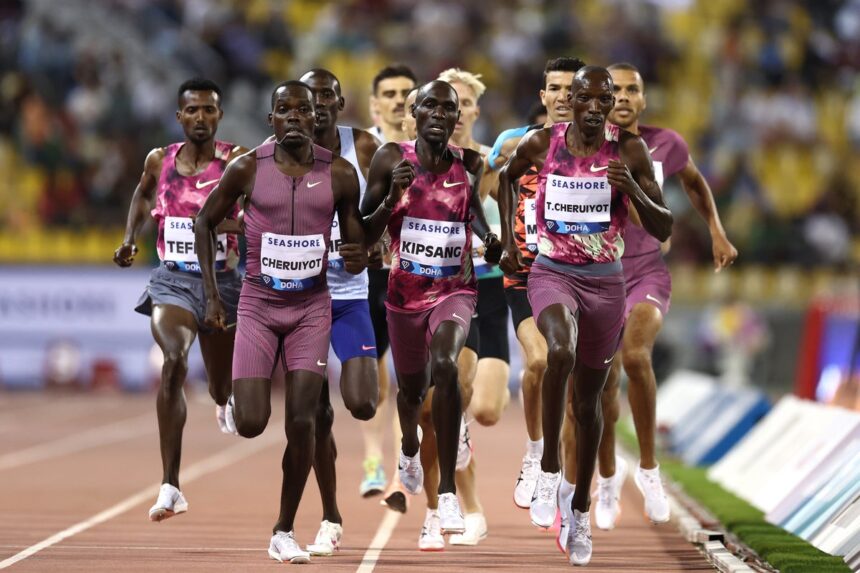
Doha Diamond League in the Balance: Can Athletics’ Season Opener Navigate Regional Turmoil?
The crisp, air-conditioned air of the Qatar Sports Club stadium in Doha has become a familiar opening scene for the global athletics season. As the first stop of the prestigious Wanda Diamond League, it traditionally sets the tone for a summer of world-class competition. This year, however, the roar of the sprinters may be drowned out by the distant echoes of geopolitical strife. With the Middle East engulfed in conflict, the fate of the May 8th Doha meet hangs in the balance, posing a profound challenge to the sport’s governing bodies and casting a shadow over the 2024 season.
Following US and Israeli air strikes on Iran in late February, a wave of instability has rippled across the region, disrupting the carefully laid calendars of international sport. The Diamond League, track and field’s premier circuit, now finds itself in a precarious position, forced to weigh the imperative of athlete safety against the logistical and commercial momentum of the season. While organizers have stated the meet is “currently scheduled to go ahead,” the active exploration of “alternative options” reveals a deep-seated contingency planning rarely seen for an event of this stature.
A Precedent of Disruption: Sport’s Fragile Dance with Geopolitics
The current situation is not an isolated incident. The conflict has already demonstrated its capacity to upend the sporting world. Several events across the region have been postponed or thrown into doubt, creating a precedent of disruption that Diamond League officials cannot ignore. When geopolitics and global sport collide, the latter almost always yields. The fundamental question is no longer *if* the conflict affects scheduling, but *how severely* and for *how long*.
This vulnerability highlights a critical tension in modern athletics. The sport has aggressively expanded its footprint, seeking new markets and revenue streams in regions like the Middle East and Asia. Doha, a hub for international sport, has been central to this strategy, hosting not only the Diamond League but also the 2019 World Athletics Championships. This expansion, however, comes with inherent risk. Event security protocols and political risk assessments are now as crucial as lane assignments and starting blocks. The statement from the Diamond League, emphasizing they are “working in close coordination with… the relevant authorities in Qatar,” underscores this shift from pure sports management to complex crisis diplomacy.
The Stakes: More Than Just a Season Opener
Postponing or relocating the Doha Diamond League is a logistical nightmare with cascading consequences. This isn’t merely a one-off meet; it’s a meticulously choreographed opening act.
- Athlete Preparation and Peak Performance: Elite athletes build their entire annual training cycles around Diamond League events, which offer crucial world ranking points, qualification standards, and high-level competition. Doha’s early-season timing is specifically designed to kickstart form. Disruption here forces a recalibration of training peaks, potentially impacting readiness for the summer’s pinnacle event, the Paris 2024 Olympics.
- Commercial and Broadcast Implications: The Diamond League operates on significant commercial partnerships and global broadcast deals. A late change to the schedule creates contractual headaches, travel chaos for crews, and potential revenue shortfalls. The financial impact of cancellation would be felt by the local organizing committee, sponsors, and the league itself.
- Competitive Integrity of the Circuit: Each meet on the 15-event calendar offers a specific set of disciplines. Athletes plan their seasons around which meets host their events. Moving Doha could create an imbalance, unfairly advantaging or disadvantaging athletes in certain events depending on the alternative solution found.
The decision, promised by early April, is therefore a high-pressure calculus. Organizers must balance the absolute primacy of safety against these substantial sporting and commercial stakes.
Expert Analysis: Navigating the Uncharted Territory
From a logistical standpoint, the Diamond League does have options, though none are ideal. The most likely alternative hosting scenarios would involve shifting the meet to another established Diamond League venue earlier in the schedule, such as Suzhou (China) or moving it to a European standby location. However, securing venues, permits, and local organization on such short notice is a monumental task.
The other, more radical option is a virtual cancellation—simply dropping the event from the calendar and adjusting the points structure for the Diamond League final. This would be a last resort, damaging the league’s brand and depriving athletes of a key competitive opportunity.
The role of the Qatar Athletics Federation and Qatari authorities is pivotal. Qatar has invested billions in positioning itself as a global sports sanctuary, a neutral ground capable of hosting events amid regional turbulence. Their ability to provide ironclad security assurances and demonstrate a stable environment will be the single biggest factor in the final decision. The coming weeks will be a intense period of behind-the-scenes risk assessment and diplomatic assurance.
Predictions and the Path Forward
Based on the organizers’ current language and the early April decision deadline, a last-minute relocation seems the most probable outcome if the meet is moved. The statement’s careful phrasing—”currently scheduled to go ahead”—suggests a strong desire to proceed, but with a clear exit strategy.
Prediction 1: There is a 60% chance the meet is relocated to another Diamond League city, likely creating a compressed early-season double-header with another event.
Prediction 2: There is a 35% chance it proceeds in Doha under significantly enhanced, visibly tightened security, with potential athlete withdrawals from those whose federations or personal advisors deem the risk too high.
Prediction 3: There is a 5% chance of outright cancellation, which would only occur if the regional situation deteriorates markedly in the coming weeks.
Regardless of the outcome, this episode serves as a stark reminder. It will inevitably lead to a reevaluation of the Diamond League calendar’s geopolitical risk. Future schedules may prioritize long-term stability over commercial expansion in volatile regions, or at the very least, mandate more robust contingency planning.
Conclusion: A Test of Resilience for Global Athletics
The uncertainty surrounding the Doha Diamond League is a microcosm of the challenges facing international sport in an increasingly fragmented world. The track, a symbol of pure, unadulterated competition, cannot exist in a vacuum. It is laid across the real world, with all its complexities and conflicts.
The final decision in early April will reveal much about the sport’s priorities and its capacity for agile governance. Will it be a triumph of logistical ingenuity and diplomatic coordination, or a reluctant admission that some forces are beyond the control of even the most powerful sporting bodies? One thing is certain: the starting pistol for the 2024 Diamond League season will be fired not just by a starter, but by a committee weighing safety, sport, and the unsettling winds of conflict. How athletics navigates this hurdle will set a precedent for years to come, proving that the race for peace and stability is the most important one run off the track.
Source: Based on news from Yahoo Sports.