Dolphins Make Painful Cap Decision: Miami Releases Bradley Chubb
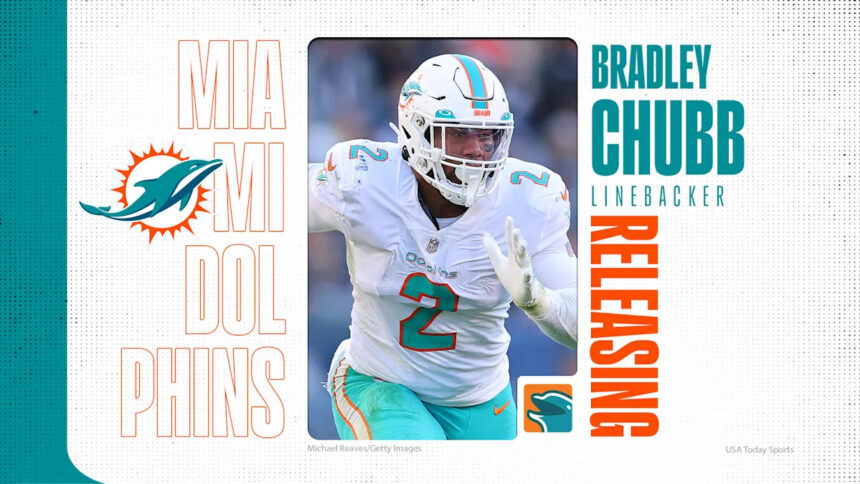
The Miami Dolphins’ offseason of financial reckoning has claimed its most significant and symbolic victim. According to a report from NFL Network’s Tom Pelissero, the Dolphins are releasing veteran pass rusher and team captain Bradley Chubb in a stark move to alleviate severe salary cap pressure. This decision, while fiscally logical, underscores the harsh realities of NFL roster management and marks the end of a costly, injury-marred era for a player who embodied both peak performance and profound misfortune in South Florida.
The Unavoidable Math of a Massive Cap Hit
For the Dolphins’ front office, this was less a football decision and more an accounting imperative. The numbers were simply untenable. Chubb was slated to count a staggering $31.2 million against the Dolphins’ 2026 salary cap and another $31.5 million in 2027—figures that are astronomical for any non-quarterback. The central question now is not “if,” but “how” Miami structures the release, a choice with significant short and long-term ramifications.
The team faces two primary options:
- Immediate Release: This path would provide only $7.3 million in cap savings this year, a relatively modest sum given the team’s overall cap constraints, while incurring a massive dead money charge.
- Post-June 1 Designation: This more strategic move would delay the cap relief until after June 1 but would ultimately clear $20.2 million from the team’s salary cap for the 2026 league year. It would also spread the remaining dead money over the 2026 and 2027 seasons.
Given Miami’s well-documented cap crunch, the post-June 1 designation is the overwhelming favorite, offering the breathing room needed to sign their draft class and perhaps add a few budget-free agents. It is a classic example of kicking the financial can down the road, a practice the Dolphins have used frequently and are now paying for.
A Tale of Two Seasons: Peak Performance and Devastating Injury
Bradley Chubb’s tenure with the Dolphins was a heartbreaking narrative of “what could have been.” Acquired in a blockbuster 2022 midseason trade from the Denver Broncos, Chubb was meant to be the final, fearsome piece of a championship-caliber defense. For a brief, brilliant period in 2023, he was exactly that. He racked up 11 sacks with a league-leading six forced fumbles, playing at a legitimate Defensive Player of the Year candidate level. His impact was transformative, a constant disruptive force that elevated the entire unit.
Then, catastrophe struck. A devastating knee injury ended his 2023 season prematurely and wiped out his entire 2024 season. His triumphant return in 2025 was a testament to his resilience; named a team captain, he led the Dolphins with 8.5 sacks and was honored as the team’s Walter Payton Man of the Year nominee for his impactful community work. Yet, the specter of the injury and the looming cap charges cast a long shadow over this comeback story. The Dolphins were paying for the 2023 version of Chubb, while the post-injury reality, though still productive, presented an unacceptable financial risk.
The Great Pass Rush Exodus: Rebuilding from Scratch
Chubb’s release is not an isolated event. It is the culmination of a dramatic dismantling of what was once considered the strength of the franchise. Just months ago, the Dolphins traded away former first-round pick Jaelan Phillips to the Philadelphia Eagles, parting with another dynamic, yet injury-prone, edge talent. In a span of one season, Miami has gone from boasting one of the most enviable young pass-rushing duos in the league to starting from near scratch.
The torch now passes to a completely unproven group. Chop Robinson, a first-round pick in 2024, will be thrust into the role of primary pass rusher, with backups Quinton Bell and Cameron Goode providing depth. The pressure on Robinson to develop into a star is immense and immediate. This dramatic turnover signals a clear, if painful, shift in team-building philosophy: moving away from high-priced, veteran stars and towards a younger, cheaper, and hopefully healthier foundation. The Dolphins’ defense will look radically different in 2026, betting on potential over proven production.
Expert Analysis: A Necessary, Yet Painful, Reset
From a pure roster construction standpoint, this move is unavoidable. The Dolphins’ salary cap situation has been a ticking time bomb, built on restructures and back-loaded contracts. Chubb’s deal was a prime candidate for correction. The NFL is a production-versus-cost league, and a 30-year-old edge rusher with a major knee injury in his recent past is a perilous investment at over $30 million per season.
However, the human and locker room element cannot be ignored. Releasing a respected team captain and community pillar sends a chilling message about the business’s ruthlessness. It creates a leadership void on defense and places immense pressure on the coaching staff to cultivate a new culture. The Dolphins are banking that the cap flexibility gained will allow them to address multiple roster holes, theoretically creating a more balanced and sustainable team.
What’s next for Bradley Chubb? His market will be fascinating. He will likely attract contenders on short-term, “prove-it” deals heavy on incentives. Teams like the Baltimore Ravens, Detroit Lions, or a return to the AFC East with the Buffalo Bills could be logical fits for a motivated veteran seeking a ring. He remains a potent pass rusher when healthy, but the injury history will suppress his value.
Conclusion: The Price of Past Ambition
The release of Bradley Chubb is a defining moment for the Chris Grier and Mike McDaniel era. It is the bill coming due for the aggressive, all-in maneuvers of previous seasons. While the 2023 version of Chubb was worth every penny, the NFL’s unforgiving calendar and salary cap wait for no one, not even a team captain and Man of the Year nominee.
For the Dolphins, this is a painful but necessary step in a protracted salary cap detox. The era of the superstar-laden defense is over, replaced by a focus on youth, development, and fiscal responsibility. For Bradley Chubb, it is an abrupt and unceremonious end to a Miami chapter filled with spectacular highs and tragic lows. His legacy will be one of brilliant, fleeting dominance and a stark reminder that in the modern NFL, financial viability is as critical to a championship blueprint as talent itself. The reset button in Miami has been pressed, and the rebuild on the edge begins now.
Source: Based on news from Yahoo Sports.