Edgecombe’s Grit, Maxey’s Flash Lead 76ers to Stunning Game 2 Victory, Tie Series with Celtics
In the crucible of the NBA playoffs, where narratives are forged and legends take their first steps, the Philadelphia 76ers authored a defiant response on Tuesday night. Facing a potential 0-2 deficit against the juggernaut Boston Celtics, the Sixers leaned on a stunning rookie performance and the electric brilliance of their All-Star guard to secure a commanding 111-97 victory. The story of the night, and perhaps the series, was the emergence of VJ Edgecombe, whose pain-defying 30-point, 10-rebound double-double, combined with Tyrese Maxey’s 29-point offensive showcase, has dramatically shifted the momentum and tied this Eastern Conference semifinal at one game apiece.
A Rookie’s Trial by Fire: Edgecombe’s Defining Moment
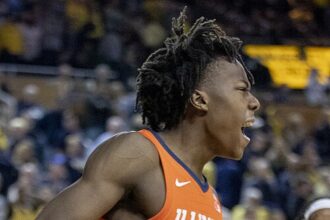
The game’s pivotal moment came not in the final minutes, but in the first quarter. Rookie sensation VJ Edgecombe, driving hard to the rim, took a terrifying, awkward fall, landing on his side and remaining down for an anxious minute. The collective breath of the Wells Fargo Center hitched. Yet, after a brief trip to the locker room, Edgecombe returned. And he didn’t just return; he dominated.
Playing through evident discomfort, Edgecombe transformed from a promising first-year player into a playoff cornerstone. His 30 points were a masterclass in efficient aggression, attacking closeouts and finishing through contact. His 10 rebounds, many in traffic, underscored a toughness that cannot be taught. This was more than a stat line; it was an announcement. Edgecombe’s resilience became the emotional fuel for his team, proving that Philadelphia’s playoff hopes run deeper than their established stars.
- Key Impact: Provided critical secondary scoring, alleviating pressure on Joel Embiid.
- Intangible Factor: His willingness to play through pain set a physical, defiant tone for the entire roster.
- Series Alteration: Forces Boston to game-plan for a major, confident offensive threat beyond their primary concerns.
Maxey’s Speed Kills: Unlocking the Celtics’ Defense
While Edgecombe provided the grit, Tyrese Maxey supplied the lightning. After a relatively quiet Game 1, Maxey exploded in Game 2, his 29 points acting as the Celtics’ persistent nightmare. Boston’s defense, so stout for much of the season, had no answer for his blinding first step and improved playmaking. Maxey consistently turned the corner on high pick-and-rolls, putting immense pressure on Boston’s bigs and creating open looks for himself and others.
More than just his scoring, Maxey’s pace was the key offensive catalyst for Philadelphia. He pushed the ball relentlessly in transition, preventing Boston’s elite half-court defense from getting set. This strategic tempo control, orchestrated by Maxey, was a decisive factor. When the Celtics threatened to make runs, it was often Maxey who silenced them with a pull-up three, a daring drive, or a perfectly timed dish. His performance was a reminder that in the playoffs, a singular, unstoppable guard can be the great equalizer against a more talented overall roster.
Strategic Adjustments: How Philly Turned the Tide
Coach Nick Nurse’s adjustments from Game 1 to Game 2 were profound and effective. The 76ers didn’t just play harder; they played smarter. Defensively, they were far more committed to running the Celtics off the three-point line, forcing Boston into more contested two-point attempts. The communication on switches was sharper, and the help defense was timely, leading to a more disjointed offensive night for Jayson Tatum and Jaylen Brown.
On the other end, the offense flowed through Joel Embiid as a facilitator from the high post more frequently, a move that pulled Boston’s rim protector, Kristaps Porzingis, away from the basket. This created driving lanes for Maxey and Edgecombe to exploit. The Sixers’ defensive intensity, particularly on the perimeter, was the underrated foundation of this win. They turned defensive stops into early offensive opportunities, a formula that negates Boston’s structured half-court strengths.
Series Forecast: Pressure Shifts to Boston
With the series tied 1-1 heading to Philadelphia for Game 3, the tectonic plates of pressure have undeniably shifted. The Celtics, who owned the NBA’s best regular-season record, are now facing a confident opponent that has proven it can withstand Boston’s best punch and counter effectively. The questions now land squarely in Boston’s locker room.
- How do they adjust to VJ Edgecombe? He is no longer an afterthought; he is a primary scouting report item.
- Can they slow down Tyrese Maxey’s penetration? Their drop coverage was eviscerated in Game 2.
- Do the Celtics have the requisite toughness? Philadelphia won the 50/50 balls and the physical battles in Game 2.
For the 76ers, the mission is clear: protect home court. The energy from Edgecombe’s heroics and Maxey’s brilliance must translate into a sustained, physical style of play for the remainder of the series. Joel Embiid, while impactful as a passer and defender, will need to hunt his offense more aggressively as the series progresses. The blueprint, however, is now clear.
Game 2 was not merely a win for the Philadelphia 76ers; it was a statement of identity. It was a declaration that they possess not only the star power in Tyrese Maxey, but also the unexpected, heroic depth in VJ Edgecombe. It proved that playoff resilience can sometimes outweigh regular-season pedigree. As the scene shifts to South Philadelphia, the Celtics must solve a puzzle that became exponentially more complex on Tuesday night. The 76ers, behind their dazzling guard and his gritty rookie counterpart, have ensured this is no longer a coronation for Boston—it’s a fight.
Source: Based on news from ESPN.
Image: CC licensed via commons.wikimedia.org