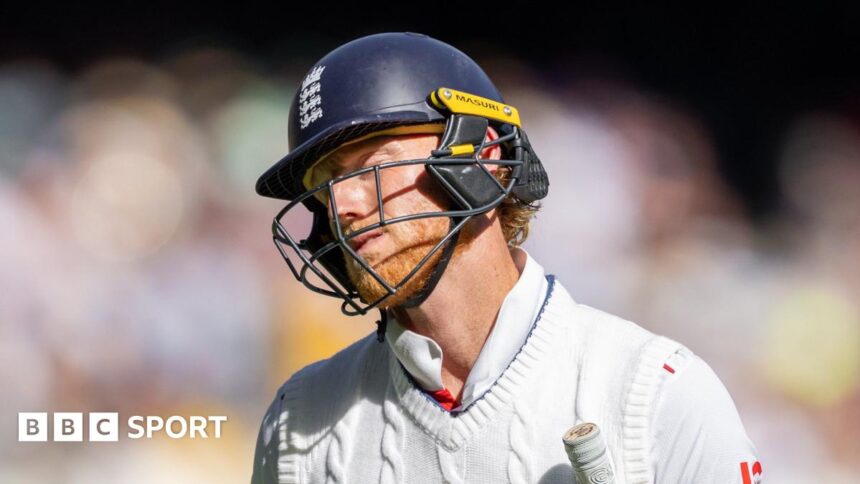
England Rolled for 110 on Chaotic Day of Carnage at the MCG
The hallowed turf of the Melbourne Cricket Ground, a theatre of dreams for many, transformed into a house of horrors for England on a breathtakingly chaotic opening day of the Fourth Ashes Test. In a stunning reversal of fortunes, England’s bowlers, led by the fiery Josh Tongue, skittled Australia for a seemingly subpar 152, only for their batting order to implode in spectacular fashion, rolled for a paltry 110. The day, a masterclass in relentless seam bowling and abject batting collapse, leaves the Ashes hanging by a thread and has already etched itself into the folklore of this storied rivalry.
A Morning of English Ascendancy: Tongue Unleashes Fire
Under heavy Melbourne skies, Pat Cummins’s decision to bat first appeared a bold gamble. It backfired spectacularly as Josh Tongue, extracting steep bounce and movement, produced a career-defining spell. He was the chief architect of Australia’s demise, claiming a magnificent 5-45. His dismissal of Steve Smith, caught behind fending at a brutish short ball, set the tone for a morning of Australian frailty. Supported by disciplined lines from Stuart Broad and the ever-threatening James Anderson, England’s attack was clinical. Australia’s innings subsided to 152, with Michael Neser’s counter-attacking 35 providing late resistance. At lunch, England, and their travelling Barmy Army, were in dreamland, believing a series-levelling victory was there for the taking.
- Josh Tongue’s 5-45 dismantled Australia’s top and middle order.
- Australia’s 152 all out seemed a decisive advantage for England.
- The MCG pitch showed significant seam movement and variable bounce.
The Collapse: Carnage in the Melbourne Afternoon
What followed after the break was one of the most dramatic passages of play in recent Ashes memory. The England collapse was swift, total, and utterly devastating. If England’s bowlers had exploited the conditions expertly, Australia’s attack, led by the metronomic Scott Boland (3-30) and the bustling Michael Neser (4-45), mastered them. Boland, the local hero, was unplayable, hitting a perfect length that forced indecision. Zak Crawley, Ben Duckett, and Ollie Pope were gone in a flash, all trapped in front or edging behind. Joe Root fell to a stunning catch by Marnus Labuschagne, and the heart of England’s batting was ripped out before the tea interval had even arrived.
The post-tea session offered no respite. Ben Stokes fought briefly but fell to Neser, and only a flurry from the talented Harry Brook (41) provided a flicker of resistance, pushing England past the ignominy of a sub-100 total. The innings lasted a mere 35.2 overs, a humiliating capitulation that saw England lose their last seven wickets for 62 runs. The pressure applied by Australia’s attack was unrelenting; every ball seemed an event, every edge carried, every lbw shout plausible.
Expert Analysis: Where Did It All Go Wrong for England?
From a position of profound strength at lunch, England’s day unravelled with alarming speed. The analysis points to a combination of technical failings and, perhaps more crucially, a catastrophic mental shift. Psychologically, transitioning from the aggressive, successful mindset of the bowling group to the focused discipline required for batting on a treacherous pitch proved too much.
Technical deficiencies against the moving ball were glaring. Too many batters played with hard hands, their bats away from their bodies, a recipe for disaster on a MCG pitch offering consistent seam movement. Furthermore, the failure to adapt was stark. Where Australian lower-order players like Neser simplified their game and looked to score, England’s top order seemed frozen, caught between defence and attack.
Conversely, Australia’s tactical nous was superb. Cummins used his bowlers in short, sharp bursts, and the introduction of Neser as a change bowler was inspired. His ability to angle the ball across the right-handers and straighten it proved England’s undoing. The fielding, epitomized by Labuschagne’s blinder, was razor-sharp, amplifying the pressure with every dot ball.
The State of Play and Series Predictions
At stumps, Australia had navigated a tricky four-over period to reach 4-0, trailing by just 38 runs with all wickets intact. The match, and likely the Ashes urn, now sits firmly in their grasp. A lead of 150-200 on this surface will be monumental, potentially insurmountable.
Predictions for the remainder of the Test now seem ominously straightforward. England must produce a miraculous bowling performance on day two, early and often, to have any hope. Realistically, Australia will look to bat once and bat big, grinding England into the dust and setting a target in excess of 350. For England, the task is not just to avoid defeat but to salvage pride. The manner of this chaotic day in Melbourne—losing ten wickets for 110 after bowling Australia out for 152—will leave deep psychological scars.
- Australia holds all the cards, with a 38-run deficit and 10 wickets in hand.
- Batting last on this deteriorating MCG pitch will be a nightmare.
- The Ashes urn is now Australia’s to lose, requiring a collapse of their own to let England back in.
Conclusion: A Day That Defines an Ashes Series
Days like this at the MCG are why the Ashes captivates the sporting world. It was a raw, brutal, and utterly compelling exhibition of Test cricket at its most unforgiving. England’s bowlers showcased skill and heart, but their batters displayed a fragility that has become a recurring nightmare. For Australia, it was a day of resilience, a demonstration of their champion mentality to strike back immediately when down. The scorecard—Australia 152 & 4-0, England 110—tells a story of stunning parity in bowling but a chasmic divide in batting application. As the Melbourne shadows lengthened, one could not escape the feeling that the destiny of the Ashes had been decisively, and perhaps irrevocably, shaped in one chaotic day in Melbourne.
Source: Based on news from BBC Sport.