The Sacking Heard ‘Round the World: Flamengo Axes Filipe Luis After Historic 8-0 Win
In the often-unpredictable theater of global football, few moments leave fans and pundits genuinely speechless. The early hours of Tuesday morning in Rio de Janeiro provided one such moment. Flamengo, the Brazilian behemoth, announced the shocking dismissal of their head coach, Filipe Luis, mere hours after his team had delivered a breathtaking 8-0 demolition of Madureira to storm into the Campeonato Carioca final. The football world was left to reconcile a seemingly impossible equation: how does a manager get fired on the back of an aggregate 11-0 victory? The answer lies in the high-stakes, trophy-or-bust pressure cooker that is Flamengo, where past glory is never enough, and the future is always now.
A Stunning Exit After a Goal Glut
The sequence of events reads like a surrealist script. On Monday night, Filipe Luis’s Flamengo executed a footballing masterclass, routing Madureira 8-0 at the iconic Maracanã. The victory sealed their place in the state championship final, where they will seek a third consecutive title. The mood was celebratory; the performance, dominant. Yet, by Tuesday morning, the 40-year-old former Chelsea and Atlético Madrid defender was out of a job. The club’s brief statement cited a “need for a new direction” and thanked him for his services, a cold corporate epitaph for a reign that was, by any objective measure, wildly successful on paper.
This decision wasn’t made in a vacuum. It was the culmination of a specific, mounting pressure. Despite the Carioca dominance, Flamengo had stumbled in two crucial finals just weeks prior:
- Supercopa do Brasil Final (Feb 2026): Lost to Palmeiras.
- Recopa Sudamericana Final (Feb 2026): Lost to Argentine side Rosario Central.
For a club with Flamengo’s resources and expectations, consecutive final defeats are seen not as noble efforts, but as failures. The 8-0 win became not a saving grace, but merely the final act of a narrative the board had already written.
Deconstructing the Duality of Filipe Luis’s Reign
To understand the shock, one must first appreciate the sheer statistical weight of Filipe Luis’s 100-match tenure. Stepping into the massive shoes left by former Brazil coach Tite in September 2024, the rookie manager delivered silverware at a dizzying pace.
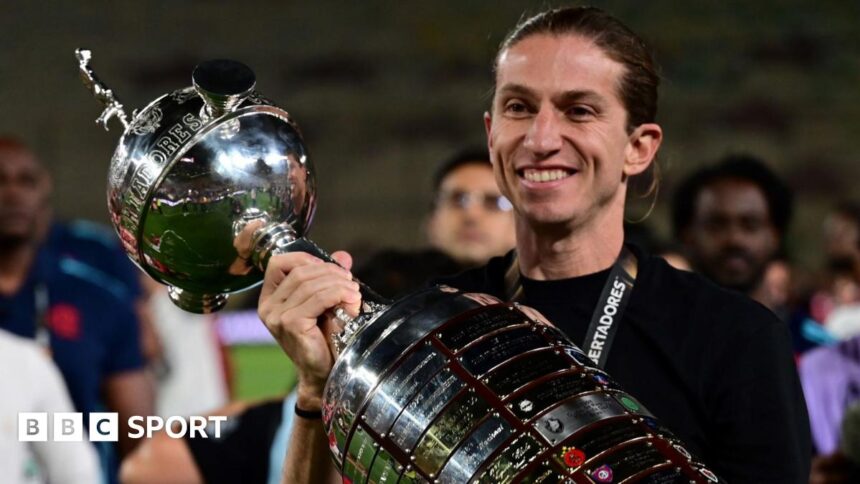
Expert Analysis: Luis’s philosophy was a clear extension of his playing identity: pragmatic, structured, and defensively intelligent, honed under Diego Simeone at Atlético Madrid. He averaged a staggering trophy every 14 games, securing seven titles in his century of matches. This included two Campeonato Carioca titles, the Brazilian Cup, and the 2025 Copa Libertadores, South America’s premier club competition. His win percentage hovered around an impressive 70%. By these metrics, his sacking is not just harsh; it’s bordering on irrational.
However, the other side of the coin reveals the brutal reality of managing a club like Flamengo. The recent final losses highlighted a perceived tactical rigidity in big, one-off matches. Critics argued that while his system bulldozed domestic opponents, it could be found wanting against equally prepared continental rivals. Furthermore, whispers of discontent regarding man-management and relationship with key squad veterans had begun to surface. In the end, the Flamengo hierarchy looked past the goal-laden Monday night and saw a trend they feared would continue into the more important Brasileirão and Libertadores campaigns ahead.
The Flamengo Mindset: A Culture of Relentless Demand
Flamengo is not just a football club; it’s a national institution with over 40 million passionate supporters. This creates an environment where the demand for not just success, but *dominant* success, is absolute. The board operates with a Champions League mentality in a South American context, where managerial turnover is high and patience is notoriously thin.
The timing, while brutal, is strategic. The Carioca final this Sunday is now an immediate opportunity for a new manager to start with a trophy. The Brazilian national league has not yet begun, and the Copa Libertadores group stage is just around the corner. The board decided to make the ruthless call now, giving a new coach a “clean” start with a final, rather than waiting for a potential crisis later. It’s a pre-emptive strike, a chilling reminder that at Flamengo, you are only as good as your next trophy.
What’s Next for Flamengo and for Filipe Luis?
Predictions for Flamengo: The club will move swiftly to appoint a high-profile replacement. Names like Jorge Jesus, who led them to Libertadores glory in 2019, or another European-experienced tactician will be at the top of the list. The immediate focus will be on winning the Carioca final against Fluminense this weekend—a game now laden with even more drama. The long-term project, however, will be judged solely on reclaiming the Brasileirão title and conquering the Libertadores again. The new manager inherits a fantastically talented squad but also the heaviest of expectations.
Predictions for Filipe Luis: Despite the brutal nature of his exit, Luis’s stock remains curiously high. He is a young, proven winner with a glittering resume from his first 100 games. His 333 appearances for Atlético Madrid and his pedigree from his time at Chelsea grant him immense credibility. He will likely not be short of offers, potentially from mid-table La Liga sides, Portuguese giants, or other ambitious Brazilian clubs. This sacking may be a bizarre footnote that ultimately accelerates his European managerial career, much like his playing days.
Conclusion: A Sobering Lesson in Modern Football
The sacking of Filipe Luis after an 8-0 win is not a football story; it is a story about the modern football *business*. It underscores a disturbing trend where context, legacy, and historic achievements are sacrificed at the altar of perpetual forward momentum and fear of future failure. Luis’s reign will be remembered as a paradox: one of the most statistically successful managerial stints in modern Brazilian history, yet one deemed not successful enough.
As Flamengo turns the page with characteristic coldness, the football world is left with an indelible image: a manager achieving a perfect, triumphant night, only to be handed his papers before the stadium lights have fully dimmed. It is a stark reminder that in the upper echelons of the sport, you can win big, but you can never stop winning. For Filipe Luis, the final whistle on his Flamengo career wasn’t blown by the referee, but by a boardroom that had already moved on.
Source: Based on news from BBC Sport.