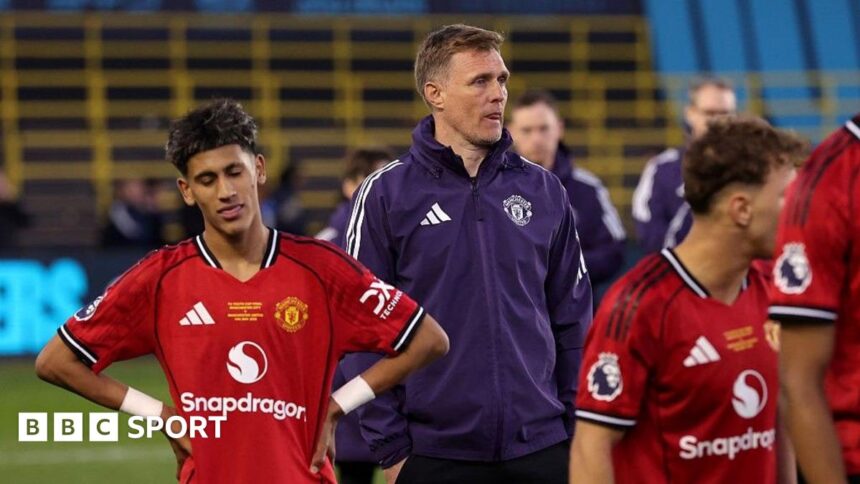
FA Let Man City Take Over Youth Cup Final – Darren Fletcher Slams ‘Soulless’ Showpiece
Manchester United legend turned youth coach Darren Fletcher has launched a blistering attack on the Football Association’s handling of the FA Youth Cup final, claiming the governing body effectively allowed Manchester City to “take over” the showpiece event. Speaking exclusively after his side’s 2-1 defeat at the Joie Stadium on Thursday night, Fletcher did not mince words, describing the atmosphere and logistics as a major disservice to the competition’s prestige.
The loss capped a bitterly disappointing campaign for United’s Under-18s, who also fell short in the Premier League Under-18 Cup final and finished second to City in the league. Yet for Fletcher, the result was secondary to a deeper frustration: the feeling that the FA had ceded control of its own flagship youth final to the host club.
“It felt like City had taken over the whole competition,” Fletcher said, his voice carrying the weight of a man who has won this trophy as a player. “The FA need to look at themselves. This is their final. It should feel neutral, special, and about the players. Instead, it felt like an away game in every sense—right down to the music, the announcer, and the build-up.”
Here is the full story of a controversial night in Manchester, the fallout that threatens to overshadow a thrilling match, and what it means for the future of English youth football.
The ‘Soulless’ Atmosphere That Sparked Fury
Fletcher’s primary grievance centred on the venue selection and matchday experience. The FA Youth Cup final has historically been held at neutral stadiums—most often at Old Trafford or the Etihad—but this year’s showpiece was staged at City’s Academy Stadium, the 7,000-seater home of the club’s women’s and under-23 teams. United fans were allocated a single, cramped section behind one goal, while City supporters filled the rest of the ground.
“It wasn’t a final,” Fletcher continued. “It was a home game for them. The PA system, the pre-match videos, the way they announced the teams—everything screamed ‘City’. Where was the FA’s branding? Where was the sense of occasion? I looked around and thought, ‘This is supposed to be the most prestigious youth cup in England?’”
The former Scotland captain pointed to specific examples:
- Matchday announcer: The same voice used for City’s women’s and U23 games led the stadium announcements, with zero neutral tone.
- Pre-match entertainment: A montage of City’s previous Youth Cup triumphs played on the big screen, featuring exclusively City players and managers.
- Ticket allocation: United received fewer than 1,500 tickets in a stadium where demand far exceeded supply, leading to a sea of blue on three sides.
- Lack of FA presence: Fletcher noted that FA officials were barely visible, with no formal trophy presentation ceremony on the pitch—just a handshake in the tunnel.
“The players deserve better,” he added. “These kids have worked their whole lives for this moment. And what do they get? A glorified training ground with the opposition’s logo everywhere. It’s not good enough.”
On the Pitch: City Edge a Tense, Tactical Battle
While Fletcher’s post-match comments dominated headlines, the game itself was a compelling contest that showcased the depth of talent in both academies. Oliver Reiss’s City side were the deserved winners, but United pushed them all the way in a final that swung on fine margins.
City took the lead in the 23rd minute through a stunning strike from Justin Oboavwoduo, who curled a first-time effort into the top corner after a clever short corner routine. United responded well, with star forward JJ Gabriel causing constant problems down the left flank. The 17-year-old, who has been tipped for a first-team breakthrough, saw a curling shot tipped onto the bar by City goalkeeper True Grant just before half-time.
United equalised in the 58th minute when Ethan Wheatley bundled home from a corner, but City restored their lead just 12 minutes later. A defensive mix-up allowed Matty Henderson-Hall to poke home from close range, and despite a frantic final 15 minutes, United could not find a second equaliser.
Fletcher admitted his team were second best on the night but insisted the occasion should have been bigger. “They were the better team, full credit to them. But that’s not the point. The point is that this competition is supposed to be about the FA, about English youth football, about a neutral celebration. It wasn’t. It was a City promotional event.”
Key tactical observations:
- City’s pressing game was relentless, forcing United into 14 turnovers in their own half.
- United struggled to break City’s low block after taking the lead, lacking a creative midfielder to unlock the defence.
- JJ Gabriel was United’s standout player, completing 8 dribbles and creating 3 chances, but lacked support in the final third.
- City’s wing-backs, Kian Noble and Jahmai Simpson-Pusey, dominated the flanks, providing width and defensive cover.
Expert Analysis: A Symptom of a Bigger Problem?
Fletcher’s outburst is not an isolated complaint. For years, critics have argued that the FA Youth Cup has lost its lustre, overshadowed by the Premier League’s Under-18 and Under-21 competitions, and undermined by inconsistent venue choices. The decision to hold the final at a club’s academy ground—rather than a neutral, iconic venue—has been a growing trend, with the FA citing cost-cutting and logistical simplicity.
“The FA Youth Cup is the oldest youth competition in the world,” said former England youth coach John Peacock, who led the U17s to European glory in 2010. “It should be treated with reverence. When you play at a club’s training ground, you lose the magic. The kids don’t get that ‘Wembley feeling’. It becomes just another game.”
The numbers back up the concern. Attendance for this year’s final was 6,847—respectable but far from the 15,000-plus that regularly attended finals at Old Trafford in the 1990s and 2000s. Broadcast viewership has also declined, with the final now streamed exclusively on the FA’s YouTube channel rather than on mainstream television.
Fletcher believes the solution is simple: return the final to a neutral, iconic venue.
- Old Trafford – A natural home for youth finals, with 74,000 capacity and a history of hosting showpieces.
- Wembley Stadium – The ultimate prize for any young player, but costly and rarely used for youth finals.
- St George’s Park – The FA’s own national football centre could provide a neutral, high-quality setting.
- Rotate among Premier League stadiums – Ensure no club has a home advantage, and spread the prestige.
“It’s not rocket science,” Fletcher said. “Pick a neutral ground, make it an event. Bring in the FA branding, have a proper trophy lift, let the families feel proud. Right now, it feels like a glorified friendly.”
What This Means for Manchester United’s Academy—and the Future
Despite the defeat, Fletcher’s young United side have shown immense promise this season. They reached two cup finals and pushed City close in the league, all while integrating several U16 players into the U18 setup. JJ Gabriel, in particular, has been a revelation, drawing comparisons to a young Marcus Rashford for his direct running and composure in front of goal.
But the academy’s long-term health is about more than results. Fletcher’s public criticism of the FA suggests a deeper frustration with the structural inequalities in English youth football. City’s academy, backed by the club’s vast resources, has produced a conveyor belt of talent—from Phil Foden to Rico Lewis—while United’s production line has slowed in recent years.
“We’re not using the FA as an excuse,” Fletcher clarified. “We lost because City were better on the night. But the environment matters. When you walk into a stadium that feels like theirs, it affects your players. It’s a psychological disadvantage. The FA should be protecting the integrity of their own competition.”
Predictions for next season:
- United’s U18s will retain most of their core, including Gabriel and Wheatley, and are early favourites for the league title.
- City’s U18s, led by the impressive Oboavwoduo, will target a double repeat, but may lose key players to the U21s.
- The FA will face mounting pressure to review venue policy, with a formal complaint expected from United’s hierarchy.
- Expect a more neutral final in 2025—potentially at St George’s Park or a rotated Premier League stadium.
Conclusion: A Final That Deserved Better
Darren Fletcher’s words will sting the FA, but they are a necessary wake-up call. The Youth Cup final should be a celebration of English football’s future—a night when raw talent takes centre stage, untainted by club politics or venue bias. Instead, Thursday’s game felt like a missed opportunity: a compelling match played in an atmosphere that diminished its importance.
City deserve credit for their victory. Oliver Reiss has built a disciplined, technically gifted side that outplayed United in every department. But the broader narrative is about the competition itself. If the FA wants the Youth Cup to retain its status as the pinnacle of youth football, it must act. Neutral venues, better branding, and a genuine sense of occasion are not luxuries—they are essentials.
For now, Fletcher and his young charges will lick their wounds and rebuild. The defeat stings, but the lessons from this night go far beyond the scoreline. The FA, and English football as a whole, must listen—before the Youth Cup becomes just another trophy in the shadow of the Premier League’s money machine.
Source: Based on news from BBC Sport.