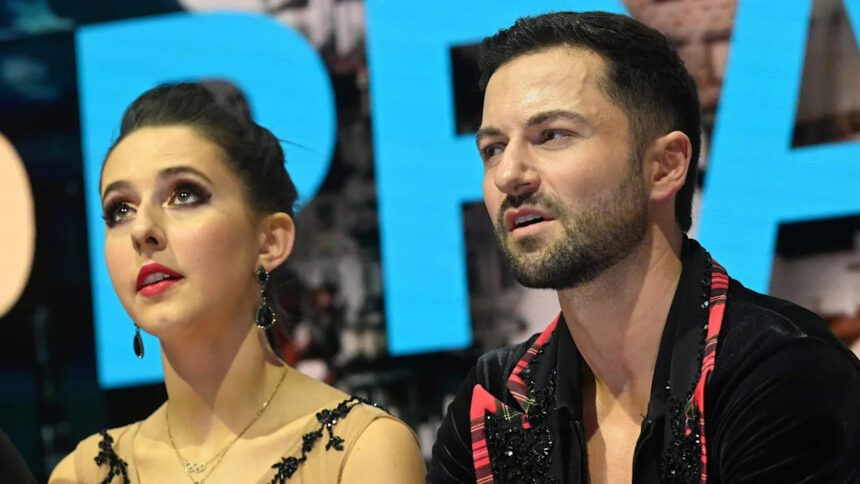
British Ice Skating Appeals ‘Incorrect’ Penalty That Cost Fear and Gibson World Bronze
The final day of the 2024 World Figure Skating Championships in Prague was supposed to be a coronation for British ice dance duo Lilah Fear and Lewis Gibson. After a stellar rhythm dance had them sitting in third, they delivered a captivating free dance to the soundtrack of Interview with the Vampire, seemingly securing their first-ever world championship medal. The celebration, however, was brutally short-lived. A devastating two-point deduction for an “illegal element” saw them plummet to fourth place, missing the podium by a heartbreaking 0.22 points. Now, British Ice Skating (BIS) has launched a formal appeal, calling the penalty “incorrect” and throwing the sport’s judging protocols into the spotlight.
A Dream Dashed in an Instant
As the final notes of their dramatic free dance faded, the roar from the Prague Arena crowd suggested a podium finish was assured. Fear and Gibson’s scores for technical elements and program components were strong. Yet, a glaring two-point deduction appeared on the scoreboard—a catastrophic penalty in a sport where victories are measured in hundredths. The Americans, Emilea Zingas and Vadym Kolesnik, who skated after them, capitalized, edging ahead by the slimmest of margins to snatch the bronze medal.
The official reason listed was simply an “illegal element.” While not explicitly confirmed in the protocol, multiple reports from on-site technical specialists and skating analysts indicate the deduction was for an overhead lift that violated the International Skating Union’s (ISU) strict rules regarding lift height and position. In ice dance, lifts must not extend above the man’s head, and the woman’s position is tightly regulated for safety and to maintain the discipline’s distinction from pairs skating. A momentary over-extension, invisible to the untrained eye, can be enough to trigger a severe deduction.
“We are incredibly proud of Lilah and Lewis’s performance at the World Championships,” a BIS statement read. “However, we believe the deduction applied to their free dance score was incorrect. We have therefore lodged a formal challenge with the ISU to review this decision.”
The Anatomy of a Controversial Call
To understand the gravity of the appeal, one must understand the precision of ice dance judging. Elements are scrutinized in real-time by a technical panel, which includes a technical controller and technical specialists, often former skaters themselves. Their calls are immediate and, under current ISU procedure, largely final during the event.
Expert analysis of the routine in question points to a specific, high-risk rotational lift. The infraction, as speculated by veteran commentators, likely involved Fear’s body rising slightly above the permitted plane relative to Gibson’s shoulders, or her posture exceeding the allowed arch. The key questions BIS’s appeal will pose are:
- Was the visual angle of the technical panel obstructed? Even with multiple camera feeds, a single perspective can be deceptive.
- Is there a consistent application of the rule? Skating fans and federations often point to perceived inconsistencies in how lifts are judged across different events and different teams.
- Does the punishment fit the infraction? A two-point deduction is massive, effectively nullifying the difficulty and execution of the entire element. Critics argue such penalties should be tiered based on the severity of the violation.
This incident is not happening in a vacuum. It follows a long history of post-event judging controversies in figure skating, where results are sometimes amended days later after official protests. The shadow of the 2022 Olympic team event scandal still looms large, eroding public trust in the system.
What’s Next: The Appeal Process and Its Implications
BIS’s formal challenge initiates a multi-step process. The ISU will convene a review panel, separate from the on-ice officials, to examine video evidence and the technical panel’s call. This is not a quick fix. The process can take weeks, and reversals of such deductions are historically rare. The hurdle is high: the appellant must prove a clear and unequivocal error was made in the application of the rule, not merely a difference in interpretation.
The potential outcomes are stark:
- Denial of Appeal: The standings remain. Fear and Gibson are left with a crushing “what if,” and pressure mounts on the ISU to clarify and potentially reform its real-time judging protocols for lifts.
- Successful Appeal: The deduction is removed. Fear and Gibson’s score would be recalculated, almost certainly bumping them back into the bronze medal position and dropping Zingas and Kolesnik to fourth. Medals would be reallocated—an unprecedented and awkward scenario for all involved.
Beyond the podium, the sporting consequences are significant. World Championship results directly impact funding, sponsorship, and seeding for future events. For Fear and Gibson, a confirmed bronze would solidify their status as global medal contenders heading into the next Olympic cycle.
A Legacy of Uncertainty and a Test of Resilience
Regardless of the appeal’s outcome, this moment will define Fear and Gibson’s career. They have handled the public devastation with remarkable grace, thanking fans and expressing pride in their performance. This poise will be critical as they move forward.
Predictions for the coming season are now twofold. First, we predict an intensified focus on technical precision in their training, with their coaching team likely implementing even more conservative measures on lifts to avoid any future doubt. Second, this controversy may galvanize them, creating a powerful narrative of injustice overcome. We can expect programs next season that are not only technically bulletproof but emotionally charged with the fire of Prague.
For the sport, this is another judging controversy it can ill afford. It highlights the perennial tension between athletic pushing of boundaries and the black-and-white letter of the law. Calls for increased transparency—such as live explanation of deductions or the publication of specific angle video used by the technical panel—will grow louder.
Conclusion: More Than Just Points on a Board
The story of Lilah Fear and Lewis Gibson at the 2024 World Championships is a brutal reminder that elite sport exists at the intersection of supreme human artistry and cold, unforgiving regulation. Their performance was, by any artistic measure, medal-worthy. Yet, a judgment call on a fraction of an inch has, for now, rewritten their story.
British Ice Skating’s appeal is a necessary fight, not just for 0.22 points, but for clarity, consistency, and fairness. Whether the bronze medal ultimately hangs around their necks or not, Fear and Gibson have been thrust into the center of a crucial debate about the soul of their sport. Their resilience in the face of this adversity may ultimately prove to be their most powerful lift of all—one that no judge can ever deduct.
Source: Based on news from Yahoo Sports.