


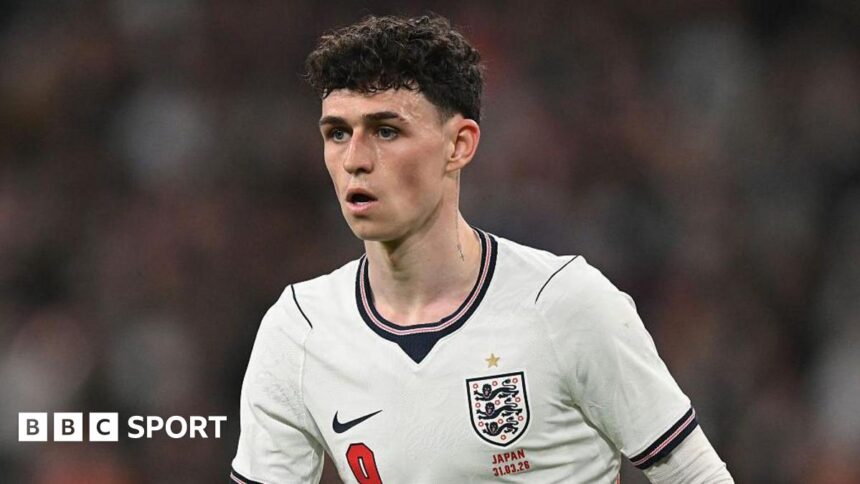
Tuchel’s Shock Warning: Phil Foden’s World Cup Spot in Jeopardy
In the often-sanitized world of international football management, where platitudes are common and hard truths are rare, Thomas Tuchel has delivered a seismic jolt. Following England’s tepid 1-0 defeat to Japan in their final pre-World Cup friendly, the Three Lions boss pointedly refused to guarantee a place for one of the nation’s most gifted talents: Phil Foden. The Manchester City star, long heralded as England’s golden boy, now finds himself in an unfamiliar and precarious position—fighting for his ticket to the global showpiece.
A False Nine Experiment That Backfired
The context of Tuchel’s startling admission is crucial. With captain and talisman Harry Kane rested, Tuchel deployed Foden in a central false nine role against a disciplined Japanese side. The experiment was a resounding failure. England looked devoid of creativity and cutting edge, with Foden struggling to influence the game from a position that demands constant movement, physical hold-up play, and lethal finishing—attributes not central to his winger/attacking midfielder skill set.
Foden cut an isolated figure, often dropping deep to seek the ball, which in turn left no focal point in the penalty area. The tactical gamble highlighted a potential flaw in Tuchel’s planning: an over-reliance on Kane’s unique profile. It also exposed Foden’s limitations when asked to lead the line against a compact, low-block defense, a scenario England will face frequently in Qatar.
- Tactical Misalignment: Foden’s best work comes from wide or drifting between lines, not with his back to goal.
- Kane Dependency: The performance amplified concerns about England’s plan B without their world-class striker.
- System Over Individual: Tuchel’s comments suggest he prioritizes a specific system where every cog must fit perfectly.
Reading Between the Lines of Tuchel’s “No Guarantee”
Tuchel’s post-match words were measured but brutally clear. “Well, it’s not a guarantee that he will come,” he stated when directly questioned about Foden’s squad security. For a player who started both of England’s September fixtures—the only outfielder to do so—this represents a dramatic shift in perception. Analysts are now parsing what this means for Tuchel’s selection philosophy.
Firstly, it underscores the German’s meritocratic and ruthless approach. Past accolades, club reputation, or transfer fees mean little. Current form, tactical suitability, and training ground application are the sole currencies. Secondly, it reveals the intense competition for places in England’s attacking quarters. With the likes of Bukayo Saka, Raheem Sterling, Jack Grealish, Jarrod Bowen, and Marcus Rashford (if fit) vying for wide roles, and Kane, Tammy Abraham, and Ivan Toney competing for the striker berth, no one can afford a passive international break.
Most intriguingly, Tuchel’s statement could be a deliberate psychological motivator. Is this a public challenge to Foden, a prodigious talent who has perhaps become comfortable in his status, to elevate his game for country as he does so consistently for City? Or is it a genuine warning that his spot is under legitimate threat from a hungrier contender?
The Foden Conundrum: World-Class Talent, Unclear International Role
Phil Foden’s dilemma is emblematic of a modern football paradox. At Manchester City, under Pep Guardiola, he is a system player perfected, seamlessly slotting into multiple roles within a well-drilled, possession-dominant machine. For England, the system is different, the personnel changes, and the expectations are more nebulous—he is often simply expected to “be brilliant.”
His statistical output for England is solid but unspectacular: 2 goals and 6 assists in 22 caps. Contrast that with his Premier League title-winning form, where he decisively affects games with goals, assists, and relentless progressive play. The question Tuchel seems to be asking is: where does Foden fit in England’s best XI? Is he a direct winger, a number 10, or a false nine? If the answer isn’t clear, and if other players offer a more defined and impactful skillset for a specific role, then squad selection becomes a numbers game.
Key factors working against Foden:
- Positional Fluidity vs. Specialization: In a short tournament, managers often prefer specialists.
- Recent International Impact: He has not had a definitive, match-winning performance for England in some time.
- Form of Peers: Bukayo Saka’s consistent threat and directness offer a compelling alternative.
Predictions: Will Foden Make the Plane to Qatar?
Despite the storm created by Tuchel’s comments, the smart money still heavily favors Phil Foden’s inclusion in the final 24-man squad. His sheer talent is undeniable, and he offers a unique profile of technical security, press resistance, and big-game experience that few English players can match. Omitting him would be a monumental gamble and a story that would dominate the build-up, potentially destabilizing the camp.
However, his starting status is now seriously in doubt. The Japan game may have convinced Tuchel that Foden is an impact substitute or a rotational option, rather than a foundational piece of his first-choice lineup. The pathway to a starting spot likely lies on the flanks, where he must outperform Saka and Sterling in the remaining club fixtures before the selection deadline.
The final prediction? Foden will be on the plane, but with a point to prove. He will travel not as an untouchable star, but as a player under pressure—a scenario that could either unlock his best England form or see him confined to a frustrating bit-part role. Tuchel has successfully placed the ball firmly at Foden’s feet; how he responds in the coming weeks for Manchester City will dictate his World Cup destiny.
Conclusion: A Wake-Up Call for Player and System
Thomas Tuchel’s public casting of doubt on Phil Foden is more than just a headline-grabbing soundbite. It is a stark reminder of the brutal competitiveness at the highest level of international football. For Foden, it is a necessary wake-up call to translate his club supremacy into consistent international performances and to define his role within the national setup.
For Tuchel and England, the episode highlights a broader strategic concern: the over-reliance on Harry Kane and the lack of a coherent, practiced alternative. The search for a tactical plan B is now an urgent priority, and Foden’s audition as a false nine did not provide the answer.
Ultimately, this tension could be productive. It has shattered any complacency and set a clear standard: selection is earned, not given. Whether this moment becomes a footnote in a successful World Cup campaign or a defining controversy depends on how both Phil Foden and Thomas Tuchel respond in the critical weeks ahead. The world will be watching.
Source: Based on news from BBC Sport.


