


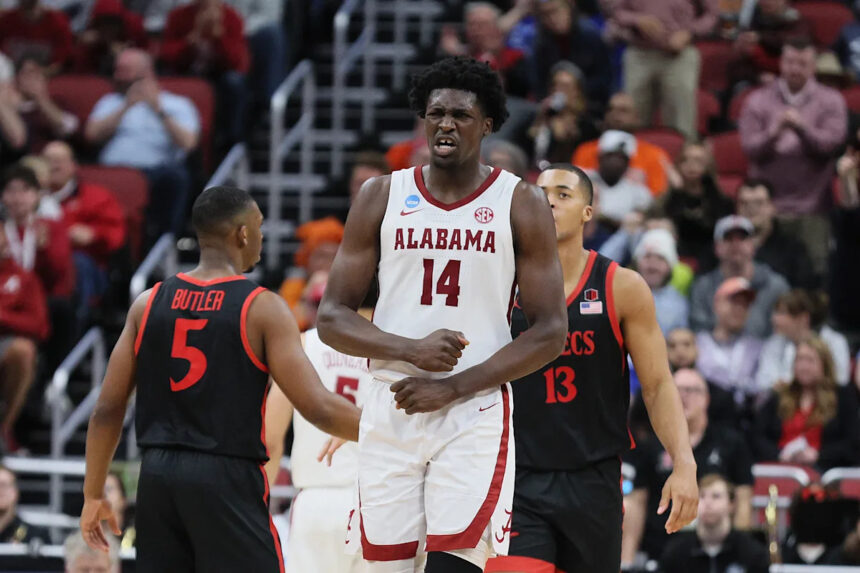
Charles Bediako Sues NCAA: A Legal Hail Mary to Return to Alabama
The labyrinthine and often contradictory world of NCAA eligibility is facing a new, high-profile legal challenge—one that strikes at the very heart of its rules regarding amateurism and professional experience. Former Alabama Crimson Tide center Charles Bediako, a defensive anchor for the 2023 SEC Championship team, has filed a lawsuit against the NCAA in a desperate bid for immediate reinstatement. His goal is singular: to suit up for Nate Oats’s squad for the remainder of the 2025-26 season. This lawsuit is more than a personal plea; it is a direct assault on what Bediako’s legal team argues is a system of arbitrary and unfair distinctions that penalize players for choosing a domestic professional path.
The Unlikely Journey: From Tuscaloosa to the G League and Back
Charles Bediako’s basketball journey took a conventional first step. The 7-foot center from Canada was a key piece for Alabama, starting 67 games over two seasons and famously blocking a game-winning shot attempt to seal a victory over Houston in 2022. After the 2022-23 season, he declared for the NBA Draft, a common path for aspiring professionals. However, going undrafted altered his trajectory.
Instead of heading overseas, Bediako pursued his NBA dream through the NBA’s official developmental pipeline, the G League. He played 34 games for the Grand Rapids Gold in the 2023-24 season, posting respectable averages of 10.4 points and 9.3 rebounds per game. This season, he appeared in six games for the Motor City Cruise. According to the NCAA’s longstanding rules, this participation in a professional league—even one designed as a developmental feeder for the NBA—renders him ineligible for collegiate competition. Alabama’s appeal for a waiver was denied, setting the stage for this unprecedented legal action.
The Core of the Controversy: A “Glaring Inconsistency”
Bediako’s lawsuit does not merely argue for mercy; it accuses the NCAA of operating a dual system that unfairly discriminates based on geography. The complaint hinges on a glaring inconsistency in NCAA eligibility rules that has become impossible to ignore: the favorable treatment of players with international professional experience.
The lawsuit explicitly points to the recent reinstatement of Baylor center James Nnaji. Nnaji was the No. 31 overall pick in the 2023 NBA Draft after playing multiple professional seasons for FC Barcelona in Spain, a top-tier EuroLeague club. Despite this clear professional history, the NCAA granted him four seasons of eligibility. Bediako’s legal team argues this creates an absurd and unjust hierarchy.
- International Path (Often Approved): A player can be a paid professional for a elite European club, get drafted, and still be deemed an NCAA amateur.
- Domestic G League Path (Routinely Denied): A player who goes undrafted and pursues the NBA’s own development league is permanently barred from returning.
“The NCAA’s rules create an entirely arbitrary distinction,” the complaint states, arguing it punishes athletes who pursue the most direct route to the NBA within the United States.
Expert Analysis: A System Under Siege
This lawsuit is the latest tremor in an NCAA landscape already reshaped by legal earthquakes like NIL and the transfer portal. “The NCAA’s amateurism model is now a patchwork of exceptions, and Bediako’s case exposes one of its most illogical seams,” notes Dr. Amanda Greene, a sports law professor. “They are essentially arguing that playing for FC Barcelona for pay is less ‘professional’ than playing for the Grand Rapids Gold. The courts have shown decreasing patience for these kinds of arbitrary distinctions, especially when they significantly impact a young athlete’s career and education.”
The legal strategy is clear: frame the NCAA’s rules as capricious and anti-competitive. By highlighting the Nnaji case and others, Bediako’s lawyers aim to prove the NCAA is not uniformly applying its own standards, which could violate basic tenets of fairness. Furthermore, they underscore the irony of the NBA’s own development league being treated as a greater threat to “amateurism” than foreign professional leagues.
From a basketball perspective, Bediako’s return would be a game-changer for Alabama. “He was one of the best rim protectors in college basketball during his last stint,” says SEC Network analyst Mark Walters. “Nate Oats’s system thrives with a defensive anchor like Bediako. His experience, size, and knowledge of the program would be an immediate injection of talent and depth for a team with championship aspirations.”
Predictions and Potential Ramifications
The immediate outcome is uncertain, but the case carries significant weight regardless of the verdict. Here are the potential paths forward:
- Injunction and Immediate Play: The court could grant a temporary injunction, allowing Bediako to play while the case proceeds. This is his primary goal for the 2025-26 season.
- NCAA Settlement: Facing yet another public relations and legal loss, the NCAA could quickly settle, granting Bediako eligibility and quietly adjusting its waiver guidelines to avoid future lawsuits.
- Long-Term Rule Change: Win or lose, this case pressures the NCAA to formally re-evaluate its stance on G League experience. A standardized, more lenient waiver process for domestic professionals could emerge.
- Floodgates Effect: A successful lawsuit would open the door for other players in similar situations—those who tested the G League waters after going undrafted—to seek a return to college, creating a new avenue for roster construction.
The broader prediction is that the NCAA’s walls continue to crumble. This case is another example of an individual athlete leveraging the legal system to challenge a rule that appears fundamentally unfair. Even if Bediako loses on a technicality, the public relations damage to the NCAA’s already battered concept of “amateurism” is severe.
Conclusion: More Than a Personal Comeback
Charles Bediako’s lawsuit is not just about one man’s desire to return to Alabama. It is a focused challenge to a rule that many in basketball see as archaic and discriminatory. It questions why the NCAA treats its own country’s professional development system as a greater contaminant than well-established foreign leagues. In an era where athletes can profit massively from their NIL while in school, the prohibition against a player earning a modest G League salary before seeking an education seems increasingly anachronistic.
This case underscores the evolving and often messy relationship between collegiate athletics and professional sports. As the paths to a professional career multiply, the NCAA’s rigid binaries are breaking down. Whether through a court order or a forced policy shift, the outcome of Bediako v. NCAA could finally align the rules with the modern reality of basketball development, ensuring that choices made in pursuit of a dream don’t permanently close the door on a return to campus. The court’s decision will signal whether the NCAA’s power to draw these arbitrary lines is finally at its end.
Source: Based on news from Yahoo Sports.


