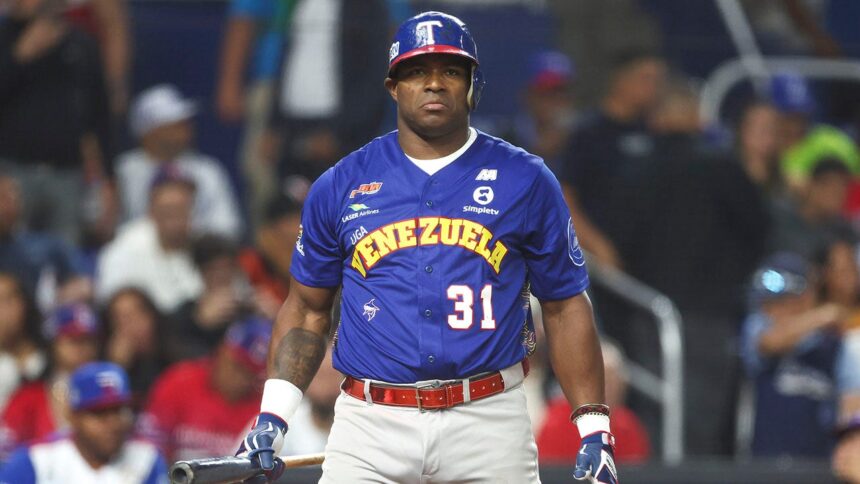
From Dodger Blue to Federal Case: Yasiel Puig’s Gambling Conviction and a Career in Crisis
The arc of a baseball, soaring from home plate to the bleachers, is a predictable parabola of physics. The arc of a baseball career, however, is a story of human volatility, subject to the unpredictable forces of talent, pressure, and personal choice. For Yasiel Puig, once the most electrifying force in the sport, his trajectory has taken a devastating turn from the bright lights of Chavez Ravine to the solemn halls of a federal courthouse. In a verdict that reverberated beyond the sports world, a jury found the former Los Angeles Dodgers superstar guilty of obstruction of justice and lying to federal investigators about his involvement in an illegal gambling operation. This conviction doesn’t just tarnish a legacy; it threatens to erase it, with Puig now facing a potential sentence of up to 20 years in federal prison.
The Verdict: Unpacking the Charges and the Trial
The U.S. Attorney’s Office announced the guilty verdict on Friday, capping a weekslong trial that peeled back the curtain on a shadowy gambling ring and Puig’s frantic attempts to distance himself from it. The core of the case was not that Puig placed bets on baseball—a cardinal sin in MLB that would have triggered a lifetime ban—but on his actions after federal authorities began their investigation. Prosecutors successfully argued that Puig deliberately misled investigators about the nature and extent of his financial transactions with the operation’s ringleader, a former minor league player.
Testimony during the trial painted a picture of a man caught in a web of his own making. Key witnesses included Donny Kadokawa, a Hawaii-based baseball coach with ties to both Puig and the gambling operation, whose account helped corroborate the timeline and nature of Puig’s involvement. Perhaps more striking was the testimony from MLB officials, who detailed the league’s own investigative protocols and the severe consequences for gambling, underscoring the gravity with which the sport views such transgressions. The jury ultimately found that Puig’s false statements were a willful attempt to obstruct the federal investigation, a serious felony charge.
- Charge: One count of Obstruction of Justice.
- Charge: One count of Making False Statements.
- Maximum Penalty: Up to 20 years in federal prison.
- Sentencing Date: Scheduled for May 26.
The Rise and Fade: How “The Wild Horse” Galloped Off Course
To understand the magnitude of this fall, one must recall the height from which Yasiel Puig fell. Bursting onto the scene in 2013, he wasn’t just a rookie; he was a phenomenon. Nicknamed “The Wild Horse” for his untamed and exhilarating style of play, Puig energized the Dodgers and the entire city of Los Angeles. His combination of raw power, a cannon-like arm, and reckless baserunning made him a nightly highlight reel. He finished second in Rookie of the Year voting and helped lead a moribund Dodgers team to the NLCS, sparking a decade of dominance.
Yet, from the beginning, his brilliance was intertwined with controversy. Clashes with veterans over work ethic, late arrivals, and on-field antics created a narrative of immaturity. Despite an All-Star selection in 2014, his production became inconsistent. He was traded to the Cincinnati Reds in 2018, later moving to the Cleveland Indians. By 2019, his MLB career was effectively over, a stunning decline for a player still in his physical prime. His exit from the league was attributed as much to his off-field reputation as any decline in skill. Since then, Puig played in foreign leagues and the Mexican League, always holding out hope for an MLB return that now seems impossibly distant.
This context is critical. The gambling case did not derail a thriving career; it appears to have been a catastrophic error by a man already on the periphery, desperately trying to manage his finances and his future outside the structured world of Major League Baseball. The trial revealed a figure operating in a space where poor judgment met serious federal crime.
Expert Analysis: The Legal and Professional Repercussions
From a legal standpoint, Puig’s conviction is a stark lesson in the perils of lying to the federal government. “Obstruction charges are taken extremely seriously by the Department of Justice,” notes a former federal prosecutor specializing in financial crimes. “The sentence isn’t just about the underlying activity—it’s about attacking the integrity of the investigative process itself. The judge will consider the willfulness of the lies and the effort to mislead.” While a 20-year sentence is the statutory maximum, legal experts suggest a far shorter term is likely for a first-time offender, though any prison time represents a life-altering outcome.
The professional repercussions within baseball are absolute and final. Under MLB’s Rule 21, betting on baseball games in which a player has no direct involvement results in a one-year suspension. Betting on games involving one’s own team carries a permanent ban. While Puig’s charges are not for betting on baseball, his conviction and association with an illegal gambling operation represent a third-rail scenario for any team. “The cloud is now permanent,” says a veteran MLB front-office executive. “Even if he avoids significant prison time, no franchise will touch this. The liability, the media frenzy, and the simple breach of trust are insurmountable. His MLB career is unequivocally over.”
This case also serves as a grim bookend to an era of Cuban defectors who arrived with immense talent but often without the support systems to navigate sudden wealth and fame. Puig’s story, from a harrowing defection to stardom to this conviction, is a tragic arc of potential unfulfilled and guidance missing at critical junctures.
Predictions and Lasting Impact
As the sentencing date of May 26 approaches, the baseball world will watch to see the final chapter of this legal saga unfold. Predictions hinge on several factors:
- Sentence Length: Most experts predict a sentence ranging from several months to a few years, with an emphasis on deterrence.
- Appeal: Puig’s legal team is almost certain to file an appeal, potentially dragging the process out for years.
- International Baseball: Even after any sentence is served, Puig’s ability to play in foreign professional leagues will be severely hampered by his felony status and notoriety.
- Legacy: Yasiel Puig will be remembered as a cautionary tale—a flash of incandescent talent whose own choices led to a precipitous and disgraceful fall.
The broader impact is a reinforced warning to all professional athletes. Federal investigations are not to be trifled with, and the consequences of dishonesty can far outweigh the original transgression. For MLB, it is a reminder of the constant vigilance required against gambling, a threat to the sport’s integrity that persists in new and evolving forms, often ensnaring those on the margins of the game.
Conclusion: A Talent Extinguished
Yasiel Puig’s story is one of the most dramatic rises and falls in recent baseball memory. He was a force of nature who, for a brief, shining moment, captured the imagination of a city and a sport with his unparalleled energy and ability. However, the very lack of control that made him thrilling on the field seemingly manifested destructively off it. His conviction for obstruction and lying to federal investigators is not a mere postscript to his career; it is a defining, devastating final act. The man who once swung for the fences with joyous abandon now faces a future where his biggest battle will be for his freedom. The Wild Horse has been corralled not by a pitcher or a catcher, but by the cold, hard judgment of the law, leaving behind a legacy of what was, and a sobering lesson on what could have been.
Source: Based on news from Fox Sports.