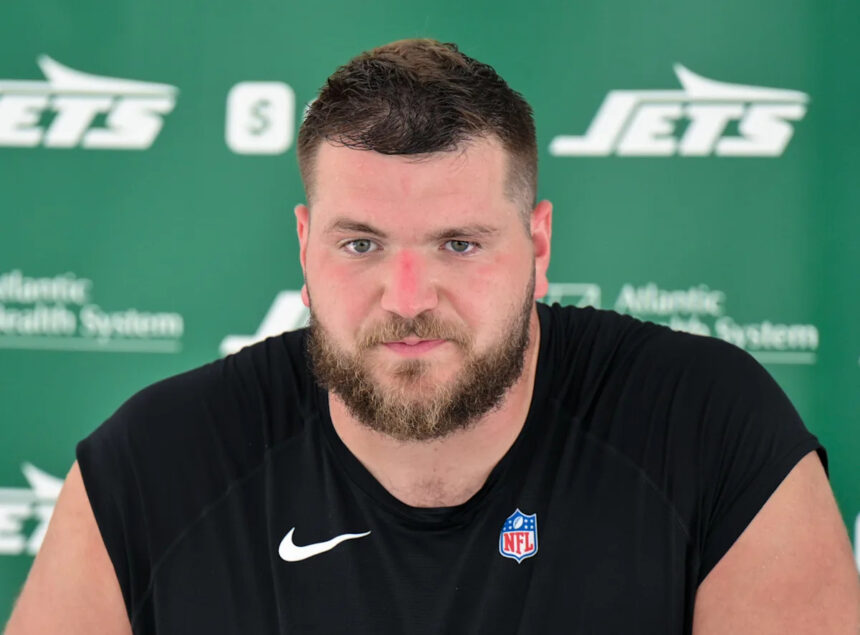
Jets Lock Down Center Josh Myers with Surprising Two-Year Extension: A Deep Dive
The New York Jets, an organization perpetually in a high-stakes “win-now” cycle, made a telling move on Friday, securing a piece of their present and future along the offensive line. The team announced a two-year contract extension for starting center Josh Myers, a decision that raises eyebrows not for its ambition, but for its intriguing timing and underlying message. The deal, worth $11 million with $6 million guaranteed, rewards a player who arrived on a modest one-year “prove-it” deal just months ago. This move is less about celebrating elite performance and more a revealing window into the Jets’ philosophy, their evaluation process, and the immense value they place on stability—even if it’s imperfect—in front of Aaron Rodgers.
From Green Bay Castoff to Jets’ Keystone: The Myers Journey
Josh Myers’ path to this extension is a study in perceived value versus analytical evaluation. A second-round pick (62nd overall) by the Green Bay Packers in 2021, Myers was handed the starting center job as a rookie. Over four seasons in Titletown, he started 56 games, experiencing both the highs of playoff runs and the lows of inconsistent play. When he hit unrestricted free agency this past offseason, the market was tepid. The Jets swooped in with a one-year, $2 million contract—essentially a veteran minimum deal with upside—viewing him as competition for the vacant center role.
Myers won the job outright in training camp and has been an ironman in the 2025 season, playing over 800 snaps. For a front office and coaching staff that watched their 2024 campaign disintegrate due to offensive line injuries, this durability alone carries significant weight. The extension, which locks Myers through the 2027 season, signals that the Jets saw what they needed to see, even if the popular analytics tell a different story.
Decoding the Disconnect: PFF Grades vs. Jets’ Valuation
Here lies the core of the debate surrounding Myers’ new deal. By the metrics of Pro Football Focus, the extension is a head-scratcher. A closer look at the numbers reveals a player performing at a level similar to, or slightly below, his Packers tenure:
- Current PFF Blocking Grade (2025): 53.6
- 2024 PFF Blocking Grade (with Packers): 54.6
- Rank among Centers (min. 450 snaps): 30th overall
- Pass Block Grade Rank: 25th
- Pressures Allowed: 25
- Penalties Committed: 7
These are not the numbers typically associated with an $11 million extension. So why did Jets General Manager Joe Douglas pull the trigger? The answer is multi-layered. First, offensive line continuity is paramount, especially with a 41-year-old quarterback. Rodgers operates a complex offense requiring precise communication from the center; changing that piece annually is a recipe for disaster. Second, internal grading by the Jets’ coaching staff clearly differs from external analytics. They may value Myers’ pre-snap identification, his rapport with Rodgers, and his fit in their outside zone scheme more than a singular pressure stat.
“The analytics are a tool, not the final verdict,” a veteran NFL scout would tell you. “If your quarterback trusts the guy making the calls, and your line coach sees consistent technical improvement and toughness, you invest. You can’t have All-Pros at every spot, but you must have reliable communicators at center.”
The Rodgers Factor and the Jets’ Win-Now Calculus
Every major decision the Jets make is filtered through the lens of Aaron Rodgers’ championship window. This extension is a direct reflection of that reality. Rodgers has historically demanded and benefited from stability at the center position. The Jets, burned by the revolving door that plagued them last season, are prioritizing known quantities. Paying Myers now, mid-season, eliminates a major offseason question mark and allows them to focus resources elsewhere—namely, at tackle and perhaps guard.
Furthermore, the financials of the deal are team-friendly. The $5.5 million average annual value (AAV) does not break the bank for a starting center and provides cost certainty. The guaranteed $6 million is a show of faith but not a crippling commitment. In the context of a soaring salary cap, this is a calculated bet on scheme fit and developmental upside. The Jets are betting that Myers, still only 26, has his best football ahead of him and will improve with a full season in their system, away from the shadows of his draft pedigree in Green Bay.
Looking Ahead: What This Means for the Jets’ Offensive Line
The Myers extension sends clear signals about the Jets’ offensive line construction moving forward. The mission is clear: build a competent, cohesive unit for 2025 and beyond, with an eye on protecting Rodgers and establishing a run game for Breece Hall. With Myers now anchored at center, the focus shifts dramatically.
Prediction 1: The 2026 NFL Draft will heavily target offensive tackle. With Myers secured, the Jets’ biggest long-term need remains bookend tackles. Expect them to use premium capital on a left tackle of the future.
Prediction 2: Internal development is now the priority at guard. This move suggests the Jets believe in the growth potential of their young guards like Alijah Vera-Tucker (when healthy) and others, rather than seeking a massive overhaul at every interior spot.
Prediction 3: Myers’ performance will be scrutinized under a new lens. The “prove-it” deal is over. Now, the narrative shifts to whether he can justify the Jets’ faith by elevating his play from “adequate” to “above average.” The pressure to cut down on penalties and pressures will be immense.
Conclusion: A Bet on Stability Over Stardom
The New York Jets’ decision to extend Josh Myers is a quintessential example of team-building in the modern NFL, where context often outweighs cold analytics. It is not a celebration of a player who has arrived as a top-tier center. Rather, it is a pragmatic, forward-looking investment in continuity, communication, and cost-control. In a vacuum, the PFF grades suggest an overpay. But within the high-pressure ecosystem of the Jets—with an aging legend at quarterback and a history of line dysfunction—it represents a logical, if unsexy, step toward solidifying their foundation.
Ultimately, this extension is a bet on the Jets’ own evaluation over public perception, and on the intangible value of having a durable, known entity orchestrating the line. For Josh Myers, it’s a second chance and a vote of confidence. For the Jets, it’s a calculated gamble that stability at the center of the storm is worth its weight in gold—or in this case, $11 million.
Source: Based on news from Yahoo Sports.