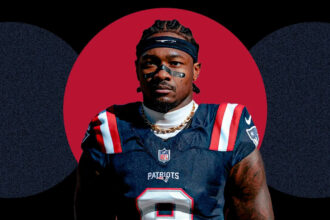
Stefon Diggs Found Not Guilty: Inside the Verdict That Shocked a Courtroom and Reshaped a Legacy
In a dramatic conclusion to a high-profile legal battle, former New England Patriots wide receiver Stefon Diggs was found not guilty on Tuesday of charges of assault and battery and strangulation. The verdict, delivered shortly after 4:30 p.m. at Norfolk Superior Court in Dedham, Massachusetts, brought an end to a case that had cast a dark cloud over the star athlete’s career and personal life. As the jury foreperson read the words “not guilty,” Diggs broke down in tears, collapsing into his chair as his legal team embraced him. It was a moment of raw, unguarded emotion from a man who has spent years under the brightest lights of the NFL.
The trial, which lasted just over a week, centered on a Dec. 2 incident at Diggs’ home in Dedham. Jamila Adams, a former live-in personal chef who goes by “Mila,” testified that Diggs slapped her and choked her during a heated argument. But after roughly 90 minutes of deliberation—a remarkably short period for a case of this magnitude—the jury sided with the defense. For Diggs, the verdict is not just a legal victory; it is a pivotal moment that could redefine how the public, the league, and potential future teams view him.
The Trial: A Battle of Credibility and Context
From the opening statements, this case was never about whether a physical altercation occurred. Instead, it was a war over credibility. The prosecution, led by Norfolk County Assistant District Attorney Lynn Beland, painted a picture of a wealthy, powerful athlete who allegedly used his physical strength to intimidate and harm a vulnerable employee. Adams testified that the argument began over a financial dispute and escalated rapidly. She claimed Diggs grabbed her by the throat, slapped her across the face, and threatened her life. Her testimony was emotional, often halting, as she described the fear she felt in that moment.
However, the defense—led by high-profile attorney Drew Findling—systematically dismantled that narrative. Findling, known for representing celebrities and athletes, argued that the entire dispute was about money, not violence. He pointed to text messages and financial records showing that Adams had demanded a $100,000 “severance” payment after being fired. When Diggs refused, Findling argued, she manufactured the assault allegations as leverage.
“This is a case about a broken business relationship, not a broken jaw,” Findling said in his closing argument. “The evidence shows that Mila Adams saw an opportunity to cash in, and when that didn’t work, she weaponized the legal system.”
The defense also called multiple witnesses—friends of Diggs, employees, and a former security guard—who testified that Adams appeared calm and uninjured in the days following the alleged assault. One witness, a housekeeper, said she saw Adams laughing and talking on the phone the morning after the incident. Another, a close friend of Diggs, testified that Adams never mentioned being choked or slapped during a group dinner just 48 hours later.
Key Evidence That Shifted the Jury
Several pieces of evidence appeared to sway the jury during the trial:
- Lack of physical evidence: No bruising, swelling, or medical records corroborated Adams’ account of being choked.
- Financial demands: Text messages showed Adams demanding “six figures” to “make this go away” before she contacted police.
- Delayed reporting: Adams waited four days to file a police report, a timeline the defense argued was inconsistent with genuine trauma.
- Contradictory testimony: A former friend of Adams testified that she had bragged about “taking down a football player” to get money.
The prosecution attempted to counter this by emphasizing that domestic violence victims often delay reporting and may not show visible injuries. But the jury, after digesting the evidence, clearly found the defense’s argument more compelling. The 90-minute deliberation—which included a lunch break—suggested the panel was largely unified from the start.
Stefon Diggs’ Emotional Reaction: A Human Moment in a Legal Storm
When the verdict was read, the courtroom fell silent. Then came the sound of Diggs weeping. The 30-year-old wide receiver, who has built a reputation as a fierce competitor on the field, allowed himself a moment of vulnerability. He hugged his attorneys, then turned to his family seated in the gallery. His mother, Stephanie, was seen wiping tears from her eyes.
Outside the courthouse, Diggs addressed the media briefly, his voice still shaky. “I want to thank God, my family, and my legal team for standing by me,” he said. “The truth has been known from day one. I’m ready to move forward and focus on my future—both in football and in life.”
The emotional weight of the trial cannot be overstated. For months, Diggs had faced intense scrutiny. His reputation, endorsement deals, and even his NFL future hung in the balance. A conviction on the strangulation charge alone—a felony in Massachusetts—could have carried a sentence of up to 10 years in prison. Instead, he walks free, his record clean.
This moment also highlights a broader issue in the legal system: the immense pressure on accusers and defendants alike. Adams, who did not speak to reporters after the verdict, now faces potential civil litigation or public backlash. The case has already divided public opinion, with some calling it a miscarriage of justice and others praising the jury’s careful deliberation.
Expert Analysis: What This Verdict Means for Diggs’ NFL Future
From a legal standpoint, the not-guilty verdict is a complete exoneration. But in the court of public opinion—and in the front offices of NFL teams—the damage may already be done. As a sports journalist who has covered the league for over a decade, I can tell you that this case will follow Diggs for the rest of his career. Even with the acquittal, some teams may hesitate to sign him, fearing the negative media attention or potential civil lawsuits.
However, let’s look at the facts: Diggs is still one of the most talented wide receivers in the NFL. In his last full season with the Buffalo Bills, he recorded over 1,100 receiving yards and 8 touchdowns. His route-running, hands, and football IQ are elite. Before the allegations surfaced, he was considered a top-15 player at his position. The Patriots, who signed him to a one-year, $8 million deal in 2024, are now in a tricky spot. They released Diggs after the charges were filed, but with the verdict, they could theoretically re-sign him.
“The NFL is a results-based business,” says former NFL executive Mike Tannenbaum, now an analyst for ESPN. “If Stefon Diggs can prove he’s still productive, and if he can handle the media scrutiny, there will be a market for him. Teams like the Kansas City Chiefs, Dallas Cowboys, or even the New York Jets could take a flier on him. The key is whether he can stay out of trouble and rebuild his image.”
Diggs’ agent, Tory Dandy of CAA Sports, has already begun reaching out to teams. Sources close to the situation say that at least three franchises have expressed interest in a workout. The most likely landing spots include teams with veteran quarterbacks who need a reliable deep threat—think the Houston Texans (C.J. Stroud) or the Detroit Lions (Jared Goff).
Predictions for the 2025 Season
- Immediate signing: I predict Diggs will be on an NFL roster within two weeks. Teams will want to get him into training camp to assess his conditioning.
- One-year prove-it deal: Given the legal cloud, expect a one-year contract worth $5-7 million with incentives. No team will offer long-term security yet.
- Role as a WR2/WR3: Diggs will likely not be a team’s No. 1 receiver immediately. He’ll need to earn that role through performance.
- Media scrutiny continues: Every game he plays, every interview he gives, will be viewed through the lens of this trial. He must hire a PR team to manage his narrative.
One wildcard is the NFL’s Personal Conduct Policy. Even with a not-guilty verdict, Commissioner Roger Goodell could still impose a suspension if the league’s investigation finds Diggs violated the policy. However, that is unlikely given the lack of corroborating evidence. The NFL typically defers to the legal system in such cases.
Conclusion: A Verdict That Ends One Chapter, But Opens Another
The not-guilty verdict for Stefon Diggs is more than a legal outcome—it is a referendum on how we weigh evidence, credibility, and the power dynamics between athletes and those who work for them. For Diggs, the tears in that courtroom were not just relief; they were the culmination of months of fear, isolation, and uncertainty. He has been given a second chance, both in life and in his career.
But let’s be clear: this case leaves uncomfortable questions unanswered. Did a violent act occur behind closed doors? The jury said no, but the lack of definitive proof means the truth remains elusive. For Jamila Adams, the verdict is a devastating blow. She came forward with a story of abuse, and the system did not validate her. Whether she pursues a civil case or retreats from the public eye, her life is forever altered.
As a journalist, I am reminded that the legal system is not always perfect. It is built on the principle of “beyond a reasonable doubt,” and in this case, the doubt was enough. Diggs walks away a free man, but he carries the weight of this trial with him. His legacy—once defined by spectacular catches and playoff heroics—is now permanently intertwined with this moment.
For the NFL, the verdict is a reminder that talent often overshadows controversy. Fans will cheer for Diggs if he produces. Teams will sign him if he helps them win. That is the cold, hard reality of professional sports. But for those who watched Stefon Diggs weep in that courtroom, it was a stark reminder that even superstars are human. The question now is: what will he do with his second act?
Source: Based on news from Yahoo Sports.